Hi, welcome to the team. I'm so glad you are here at Indeed.
One of the working relationships we need to define is ours. The following is a user guide for me and how I work. It captures what you can expect out of the average week, how I like to work, my north star principles, and some of my, uh, nuance. My intent is to accelerate our working relationship with this document.
This should be a quick read... it's broken up into:
- My job
- North star principles
- Communication style
- Work hours
- Giving feedback
- How I can help you
- How you can help me
- What matters for managers
- Nuance
My title is Group Manager. I didn't know what that meant when I joined Indeed. For a long time, that meant just continuing to run Assessments as though I was still CEO of Interviewed with oversight of our engineering, product, and sales. Once I started leading CDQ and now the Candidates T1, my role feels more like a conventional Product Director role.
It's becoming increasingly rare that I directly build a product sketch or write code -- in fact, my last commit to an Indeed production codebase was back in February 2018 (I code on weekend projects instead). It feels weird being responsible for everything that happens, the good and the bad, without directly touching the underlying work.
Here are my responsibilities:
- Create high level plans for the products we should build with Product and Engineering teams
- Balance long and short term investments e.g. NPV net present value
- Represent SMB Candidates to the rest of the organization
- Attract, retain and grow high-performing individuals and teams
- Develop team culture that is pragmatic, impact-focused, fast, and rewarding
Meetings where we debate potential directions are valuable, but I expect the discussion to result in a decision by the end of the meeting. I believe that starting is the best way to begin learning and make progress. This is not always the correct strategy. This strategy annoys those who like to discuss.
I am always looking for the parts of a thing that are in the bad side of the Pareto principle. This often results in my wanting to simplify features or our approach.
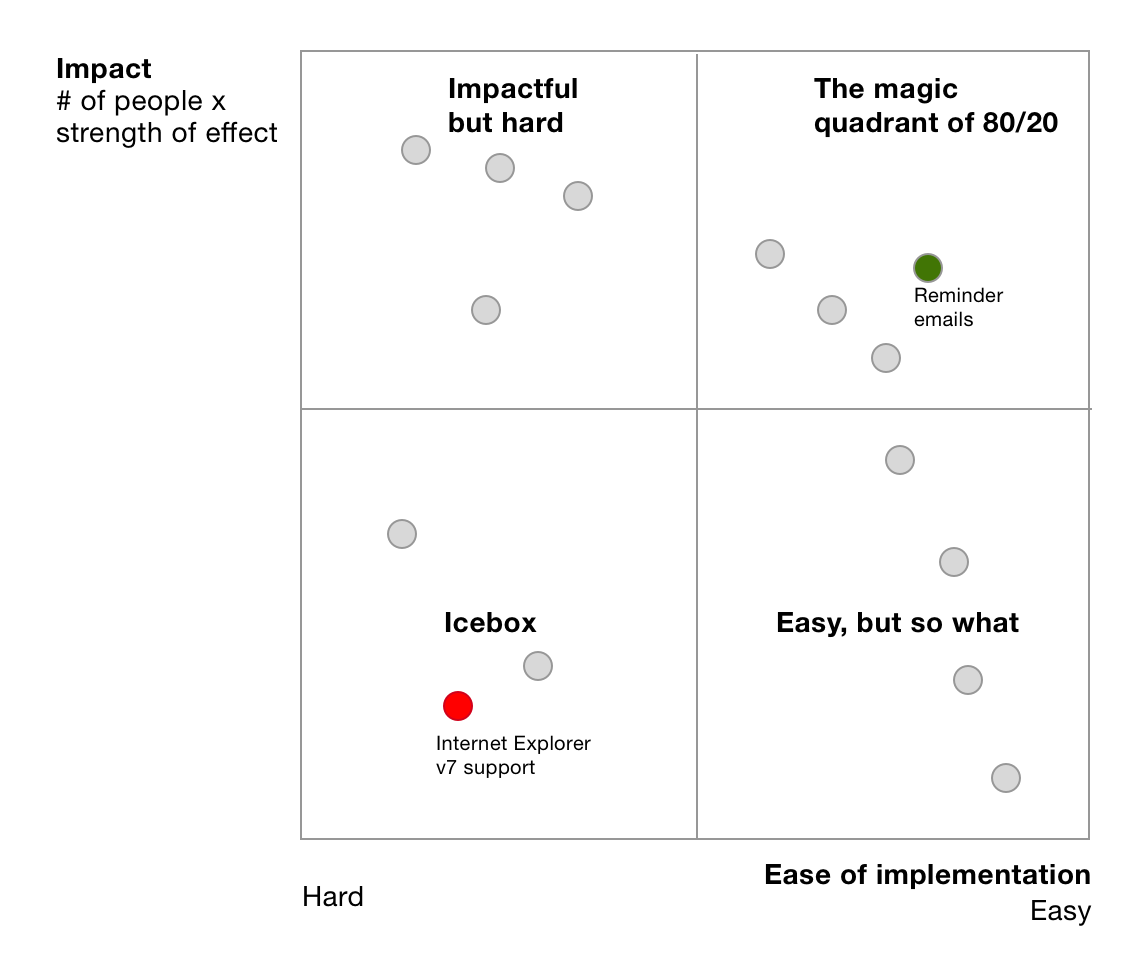
I think of this as a matrix:
- Impact (number of people times strength of effect)
- Ease
Avoid working on time-consuming things that weakly affect a small number of people. See 80/20.
I'm not a sports fan, but the analogy fits. My thinking on teams most closely aligns with Netflix's philosophy (https://hbr.org/2014/01/how-netflix-reinvented-hr).
We are high-performing professionals who have come together to achieve a shared team goal: to help people get jobs; and to achieve personal professional goals: career success and fulfillment. Because we are high-performing professionals; there are many teams we could be on at Indeed or at other companies. Our team must continually re-earn its spot as the best team to be on or else our teammates will leave for other teams. When someone is not delivering what the team needs, we coach them. If coaching doesn't work, we ask them to leave the team.
Amazon says it more succinctly than I can...
Leaders are obligated to respectfully challenge decisions when they disagree, even when doing so is uncomfortable or exhausting. Leaders have conviction and are tenacious. They do not compromise for the sake of social cohesion. Once a decision is determined, they commit wholly.
http://www.amazonianblog.com/2016/11/what-it-means-to-disagree-and-commit-and-how-i-do-it.html
I will frequently ask:
- What do other teams at Indeed do to solve this?
- What do our competitors do?
- Who has done something similar before?
Knowing the answers is table stakes before we begin discussing our approach.
I prefer email over Slack (this was not true two years ago).
I "process" my inbox to stay at inbox zero all the time. That means I quickly scan messages to get the gist and then archive them. If I can reply on the go, I do. If the message requires more thought or is a long read, I star it and archive. Then I'll read it later in the day when I have a block of open time.
I will almost always respond to any email you send me within 24 hours and usually the same day.
I'm conscious of switching to email when I want the discussion to be more thoughtful, slower, with longer responses than slack.
I do respond to Slack messages but I'm not as reliable about it as I am with email. I have all Slack notifications turned off on my phone and computer.
For discussions that are emotionally nuanced or require lots of typing, I prefer to shift discussion from Slack to a high-bandwidth channel like a call or in person. I encourage you to do the same.
I go to a lot of meetings. I aggressively prune the attendee list and frequency of meetings. I try to foster small group meetings where everyone participates actively. Meetings with three of us are perfect, three to eight are ok, and more than eight you will find that I am secretly thinking the whole time that the meeting should be smaller.
I keep calendar events public by default and allow-modify by guests; that means you can move the meeting without asking me. I think it's a bit inconsiderate to schedule a meeting with someone and not have the meeting be editable -- this prevents the person from adding notes, adding rooms, rescheduling, etc. I highly recommend changing your defaults to allow-modify.
If a meeting completes its intended purpose before it's scheduled to end, let's give the time back to everyone. If it's clear the intended goal won't be achieved in the allotted time, let's stop the meeting before time is up and determine how to finish the meeting later.
If you're one of my direct reports, we'll have a 1:1 every week for at least 30 minutes.
- 1:1s are for you
- 1:1s are not for status updates
- I'd rather discuss topics of substance and get status updates via email
I keep a running notes file for every person I have 1:1s with. When I think of something I want to talk about in our next 1:1, I leave myself a note. During our 1:1, I'll cross things off and add comments.
I typically wake up around 6-7 and do a couple hours of work sitting in the tub with my laptop before coming into the office around 9-10. I usually leave the office around 6-7 and then do a couple more hours of work at home.
I work on weekends; it's my time to get long, uninterrupted stretches when I can focus on the bigger picture and work on creative projects (like this readme). This is my choice, I don't expect you to work on weekends. I might Slack you things but unless the thing says URGENT, it can always wait until Monday morning.
Very few things are more important than talking to you if you want to talk to me. If you need to talk, let's talk.
Heard a rumour? Need clarification on something? Blocked? I'd love to hear as soon as possible. Come by my desk, stop me in the hall, shoot me a Slack message, we don't need to wait for our next scheduled 1:1. Feel free to put something in my calendar, don't feel like you need to ask first; just put a summary agenda in the calendar invite so I can triage appropriately. Is my calendar full? Send me a message and I'll very likely be able to move something around.
I firmly believe that feedback is at the core of building trust and respect in a team.
I don't believe in storing feedback and then scheduling a time to provide it. If I have feedback to give you I'll work to provide it as soon as possible, in the moment if I can unless I'm feeling emotionally charged and need time to reflect. It's unlikely it'll start with "I have some feedback to give you", instead it'll probably start with, "I observed that..."
We will have "career chats" every 4-6 weeks so I remember to give you thoughtful feedback, but those should mostly be a rollup of feedback you've already heard during the month if I'm doing it right.
I aspire to ask you for feedback on me, but I don't do it often enough. Please offer it to me. I appreciate those who take the time to give me thoughtful feedback because it shows that they care about helping me improve.
I know that three dimensions are required for people to continue to give you feedback:
Unlikelihood of being punished for giving feedback. Should be high.
In particular, I love to debate ideas in the moment. Some folks would prefer to digest and discuss asynchronously, after some thought. I try to pick up on that, but please help me by pointing out things I can do create a stronger environment of psychological safety for you.
The amount of work in order to give feedback. Should be low.
How likely is it that giving you feedback will materially impact your behavior? Should be high.
Let me know if I don't do well on any of these three dimensions.
I love building products. I would love to discuss your ideas at the inception stage, at 30%, and at 90%. I'm particularly sensitive to building good UX. Good UX is highly intuitive ("don't make me think"), consistent, and visually attractive.
Most of my day is spent collecting and sharing context/information across teams and products at Indeed, and helping setting priorities. I'll try to push information to you as much as I can but feel free to ask about anything else.
I won't be working on your project day to day but will be close enough to have informed thoughts.
I aspire to be someone who celebrates your successes. I'm not good at it yet, but I'm working on it.
Don't hesitate to say: "I could use a hand with..." or "I screwed up: ..."
This is the expectation. Let me know if there is something preventing you from accomplishing this.
I don't expect you to work 80 hours a week; but I do expect more than 9-5 M-F when we're deep in a project. There will be natural lulls when we can take it easy.
The best solutions comes from a healthy debate. We need to be able to separate our ideas from our egos. I'll challenge your ideas with the goal of coming to the best possible solution, I hope you'll challenge mine.
This is very important. I screw up and sometimes don't notice. I need to know or I'll likely do it again.
One of my jobs is to provide context. Are you missing some? Let me know and I'll fill you in or go find out.
Instead of sending an email asking, "Can I ...", say "I intend to ... because ...". Then proceed with your intentions unless you hear back otherwise.
First, Break All The Rules resonated with me. Some of its points are controversial; if you disagree, please read the book and then lets discuss.
- Differentiate between talents, skills, and knowledge. Skills and knowledge can be trained rapidly; talents can not.
- Stop trying to fix someone's "weaknesses" aka "areas of opportunity". Instead, double down on their strengths.
- Finding the right fit is what matters more than anything else -- match the person's talents with individual roles; don't think of people as interchangeable.
- Confront poor performance immediately and either find another role that plays to their strengths or terminate.
- The (wrong) tendency is to over-invest in your weakest performers at the expense of your strongest performers.
- Capitalize on making your productive team members as good as they can be.
- Evaluate employee performance every quarter and focus on individual strengths and how to leverage them (not on areas that can improve).
- Give your direct reports the ability to hit goals in their own way rather than dictating the specific steps they should take -- build autonomy. This lets each employee play to their personal strengths instead of following a template.
- Treat each person differently, according to their individual needs (not as you'd want to be treated). This requires knowing your employees well and understanding their personal lives and motivations.
Strive to earn a strong "Yes!" from your team on these twelve questions:
- I know what's expected of me in my job each day.
- I have all necessary tools to do my job.
- I'm given the opportunity to do my very best.
- My work has been recognized in the past week.
- My supervisor truly cares about me as a human being.
- I feel my opinion makes a difference.
- I believe in my company's mission and feel my job matters.
- My coworkers are doing great work and care as much as I do.
- I've developed good friends on the job and feel comfortable.
- Someone talks to me about my performance every quarter.
- I feel I'm getting ample opportunities to grow and learn.
I've been completely deaf in my left ear since I was in a car accident when I was two. If you say something and I don't acknowledge you, it's almost certainly because I didn't hear you -- wave at me or something. I try to compensate for this by sitting on the leftmost chair when possible.
I am an introvert and that means that prolonged exposure to humans is exhausting for me.