
Replies: 1 comment 4 replies

-
|
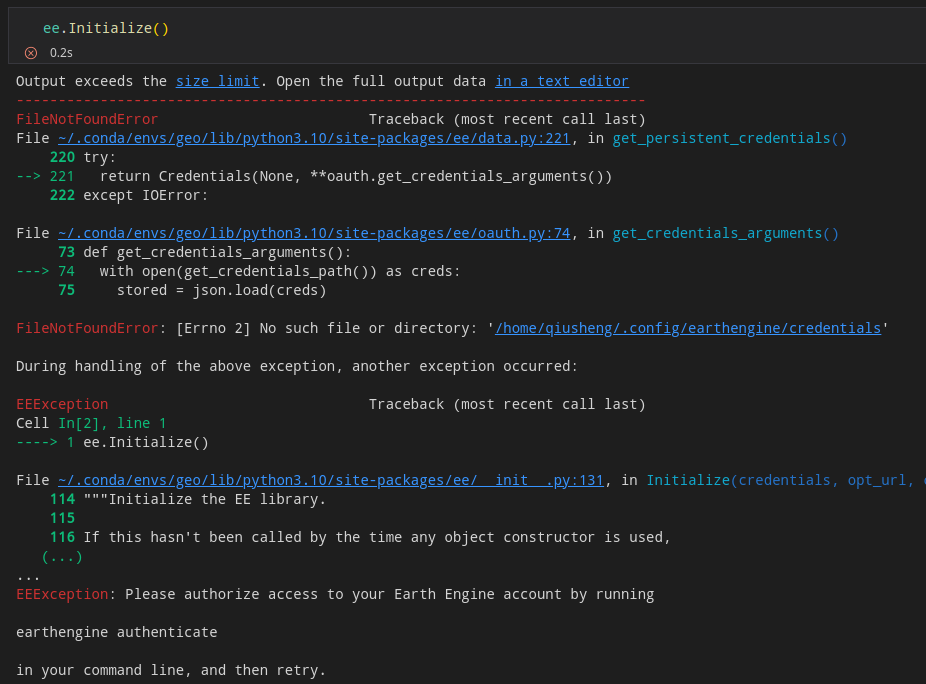
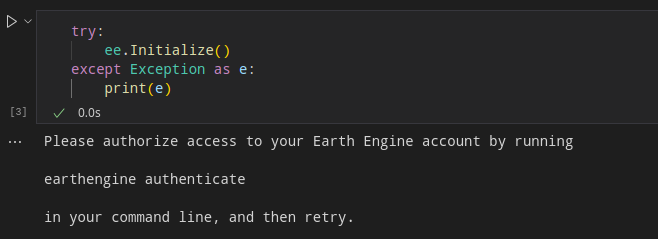
I agree that the error handling can be improved. The point of using
|
Beta Was this translation helpful? Give feedback.

-
|
Thanks for the detailed example. It seems that Google Earth's def get_persistent_credentials():
"""Read persistent credentials from ~/.config/earthengine.
Raises EEException with helpful explanation if credentials don't exist.
Returns:
OAuth2Credentials built from persistently stored refresh_token
"""
try:
return Credentials(None, **oauth.get_credentials_arguments())
except IOError:
raise ee_exception.EEException(
'Please authorize access to your Earth Engine account by '
'running\n\nearthengine authenticate\n\n'
'in your command line, and then retry.')The reason why the error log is so long is because this single function is throwing two errors for one problem: there is no credentials file. This double-error-throwing is happening despite the try-except block because the block only catches an |
Beta Was this translation helpful? Give feedback.
-
|
As in what this means for
With that said, for this case, I think the error is indeed overdone, not on try:
ee.Initialize()
except ee.ee_exception.EEException as e:
raise e from NoneWhat The end result is |

Beta Was this translation helpful? Give feedback.

-
|
Thank you for looking into this. You are welcome to submit a pull request to improve the error handling in geemap. One thing to keep in mind is that if a function is invoked directly or indirectly by the map GUI, the error message should be limited to one to two lines. Otherwise, the output widget on the map interface might be able display the full error message. |
Beta Was this translation helpful? Give feedback.
-
|
Sorry to keep you hanging. I tried my hand a bit at improving error handling and I'm finding that there's larger issues that obstruct fully being able to make this change. Namely, it's very difficult to incrementally apply changes because of very large files like common.py being very large. I think this issue can be backlogged for the time being and we can return to it when the codebase is made more atomic (the addition of a core.py file #1527 is a great step!). I can submit an issue with that summarizes what needs to be done based on this discussion thread. |
Beta Was this translation helpful? Give feedback.


Uh oh!
There was an error while loading. Please reload this page.
-
Working on PR #1511, I noticed that the error handling in common.py was a bit bloated in general, probably due to legacy code not being updated, several people working on it, etc. I found a couple code patterns where it's clear that a try-except block is unnecessary. I included examples of these patterns below.
Catches an exception only to re-raise it.
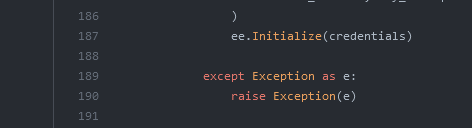
Catches an exception and simply prints the error message.

Catches an exception, repackages it in a less specific Exception and re-raises.

For the first case, the try-except block will actually not do anything, so it can be removed without any change in behavior.
The second case technically prevents the error from being raised while still providing info about it. The error catching for the second case unnecessary and arguably misleading, since the receiving an error communicates to the user that something went wrong better than just a print statement. Errors may look ugly, but they should be raised, especially if the user's command did not go through.
The third case is unnecessary because the ImportError by itself is already alerting the user to the fact that they need to install the missing package. Repackaging it into a generic Exception with a different message may make the problem more difficult to resolve. A user will find much more information about how to solve a ImportError rather than a generic exception with geemap's specific error message.
As mentioned in #1511, there still remains room for bugs in common.py, especially in the error handling. Reducing unneeded try-except blocks would help narrow down the room for bugs. I would love to hear your thoughts on this refactoring proposal
Beta Was this translation helpful? Give feedback.
All reactions