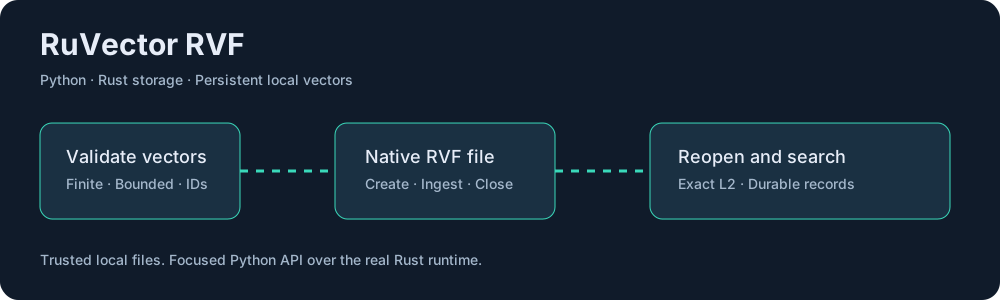
Create a local vector file, store embeddings with integer identifiers, search by L2 distance, and reopen the file later. ruvector-rvf wraps the real Rust rvf-runtime through the shared ruvector native extension. It is a focused Python counterpart to the storage operations in @ruvector/rvf, not full API parity.
Requires Python 3.10 or newer and a platform supported by ruvector==0.1.4.
python -m pip install ruvector-rvf==0.2.0from pathlib import Path
from tempfile import TemporaryDirectory
from ruvector_rvf import RvfStore
with TemporaryDirectory() as directory:
path = str(Path(directory) / "documents.rvf")
store = RvfStore.create(path, dimension=3)
try:
assert store.ingest([[1, 0, 0], [0, 1, 0]], [10, 20]) == 2
hits = store.query([1, 0, 0], k=1)
assert hits[0][0] == 10
finally:
store.close()
reopened = RvfStore.open(path) # Read only by default.
try:
assert reopened.status()["total_vectors"] == 2
assert reopened.query([0, 1, 0], k=1)[0][0] == 20
finally:
reopened.close()flowchart TD
A[Python vectors and IDs] --> B[Dimension and finite checks]
B --> C[Native Rust RVF runtime]
C --> D[Local RVF file]
D --> E[Reopen and exact L2 query]
query returns (id, distance) pairs with smaller distances preferred. This initial binding forces exact search for predictable semantics; latency grows with the number and dimension of stored vectors. It does not expose metadata, approximate search tuning, compression, branching, or signature APIs.
| Operation | Behavior |
|---|---|
RvfStore.create(path, dimension) |
Creates a new file, refusing existing paths; dimension 1 through 4096 |
RvfStore.open(path, read_only=True) |
Opens an existing trusted file |
store.ingest(vectors, ids) |
Returns accepted count; 1 through 10000 finite vectors of magnitude at most 1e10 with matching dimensions and unique batch IDs |
store.query(vector, k=10) |
Exact L2 retrieval; k 1 through 10000 |
store.delete(ids) |
Soft deletion; returns deleted count |
store.status() |
Live vector count, bytes, epoch, and integer read_only flag |
store.close() |
Closes the handle; repeated calls are harmless |
Use open(path, read_only=False) before mutating an existing file. Always call close() in a finally block. Native errors become RuntimeError; invalid vector inputs become ValueError. An ingest error reporting partial acceptance means some records were committed; inspect the store before retrying.
Open only locally produced RVF files you own and explicitly trust. Native file decoding occurs before the dimension limit is checked. This binding is not an untrusted file sandbox, authentication system, encrypted database, or cryptographic verification API. Dimension and batch limits constrain ordinary API requests; they are not protection against hostile Python objects or crafted files. File permissions and directory access are the application's responsibility. The native create_new operation prevents replacing an existing file even if another process creates it during validation.
Tests: python -m pytest python/portfolio/tests/test_rvf_portfolio.py. Install this package against a locally built ruvector==0.1.4 wheel before running. Source: RVF Rust runtime. Issues.