Module 1 (Deque)
- Head - the first node/located in the front of the deque.
- Tail - the last node/located at the back of the deque.
Deque (Double-ended Queue) is a linear data structure that is similar with the Doubly Linked List data structure as well as a variation of the Queue. One thing that differentiates a Deque with a Queue is the way how a data is added or removed. Unlike Queues, that can only add a data at the back and remove the data in the front of the queue, Deques can add/remove data at the back or in the front.
- isEmpty - to check whether a Deque is empty or not.
- pushFront - to add a new data at the front.
- pushBack - to add new data at the back.
- front - to get the data located at the front.
- back - to get the data located at the back.
- popFront - to remove the data located at the front.
- popBack - to remove a data located at the back.
The Time Complexity for the above operations are constant O(1).
Deques are commonly used to solve problems with a Sliding Window characteristic. On such problems, we need to remove both data located at the front and at the back. An example of a Sliding Window problem is to search the maximum value within a subarray with a certain size.
A complete implementation of Deque can be accessed here.
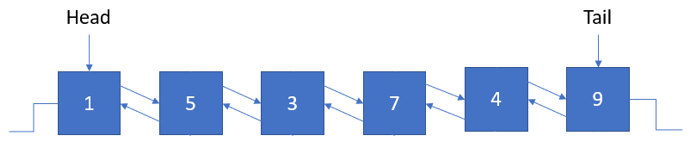
As mentioned earlier, Deques can be implemented by modifying the Doubly Linked List data structure where two pointers, tail/rear is used to refer to the node located at the back and head/front to refer to the node located at the front.
-
Nodes within a Deque can be represented by a struct named
DListNodethat stores anintand a referenced to the next and previous nodes.typedef struct dnode_t { int data; struct dnode_t \ *next, *prev; } DListNode;
-
Deques have two pointers within their structures, that is
headandtail.typedef struct deque_t { DListNode \ *_head, *_tail; unsigned _size; } Deque;
-
To check whether a Deque is empty or not, check whether both the
headandtailare pointing toNULLor not.bool deq_isEmpty(Deque *deque) { return (deque->_head == NULL && \ deque->_tail == NULL); }
-
to do a pushFront, do the following steps:
- make a new node
- if the Deque is empty, make that new node as the
headand thetail. - if it is not, make the next of the new node points to the current
headand the prev of the currentheadto the new node. - make the
headpoints to the new node.
void deq_pushFront(Deque *deque, int value)
{
    DListNode *newNode = __dlist_createNode(value);
    if (newNode) {
        deque->_size++;
        if (deq_isEmpty(deque)) {
            deque->_head = newNode;
            deque->_tail = newNode;
            return;
        }

        newNode->next = deque->_head;
        deque->_head->prev = newNode;
        deque->_head = newNode;
    }
}
-
Follow the following steps to do a pushBack.
- make a new node.
- if the Deque is empty, make the new node as both the
headand thetail. - if it is not empty, make the prev of the new node to point at the current
tailnode, and the next of the currenttailto point at the new node. - make the
tailnode to point at the new node.
void deq_pushBack(Deque *deque, int value)
{
    DListNode *newNode = __dlist_createNode(value);
    if (newNode) {
        deque->_size++;
        if (deq_isEmpty(deque)) {
            deque->_head = newNode;
            deque->_tail = newNode;
            return;
        }

        deque->_tail->next = newNode;
        newNode->prev = deque->_tail;
        deque->_tail = newNode;
    }
}
-
int deq_front(Deque *deque) {
    if (!deq_isEmpty(deque)) {
        return (deque->_head->data);
    }
    return 0;
}
-
int deq_back(Deque *deque) {
    if (!deq_isEmpty(deque)) {
        return (deque->_tail->data);
    }
    return 0;
}
-
To do a popFront, follow these steps:
- store the current
headnode within a temporary variable - make the 'head' to refer to the next of the current 'head'
- remove the node within the temporary variable
- if the
headis empty, the thetailshould be too.
void deq_popFront(Deque *deque)
{
    if (!deq_isEmpty(deque)) {
        DListNode *temp = deque->_head;
        if (deque->_head == deque->_tail) {
            deque->_head = NULL;
            deque->_tail = NULL;
            free(temp);
        }
        else {
            deque->_head = deque->_head->next;
            deque->_head->prev = NULL;
            free(temp);
        }
        deque->_size--;
    }
}
- store the current
-
To do a popBack, follow these steps:
- store the current
tailwithin a temporary variable. - make the
tailto refer to the prev of the currenttail. - remove the node within the temporary variable
- if the
tailis empty, then theheadshould be too.
void deq_popBack(Deque *deque)
{
    if (!deq_isEmpty(deque)) {
        DListNode *temp;
        if (deque->_head == deque->_tail) {
            temp = deque->_head;
            deque->_head = NULL;
            deque->_tail = NULL;
            free(temp);
        }
        else {
            temp = deque->_tail;
            deque->_tail = deque->_tail->prev;
            deque->_tail->next = NULL;
            free(temp);
        }
        deque->_size--;
    }
}
- store the current