Expand hosted agent controls and message projection - #16
Merged
Conversation


Cvv9
force-pushed
the
codex/buzz-inbox-alerts-parity
branch
4 times, most recently
from
August 4, 2026 11:45
b9032ac to
4e509aa
Compare
Cvv9
marked this pull request as ready for review
August 4, 2026 15:49

Signed-off-by: Cvv9 <Varun.cumbamangalam@oralens.com>


…g keystrokes (block#4411)

## What

Fixes the create-agent dialog's "Run on" provider config fields eating
keystrokes — reported by Tyler in buzz-remote-agents (channel
`29414326`, thread `db76677a`): the Kubernetes **Kubeconfig context**
field would not accept typing.

## Why it happened (the Typewriter Eraser, shipped in block#4289)

`WhereToRunSection`'s probe `useEffect` depended on the whole `draft`:

1. every keystroke changed the draft → effect re-fired → provider binary
re-probed;
2. each probe result is a fresh object written into the draft → the
effect re-triggered **itself**, respawning the provider binary in a loop
for as long as the dialog sat on a provider;
3. every probe resolution reset `providerConfig` to schema defaults —
erasing whatever was typed. A field with no schema default (`context`)
snapped back to empty, i.e. "won't let me type". Unrelated to how many
kubeconfig contexts you have.

## Fix

- **Probe once per provider selection**, keyed on the provider's stable
`binaryPath` — not the draft, not the provider object (a
`useBackendProvidersQuery` refresh must not reprobe an unchanged
selection).
- **Latest-state resolution** via `React.useEffectEvent` + a new pure
`applyProbeResult` helper: schema defaults merge **beneath** the current
`providerConfig`, so a probe landing after the user typed can never
clobber in-flight input (per Wren's pre-patch red-team: changing deps
alone leaves a stale closure).

Existing `cancelled` cleanup keeps provider-switch/unmount safe;
selection reset (`emptyWhereToRunDraft`) and the fail-closed probe-error
path are unchanged.

## Tests

- **Unit** (`whereToRunIntent.test.mjs`): `applyProbeResult` merge
semantics — defaults under typed values, user-cleared fields stay
cleared, schema-less results, unrelated fields preserved.
- **E2E** (new `where-to-run-config.spec.ts`, added to the smoke
project, **red-first verified**: all 3 fail against the unfixed
component):
- typing into a defaultless provider field sticks, and
`probe_backend_provider` fires exactly once per selection;
- the config form is gated on probe resolution (slow probe: no
half-rendered form, defaults prefill once);
  - provider → local → provider re-probes and resets cleanly.
- Mock bridge gains `backendProviders` / `backendProviderProbeResult` /
`backendProviderProbeDelayMs` seams (defaults preserve prior behavior).

## Verification at 8eb7680

- `pnpm check` + `tsc` clean, `pnpm test` 3926/3926;
- new spec 3/3 green (and 3/3 red on the unfixed component);
- pre-push lefthook: desktop-test, desktop-check, desktop-tauri-checks,
rust-tests, mobile-test all green.

---------

Signed-off-by: npub1qyvc0c5kl4gqv2fd97fsk46tu378sqgy35vc83rvgfwne90sel7s0ed67d <011987e296fd5006292d2f930b574be47c7801048d1983c46c425d3c95f0cffd@buzz.block.builderlab.xyz>
Co-authored-by: npub1qyvc0c5kl4gqv2fd97fsk46tu378sqgy35vc83rvgfwne90sel7s0ed67d <011987e296fd5006292d2f930b574be47c7801048d1983c46c425d3c95f0cffd@buzz.block.builderlab.xyz>
(cherry picked from commit 2c0ac24)
Signed-off-by: Cvv9 <Varun.cumbamangalam@oralens.com>

**Category:** fix
**User Impact:** Users can save password-protected identity backups
directly to protected macOS folders such as Downloads.

**Problem:** Signed macOS builds could not save a portable `.ncryptsec`
backup to Downloads because the atomic writer created an unauthorized
sibling temporary file. This surfaced as an “Operation not permitted”
error after the user completed backup creation.

**Solution:** Portable exports now write only to the exact path
authorized by the native Save panel, sync and verify the saved bytes,
and refuse to truncate an existing backup. Buzz’s app-managed backup
retains its atomic writer and durability guarantees.

<details>
<summary>File changes</summary>

**desktop/src-tauri/src/commands/export_util.rs**
Clarifies that secret exports use a dedicated writer compatible with
native Save-panel authorization.

**desktop/src-tauri/src/commands/identity.rs**
Routes portable NIP-49 exports through the Save-panel-compatible writer
while preserving canonical app state.

**desktop/src-tauri/src/key_backup.rs**
Adds an exclusive-create portable writer with owner-only permissions,
disk sync, byte verification, and cleanup on failure. Keeps the existing
atomic writer for app-managed backups.

**desktop/src-tauri/src/key_backup_tests.rs**
Covers portable export permissions, absence of sibling files, and
preservation of existing backups.

</details>

## Reproduction steps

1. Install a signed macOS build containing this change.
2. Open **Settings → Profile → Private key → Create backup** and
complete backup creation.
3. Save a fresh `identity.ncryptsec` file into `~/Downloads` and confirm
Buzz reports success.
4. Open and verify the saved backup with its password.
5. Repeat the save using an existing filename and confirm Buzz preserves
the existing file and asks for a new filename.

## Verification

- Full desktop Tauri suite: 2,049 passed, 14 ignored
- Diagnostic suite: 3 passed
- Focused backup coverage: 30 passed
- Tauri clippy (`--all-targets -D warnings`), Rust formatting, and `git
diff --check`: passed
- Push hooks: org safety, branch skew, and desktop Tauri checks passed

Signed-production Downloads smoke remains required after merge because
the signing workflow is restricted to `main`.

Signed-off-by: Taylor Ho <taylorkmho@gmail.com>
Co-authored-by: npub1223z34hd7vtwc6qj4s7flsxkj644nlre2nthu7lrrmkumhu3xddsrx9r6w <52a228d6edf316ec6812ac3c9fc0d696ab59fc7954d77e7be31eedcddf91335b@buzz.block.builderlab.xyz>
(cherry picked from commit 01c80aa)
Signed-off-by: Cvv9 <Varun.cumbamangalam@oralens.com>

…aned Node (block#4382)

This PR fixes two Windows-specific install failures: Windows Defender
blocking the bare `irm|iex` PowerShell install command, and managed Node
shims pointing at a version-bumped (now-absent) Node directory.

The Defender block (Trojan:Win32/Commando.A!ml) fires before PowerShell
runs and is not clearable via Allow. The Node orphaning means shims in
the managed npm prefix resolve but fail at runtime with 'node not
recognized' because they reference the deleted old Node path.

- Replace all three Windows CLI install commands (Goose, Claude, Codex)
with a two-step shape — `Invoke-RestMethod` to a named temp file, then
execute — to eliminate the dropper signature; a new
`windows_install_command!` macro in `discovery/windows_install.rs`
generates all three strings at compile time so the shape cannot drift
between runtimes
- `$ErrorActionPreference='Stop'` aborts on download failure instead of
falling through to a missing-file exit-0; `exit $LASTEXITCODE`
propagates the vendor script's own exit code
- Add `probe_node(executable, expected_version, timeout)` as a bounded
seam: stdout goes to a temp file (not a pipe) so no exit path can block
on an inherited handle; the child runs in its own process group on Unix
so an unconditional group SIGKILL on every exit path terminates all
descendants; on Windows `taskkill /T /F` provides the same tree-wide
cleanup; `managed_node_runtime_ready()` is a thin wrapper that resolves
the managed Node path and calls the seam
- Add `resolve_adapter_path()` in `managed_node.rs`: resolves the
candidate first, then calls `should_invalidate_adapter()` — a pure
predicate that returns `true` only when the resolved path is under
`buzz_managed_npm_bin_dir()` AND the managed Node runtime is orphaned;
external adapters outside the managed prefix are always preserved

Note: CI cannot reproduce the Defender block (no live Defender ML
classifier). Proof of fix is structural — the command shape no longer
matches the dropper signature. Canary validation on a real Windows
machine with Defender enabled is the definitive check.

---------

Signed-off-by: Will Pfleger <pfleger.will@gmail.com>
Co-authored-by: npub1mn7jgtj4w2pd0g0zeuhxsa6jy6p0rewxz4kujt98my82ahfmp72sxjexk7 <dcfd242e557282d7a1e2cf2e6877522682f1e5c6156dc92ca7d90eaedd3b0f95@buzz.block.builderlab.xyz>
(cherry picked from commit 80315ac)
Signed-off-by: Cvv9 <Varun.cumbamangalam@oralens.com>


…4545)

## The bug

buzz-agent emitted its `usage_update` notification in exactly one place:
after `ctx.run()` returned. Until that moment a turn's token counters
lived only in the prompt task's stack frame. **A turn killed mid-flight
reported nothing at all** — the provider had already billed every round
it completed, and no consumer ever saw any of it.

That is not a corner case for anything that ends a turn on a clock. It
is the normal case for a long-horizon benchmark run that relaunches its
agent between phases.

## How big

Measured against a provider's own billing ledger over one run's window:

| | provider ledger | what we recorded |
|---|---|---|
| the relaunched lead seat | $485 / 348M tok | $98.99 / 90.3M tok |
| the two seats that were not relaunched | $29.90 / 856M | $25.81 / 765M
— reconciles |

97% of that run's usage rows came back all zeros, against 1–4% for
comparable runs that never relaunch. In one 450-phase trial exactly 7
phases recorded any usage — and each of those carries 177k–437k input
tokens, a whole session's worth landing in the one phase that happened
to end gracefully.

Worth being precise about what was *not* wrong, since both were
plausible and both were checked:

- **Not pricing.** The rates were verified against the provider's
endpoints API and match what we charge.
- **Not a truncation bug.** The usage files were intact and internally
consistent. The tokens were never captured in the first place.

## The fix

The run loop now emits a session-cumulative `usage_update` after every
usage-bearing provider response, so an interrupted turn has reported
everything but its single in-flight request.

- **Emitting more than once per turn is already part of the contract.**
buzz-acp's `UsageTracker` advances its committed baseline only at
publish time, and goose behaves the same way — which is why the tracker
was written to tolerate it.
- **The turn-start session baseline is snapshotted into `RunCtx`** so
the mid-turn figure stays *session*-cumulative. A turn-local number
would be discarded by a high-water-mark consumer and lose the turn
entirely; there is a test for exactly that.
- **Snapshot by value, not a session handle.** The loop reports once per
round, and taking the sessions lock on each would serialise concurrent
sessions behind one another's provider round-trips. Nothing else
advances those counters while the turn holds `busy`, so it cannot go
stale.
- **One shared `wire::usage_update_payload`** for both call sites, so
the mid-turn and end-of-turn shapes cannot drift. A drift there would
present as tokens silently vanishing, which is the failure this
reporting exists to prevent.

## Why not a SIGTERM handler

That was the obvious shape and it does not work. At signal time the
counters are not sitting anywhere a handler could reach — they are in
the turn's stack frame, and the value the handler would need has not
been folded into the session yet. Making usage durable *during* the turn
is what actually fixes it; once it is, a handler adds nothing beyond the
in-flight request, whose cost is unknown until its response lands.

## Tests

- `usage_is_reported_after_each_round_not_only_at_turn_end` — two
rounds; asserts the **first** notification carries round 1's counts
alone, proving it went out before round 2 returned.
- `mid_turn_usage_includes_earlier_turns` — a mid-turn report must be
session-cumulative, not turn-local.

buzz-agent 18/18 on the `fake_llm` suite, 382 unit. `cargo fmt` /
`clippy` / `cargo check --workspace --all-targets` clean.

## Scope

Agent-side only, against `main`. The matching harness change — settling
usage on the timeout path, which was skipped on the reasoning that an
incomplete turn has nothing to flush — is **block#4553**, against the
benchmark branch, since that harness does not exist on `main`.

🤖 Generated with [Claude Code](https://claude.com/claude-code)

Signed-off-by: Atish Patel <atish@squareup.com>
Co-authored-by: Claude Code <noreply@anthropic.com>
(cherry picked from commit 09c86c5)
Signed-off-by: Cvv9 <Varun.cumbamangalam@oralens.com>

### Summary

Fixes [this
issue](buzz://message?channel=e62570dd-33ad-42c5-b92b-75f2689f9694&id=b726c366abfe62429ee3cdcd34d0c0fb98c33c3ea053480585bed71745412b56):
> I often don’t see my bot responses until after I post. they’re usually
time stamped correctly so I think it’s just a refresh issue?

### What changed?

Buzz Mobile now reconnects relay sessions after the app has remained
backgrounded beyond the existing 5-second grace period, even when the
session still reports a stale `connected` state. This makes resume
recovery independent of whether iOS runs the grace timer before or after
delivering `resumed`.

Reconnection is now based on elapsed background time rather than a
direct socket-health probe.
- If the app was backgrounded for at least the 5-second grace period,
the socket is presumed dead and the session reconnects regardless of
reported status.
- If it was backgrounded for less than that, a reported `connected`
status is still trusted.

In the sub-5-second window the socket is either genuinely alive, which
is the common case for a momentary background, or it is dead and the
client ping detects it within the two-interval worst case described
below. That is now a degraded-latency path, not a silent-forever path.

The mobile relay socket now uses `IOWebSocketChannel.connect` with a
30-second `pingInterval`. An unanswered ping closes the Dart socket
through the existing disconnect and reconnect path.

Detection takes up to two ping intervals, so about 60 seconds worst
case, not 30. One interval of idleness elapses and a ping is sent, then
a second interval elapses with no pong and the socket closes. Any
inbound pong restarts the first stage, so the clock measures idleness
rather than running on a fixed cadence.

### Why?

Buzz iOS can sometimes stop showing new bot or agent responses after a
phone has been locked for 5 to 10 minutes. When the user later posts a
message, the missing responses can appear all at once. iOS may suspend
Buzz before the short delayed cleanup that would normally close its
connection has a chance to run. Before this change, Buzz trusted the
resulting stale healthy status on resume and skipped reconnecting, so
the missing responses stayed hidden until a later post exposed the dead
connection.

A state-machine test with a stubbed connection reproduced this reported
pattern and showed that it matches this failure mode: the failed post
triggered a reconnect that fetched the missing messages. The same test
also checked the other candidate explanation, the bug tracked in
[block#3053](block#3053), where the relay has
closed the app's subscription. That state does not produce the pattern.
Posting succeeds and the user's own message appears, but nothing looks
for the missed messages, so they stay hidden. The test confirmed that
the missed messages were still available to fetch in that state, so the
missing step was a trigger to fetch them. This was not an end-to-end
reproduction on an iOS device or a live relay.

The new resume check covers the normal lock and unlock path. If the app
was backgrounded for less than the 5-second grace period, it still
trusts a connection marked as healthy. A dead connection in that window
is instead detected by the ping check, which can take up to about 60
seconds but prevents the app from remaining silently stuck. The ping
only runs while iOS is running the app, so it does not detect a
connection that died during suspension; the resume check owns the lock
and unlock path.

A pre-existing path also runs the same resume handling when network
connectivity returns while the app is already in the foreground. Because
the app was not backgrounded, this change does not alter that path,
which still trusts a connection marked as healthy and relies on the
slower ping check.

Recovery from a subscription that the relay explicitly closes remains in
[block#3053](block#3053), and the two changes
overlap in one file. Changes to how missed messages are backfilled or
replayed are out of scope.

### How is it tested?

Full mobile suite at base and head. Both runs have the same known
macOS-host-only failure in `ChannelDetailPage keeps follow mode off
while a tall newest message stays visible` at line 1053:

- Base: 1,021 passed, 1 skipped, 1 failed
- Head: 1,025 passed, 1 skipped, 1 failed

Added tests:

-
[`relay_session_test.dart`](https://github.com/block/buzz/tree/main/mobile/test/shared/relay/relay_session_test.dart):
long-background resume reconnect and within-grace control
-
[`relay_socket_liveness_test.dart`](https://github.com/block/buzz/tree/main/mobile/test/shared/relay/relay_socket_liveness_test.dart):
silent-peer disconnect and idle-but-healthy control

Mutation checks confirm that removing elapsed-background resume recovery
fails with one socket instead of two, and removing `pingInterval` leaves
the silent peer connected. Restored production code passes both
mutations' regression tests and the healthy idle control.

Signed-off-by: Tom Brow <tomb@block.xyz>
Co-authored-by: npub1tquskdu6yc4h8l7xxtceculxw600grekeq0xg2ukqfrwl7vrzg3quz3gmp <58390b379a262b73ffc632f19c73e6769ef40f36c81e642b960246eff9831222@buzz.block.builderlab.xyz>
(cherry picked from commit ce56e34)
Signed-off-by: Cvv9 <Varun.cumbamangalam@oralens.com>
**Category:** fix **User Impact:** Long custom emoji names now stay contained inside reaction popovers and remain fully readable. **Problem:** An unbroken custom emoji name could force a reaction popover beyond its intended maximum width and overflow the message view. **Solution:** Give the reaction popover a definite 288px width and allow the complete emoji name to wrap within it without truncation or ellipsis. Short names retain the same content and interaction behavior. <details> <summary>File changes</summary> **desktop/src/features/messages/ui/MessageReactions.tsx** Bounds the reaction popover width and allows long names to break across lines while preserving the full shortcode. **desktop/tests/e2e/reaction-names.spec.ts** Covers fixed width, full text preservation, and wrapping for the maximum supported colon-wrapped reaction name, with deterministic seeded Picsum visual fixtures and explicit image-load waits. </details> ## Reproduction Steps 1. Open a message with a custom emoji reaction whose name is 64 characters. 2. Hover or focus the reaction pill to open its details popover. 3. Confirm the popover remains 288px wide and the complete name wraps within it without ellipsis. 4. Open a short-name reaction and confirm its popover remains readable and unchanged in behavior. ## Screenshots | Before | After | | --- | --- | | 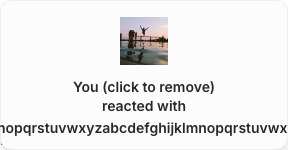 | 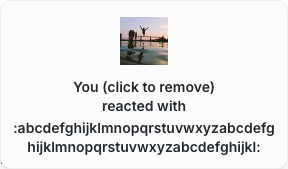 | **Short-name regression check** 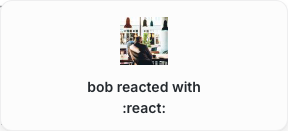 ## Verification - `pnpm test` in `desktop`: 3,858 passed - Focused reaction-name E2E with seeded Picsum captures: 2 passed - Desktop checks and commit hooks passed Originating Buzz channel: `f2ec9671-d78e-4cde-894c-9f4c458c7f1f` --------- Signed-off-by: Taylor Ho <taylorkmho@gmail.com> Co-authored-by: npub1223z34hd7vtwc6qj4s7flsxkj644nlre2nthu7lrrmkumhu3xddsrx9r6w <52a228d6edf316ec6812ac3c9fc0d696ab59fc7954d77e7be31eedcddf91335b@buzz.block.builderlab.xyz> (cherry picked from commit 7981597) Signed-off-by: Cvv9 <Varun.cumbamangalam@oralens.com>



Signed-off-by: Cvv9 <Varun.cumbamangalam@oralens.com>
Signed-off-by: Cvv9 <Varun.cumbamangalam@oralens.com>
Signed-off-by: Cvv9 <Varun.cumbamangalam@oralens.com>
Signed-off-by: Cvv9 <Varun.cumbamangalam@oralens.com>
Signed-off-by: Cvv9 <Varun.cumbamangalam@oralens.com>
Signed-off-by: Cvv9 <Varun.cumbamangalam@oralens.com>
Signed-off-by: Cvv9 <Varun.cumbamangalam@oralens.com>
Signed-off-by: Cvv9 <Varun.cumbamangalam@oralens.com>
Signed-off-by: Cvv9 <Varun.cumbamangalam@oralens.com>
Cvv9
force-pushed
the
codex/buzz-inbox-alerts-parity
branch
from
August 4, 2026 16:41
7fea26e to
cc99c77
Compare
Signed-off-by: Cvv9 <Varun.cumbamangalam@oralens.com>
Signed-off-by: Cvv9 <Varun.cumbamangalam@oralens.com>
Signed-off-by: Cvv9 <Varun.cumbamangalam@oralens.com>
Signed-off-by: Cvv9 <Varun.cumbamangalam@oralens.com>
Signed-off-by: Cvv9 <Varun.cumbamangalam@oralens.com>
Signed-off-by: Cvv9 <Varun.cumbamangalam@oralens.com>
Signed-off-by: Cvv9 <Varun.cumbamangalam@oralens.com>
Signed-off-by: Cvv9 <Varun.cumbamangalam@oralens.com>
Signed-off-by: Cvv9 <Varun.cumbamangalam@oralens.com>
Signed-off-by: Cvv9 <Varun.cumbamangalam@oralens.com>
This file contains hidden or bidirectional Unicode text that may be interpreted or compiled differently than what appears below. To review, open the file in an editor that reveals hidden Unicode characters.
Learn more about bidirectional Unicode characters
Sign up for free
to join this conversation on GitHub.
Already have an account?
Sign in to comment
6 participants


Add this suggestion to a batch that can be applied as a single commit.This suggestion is invalid because no changes were made to the code.Suggestions cannot be applied while the pull request is closed.Suggestions cannot be applied while viewing a subset of changes.Only one suggestion per line can be applied in a batch.Add this suggestion to a batch that can be applied as a single commit.Applying suggestions on deleted lines is not supported.You must change the existing code in this line in order to create a valid suggestion.Outdated suggestions cannot be applied.This suggestion has been applied or marked resolved.Suggestions cannot be applied from pending reviews.Suggestions cannot be applied on multi-line comments.Suggestions cannot be applied while the pull request is queued to merge.Suggestion cannot be applied right now. Please check back later.
What changed
Expands hosted-agent configuration and editing, message projection, ACP/relay behavior, sidecar preparation, and related UI and end-to-end coverage.
Why and impact
This publishes the accumulated Buzz agent-management work on an isolated review branch so Linux CI can validate the remaining Unix-specific ACP fixtures before merge.
Validation