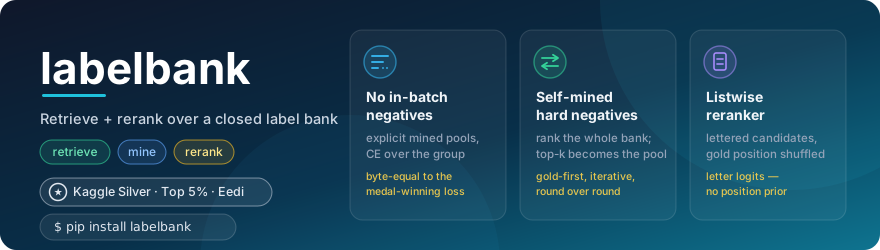


labelbank is the generalized core of a silver-medal (top 5%) solution to Kaggle's Eedi — Mining Misconceptions in Mathematics, extracted into a small, tested library you can run on your own label catalog with any Hugging Face backbone. The exact competition artifacts are preserved untouched in competition/, and golden tests pin the library's default behavior to the medal-winning code byte for byte.
Use it when your problem looks like this: given a piece of free text, find the matching entry in a fixed catalog of labels — a few hundred to a few tens of thousands of entries that all look frustratingly similar. Support tickets → known-issue KB, error logs → root-cause catalog, symptoms → diagnosis codes, content → policy categories, student mistakes → misconception taxonomies (the original task: 2,587 fine-grained math misconceptions).
Generic embedders retrieve "something related". In a fine-grained bank, related isn't enough — "ignores order of operations" and "evaluates left to right" are nearly identical sentences and different labels. Three design choices close that gap, and they are exactly what this library packages:
1. No in-batch negatives — mined pools instead.
Standard contrastive recipes use other in-batch examples as negatives. In a closed bank that's poison: another query's positive is often a sibling label of your gold (a false negative), and random negatives are trivially easy. labelbank trains on explicit per-query pools — [gold, hard negatives…] — with cross-entropy over the group (no_in_batch_neg_loss, temperature 0.01).
2. The hard negatives come from the model itself.
Train round N → rank the whole bank for every training query → take each query's own top-k as round N+1's negative pool, gold forced to the front (gold_first_pool). A self-bootstrapping curriculum: every round, the negatives are precisely the mistakes the current model still makes. This loop was decisive for the medal.
flowchart LR
    T["labeled pairs<br>(text → label id)"] --> R1["bi-encoder round N<br>(LoRA fine-tune)"]
    R1 -- "rank full bank<br>per training query" --> M["top-k pools<br>gold first"]
    M -- "hard negatives" --> R2["bi-encoder round N+1"]
    R2 -- "top-k candidates" --> RR["generative listwise reranker<br>(letters A–E, completion-only SFT)"]
    RR --> O["final ranking"]
3. A generative listwise reranker with no position prior.
The retriever's top-k candidates are inlined into one prompt as lettered options; a causal LLM is fine-tuned (completion-only) to answer the letter. The gold's position is shuffled at training time — the reranker must judge content, not slot — and at inference the next-token logits over A…E re-order the candidates (ListwiseReranker).
pip install labelbank              # core: metrics, mining, formatting, data (no torch)
pip install labelbank[retrieve]    # + bi-encoder retrieval (torch, transformers, peft)
pip install labelbank[rerank]      # + the generative listwise reranker (adds trl)
pip install labelbank[train] # everything needed to train both stagesfrom labelbank import LabelBank, BiEncoderRetriever, gold_first_pool
# 1. Your closed catalog, and some labeled (text -> label id) pairs.
bank = LabelBank.from_csv("catalog.csv", id_col="LabelId", text_col="LabelText")
queries = ["my failing log line…", "another report…"] # free text
gold_ids = [1042, 17] # matching catalog ids
# 2. Retrieve with any HF backbone (last-token pooling + L2 norm).
retriever = BiEncoderRetriever.from_pretrained(
"Qwen/Qwen2.5-0.5B-Instruct", trainable=True,
query_prefix="<instruct>Match the text to the best catalog entry.\n<query>",
)
ranked = retriever.retrieve(queries, bank, top_k=25)
# 3. Mine hard negatives from the model's own rankings, then retrain.
pools = [gold_first_pool(r, g, top_k=25) for r, g in zip(ranked, gold_ids)]
from labelbank import RetrieverTrainConfig, train_retriever
train_retriever(retriever, queries, [bank.texts_of(p) for p in pools],
RetrieverTrainConfig(epochs=1, temperature=0.01))
# 4. Evaluate against the whole bank.
metrics = retriever.evaluate(queries, gold_ids, bank) # map@25 + recall@{1,10,25,50,100}Rerank the top-5 with a generative judge:
from labelbank import build_training_rows, ListwiseReranker

rows = build_training_rows(queries, candidate_texts, gold_texts, k=5)   # gold position shuffled
reranker = ListwiseReranker.from_pretrained("Qwen/Qwen2.5-0.5B-Instruct")
reranker.train(rows, output_dir="out/reranker", lora={"r": 16})
order = reranker.rerank(query_text, candidate_texts)                     # letter-logit reorder
Or run the whole loop — zero-shot eval → rank the bank → mine gold-first pools → retrain → re-evaluate, for mining_rounds rounds — from one YAML:
python -m labelbank.run --cfg examples/configs/quickstart.yaml             # 0.5B, one consumer GPU
python -m labelbank.run --cfg examples/configs/reproduce_competition.yaml  # the medal setup (32B + NF4)
The retriever stage writes the adapter, per-split rankings.parquet and metrics.json to output_dir; the reranker stage (stage: reranker) consumes that parquet and trains the listwise judge on it.
The library's central claim, measured end to end through its public API on a public dataset — banking77 (a real closed bank of 77 customer intents), Qwen2.5-0.5B-Instruct + LoRA bi-encoder, 2,000 training pairs, 1,000 held-out test queries, pools of 8, one epoch per arm, one RTX 4080, ~1 h (examples/mined_negatives_experiment.py):
| arm (identical budgets) | MAP@25 | R@1 | R@3 | R@5 | R@10 |
|---|---|---|---|---|---|
| zero-shot backbone | 0.069 | 1.9% | 6.0% | 9.7% | 17.2% |
| random negatives (bootstrap round) | 0.788 | 67.6% | 87.8% | 94.5% | 97.6% |
| + self-mined, round 1 | 0.838 | 76.2% | 89.6% | 93.3% | 97.5% |
| + self-mined, round 2 | 0.839 | 75.7% | 90.5% | 95.0% | 97.9% |
Mining is worth +5.0 MAP and +8.6 points of R@1 over random negatives at the same budget — and the gain concentrates exactly where fine-grained banks hurt: top-1, where sibling labels collide (R@10 is saturated for both). Round 2 plateaus on this small bank; the competition iterated rounds over a 2,587-entry bank (next section).
One honest caveat the ablation makes measurable: hard negatives are only as good as the model that mines them. Mining round 1 from the zero-shot model's rankings instead of the bootstrap model's collapses to MAP 0.430 — far below plain random negatives. That is why the pipeline (and the competition protocol preserved in competition/) trains a bootstrap round first and mines from it. Reproduce both:
pip install -e .[retrieve] datasets
python examples/mined_negatives_experiment.py               # bootstrap protocol (table above)
python examples/mined_negatives_experiment.py --cold-start # the ablation: mine from zero-shotNumbers from the preserved training logs (competition/stage1_train.log) — retriever stage, Qwen2.5-32B-Instruct + LoRA over a 2,587-entry bank, scored on held-out fold:
| metric | value |
|---|---|
| MAP@25 | 0.4238 |
| Recall@1 | 0.3017 |
| Recall@10 | 0.6906 |
| Recall@25 | 0.8126 |
| Recall@50 | 0.8978 |
| Recall@100 | 0.9391 |
With the listwise reranker on top, the full two-stage system scored 0.50 on the private leaderboard — silver medal, top 5%. For intuition: Recall@25 of 0.81 means the retriever alone puts the right label among 25 candidates four times out of five — out of 2,587 that all describe subtly different math mistakes.
| sentence-transformers / BGE | RAG over a corpus | labelbank |
|
|---|---|---|---|
| Target | open-ended similarity | open document collection | closed catalog (can re-embed every eval) |
| Negatives | in-batch by default | n/a | explicit mined pools, no in-batch |
| Mining loop | bring your own | n/a | built in, gold-first, iterative |
| Reranker | cross-encoder (pointwise) | LLM reads retrieved docs | generative listwise letters, position-shuffled |
| Backbone | encoder models | any | any HF causal model as bi-encoder (last-token pool, LoRA, 4-bit) |
If you need general-purpose embeddings, use sentence-transformers. If your labels are a fixed, fine-grained catalog and generic embeddings keep confusing siblings, this is the recipe that medaled on exactly that problem.
- The competition scripts, configs, training logs, inference notebook, certificate and the full original write-up are preserved verbatim in
competition/. - Golden tests pin the library to the medal-winning code: the contrastive loss, last-token pooling, hard-negative pool construction, both prompt templates, and the Eedi data pipeline are each fuzz-tested against verbatim copies of the originals (
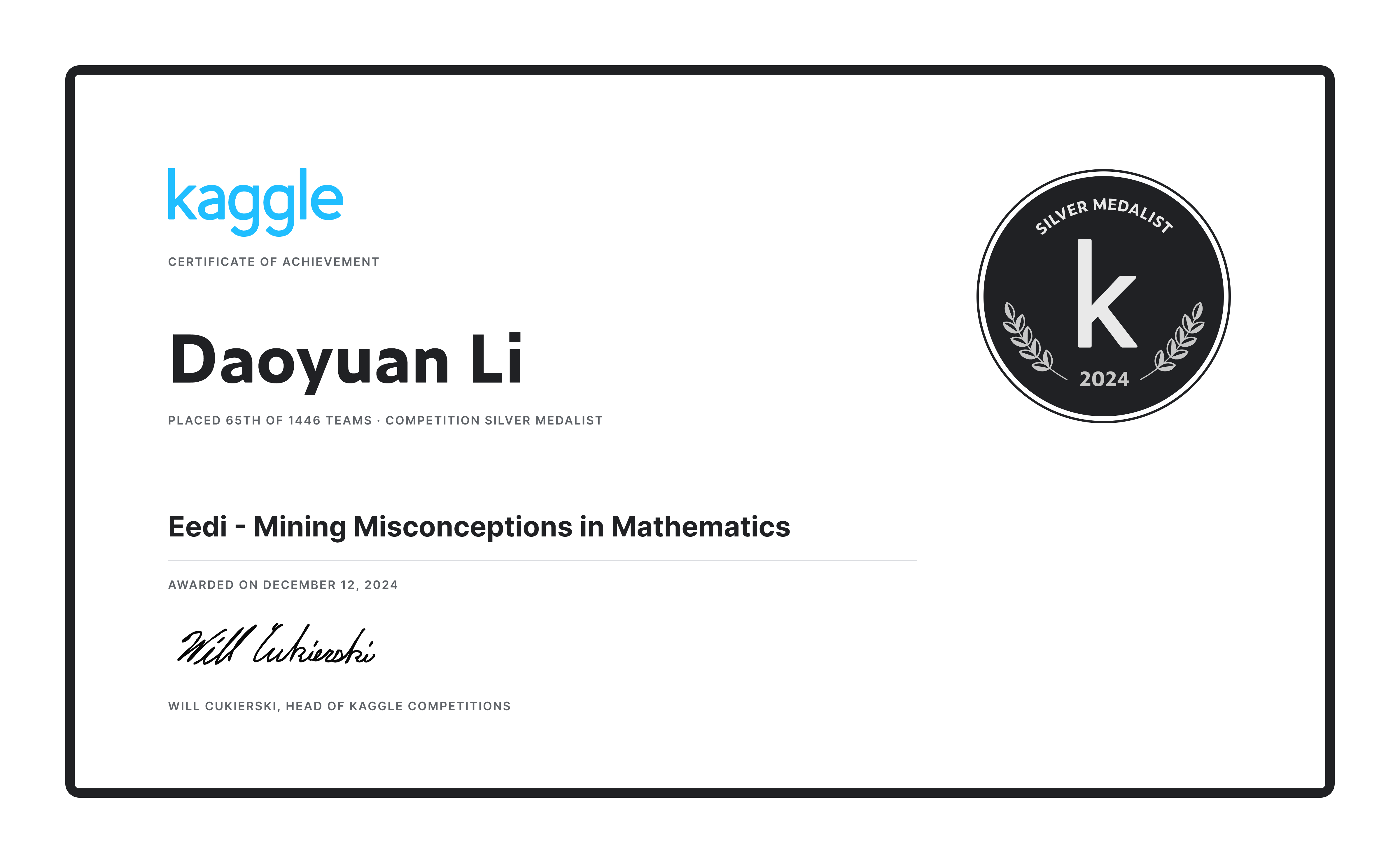
tests/reference_impl.py) and assert identical output — the library is the competition code, not a reimplementation of it. - Final result: silver medal (top 5%), private LB 0.50 (certificate).
@misc{li2024labelbank,
  author = {Daoyuan Li},
  title  = {labelbank: retrieval and listwise reranking over closed label banks with self-mined hard negatives},
  year   = {2024},
  url    = {https://github.com/DaoyuanLi2816/labelbank},
  note   = {Generalized from a silver-medal solution, Kaggle Eedi — Mining Misconceptions in Mathematics}
}MIT — see LICENSE.
Daoyuan Li — Kaggle (distiller) · lidaoyuan2816@gmail.com