Cross-team quality intelligence platform for automated testing. It ingests test results, normalizes execution history, computes quality signals, manages test cases and requirements, classifies failures with AI, and runs agentic workflows for impact analysis, test generation, and flaky-test healing.
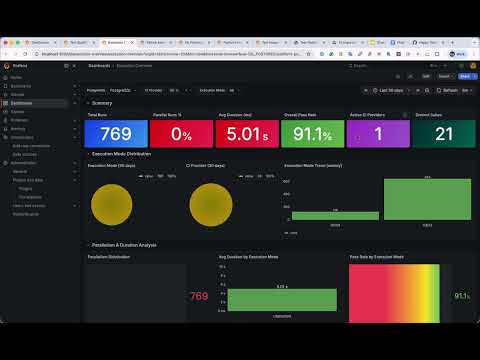
Commit b4640398780f0f339bb3a9bf5e83b271ab4e1b01 initializes the v2.0 platform revamp:
platform-agent: Agent Hub for workflow orchestration, node routing, PR impact analysis, test generation, automation generation, review decisions, and flaky-test fixes.platform-storage: shared blob storage with filesystem, MinIO, and S3-compatible backends.platform-integration-config: integration adapter registry with initial Jira Cloud and GitHub adapter skeletons.- Canonical quality model: requirements, test cases, traceability edges, test suites, manual test runs, agent workflows, review requests, token budgets, GitHub PR tracking, and impact analyses.
- Portal expansion: requirements, PR analyses, impact analyses, project settings, test case management, test runs, flaky tests, API keys, and AI settings.
- Database migrations extended through
V44.
                          Test Automation Platform

  Test frameworks and CI
  JUnit 5 / TestNG / Cucumber / Allure / Playwright / Newman / k6 / Gatling / JMeter
                 |
                 v
  +----------------------+       Kafka        +----------------------+
  | platform-ingestion   |  test.results.raw  | platform-analytics   |
  | :8081                +------------------->| :8082                |
  | parse, normalize, DB |                    | flakiness, TIA, logs |
  +----------+-----------+                    +----------+-----------+
             |                                           |
             |                                           v
             |                                +----------------------+
             |                                | platform-ai          |
             |                                | :8084                |
             |                                | Claude/OpenAI        |
             |                                +----------------------+
             |
             v
  +----------------------+                    +----------------------+
  | PostgreSQL 17        |<------------------>| platform-agent       |
  | source of truth      |                    | :8086, host :8087   |
  +----------------------+                    | agent workflows      |
             ^                                +----------+-----------+
             |                                           |
  +----------+-----------+                    +----------v-----------+
  | platform-portal      |                    | MinIO / S3 / FS      |
  | :8085                |                    | artifacts, diffs,    |
  | BFF + React SPA      |                    | checkpoints          |
  +----------------------+                    +----------------------+

  Supporting services: Redis, OpenSearch, Logstash, Loki, Promtail, Grafana,
  Prometheus, and Flyway.
| Module | Port | Role |
|---|---|---|
platform-common |
- | Shared DTOs, enums, Kafka topics, agent contracts, integration contracts, storage contracts |
platform-storage |
- | BlobStore auto-configuration for filesystem, MinIO, and S3-compatible storage |
platform-core |
- | JPA domain, repositories, Flyway migrations V1 through V44 |
platform-ingestion |
8081 | Result ingestion, parsers, project/team management, requirements, integrations, TCM APIs |
platform-analytics |
8082 | Flakiness, trends, quality gates, release reports, Test Impact Analysis, alerting, log search |
platform-integration |
8083 | Jira ticket lifecycle for repeated failures and flaky tests |
platform-integration-config |
- | Project-scoped integration adapter registry and adapter contracts |
platform-ai |
8084 | Failure classification, batch analysis, AI settings (all models via the LiteLLM gateway) |
platform-portal |
8085 | Spring Boot BFF plus embedded React SPA |
platform-agent |
8086 | Agent Hub, node registry, workflows, webhooks, review gateway, impact/test-generation/healing flows |
platform-testkit |
- | Rich Java instrumentation for JUnit 5, TestNG, Cucumber, Playwright-assisted tests |
platform-adapters |
- | Java, Playwright, and k6 publishing adapters |
| Service | Local URL | Notes |
|---|---|---|
| Platform Portal | http://localhost:8085 | Main UI |
| Ingestion API | http://localhost:8081/swagger-ui.html | Result, project, requirement, integration, and TCM APIs |
| Analytics API | http://localhost:8082/swagger-ui.html | Flakiness, TIA, quality gates, alerts, logs |
| Integration API | http://localhost:8083/swagger-ui.html | Jira lifecycle service |
| AI API | http://localhost:8084/swagger-ui.html | Failure analysis and provider settings |
| Agent Hub | http://localhost:8087 | Host port maps to container port 8086 |
| OpenSearch | http://localhost:9200 | Log search backend |
| MinIO Console | http://localhost:9001 | platform / platform123 |
| PostgreSQL | localhost:5432 | db platform, user platform, password platform |
| Kafka | localhost:9092 | KRaft mode |
| Redis | localhost:6379 | Agent checkpoints |
The Grafana monitoring stack is not part of the default
docker compose up. Start it with the override (see Full stack with monitoring) to also get Grafana (http://localhost:3000,admin/admin), Prometheus (http://localhost:9090, metrics + k6 remote-write), Loki (http://localhost:3100), and Promtail.
No Java or Maven is required for the pre-built image path. The default docker-compose.yml is the
full operational platform — a single docker compose up -d starts the data pipeline, storage, cache,
log-search backend, and the LiteLLM gateway, runs Flyway through the db-migrate one-shot container,
and then starts all backend services and the portal.
git clone https://github.com/ndviet/test-automation-platform.git
cd test-automation-platform

docker compose pull
docker compose up -d
docker compose ps
Stop the stack:
docker compose down

# Wipes database, Kafka, Redis, OpenSearch, and MinIO data.
docker compose down -vdocker-compose-full.yml is an additive override holding the self-contained extras: a bundled
LiteLLM container (the default stack expects an external endpoint) and the Grafana observability
stack (Grafana, Prometheus, Loki, Promtail). With the override present, platform-ai/agent default to
the bundled litellm. Layer it on the default to run the full stack:
docker compose -f docker-compose.yml -f docker-compose-full.yml up -d
docker compose -f docker-compose.yml -f docker-compose-full.yml down   # stop it all
scripts/dev-up.sh --full (or COMPOSE_FULL=1 scripts/dev-up.sh) does the same with the
bind-volume warmup.
Create a .env file in the project root when you need non-default settings. Docker Compose reads it automatically.
# LiteLLM gateway — the single OpenAI-compatible endpoint the platform talks to
# (Claude/GPT/Gemini/etc. are routed by model id inside LiteLLM).
#
# The DEFAULT stack uses an EXTERNAL LiteLLM: platform-ai/agent start with these
# unset (empty), so the platform comes up from scratch without a gateway. Point them
# at your LiteLLM when ready — here, or per Org/Team/Project in the Portal (/settings/ai):
# LITELLM_BASE_URL=https://your-litellm/v1
# LITELLM_API_KEY=sk-...
#
# Prefer a bundled gateway? Run the full stack (-f docker-compose-full.yml) — it adds a
# `litellm` container that proxies to the Claude API, and platform-ai/agent then default to
# LITELLM_BASE_URL=http://litellm:4000/v1. Provide your Anthropic key (and optional proxy key):
ANTHROPIC_API_KEY=sk-ant-...
LITELLM_MASTER_KEY=sk-platform-local

# Ingestion auth, disabled by default for local development
API_KEY_AUTH_ENABLED=false

# Agent integrations
GITHUB_TOKEN=ghp_...
GITHUB_WEBHOOK_SECRET=...
JIRA_WEBHOOK_SECRET=...
LINEAR_WEBHOOK_SECRET=...
SLACK_BOT_TOKEN=xoxb-...
SLACK_SIGNING_SECRET=...
SLACK_APPROVAL_CHANNEL=#agent-approvals
Storage is selected with platform.storage.type:
| Type | Use case |
|---|---|
filesystem |
Local service runs without object storage |
minio |
Docker Compose local stack |
s3 |
AWS S3 or compatible production storage |
Compose configures MinIO automatically and creates these buckets: platform-artifacts, platform-knowledge, platform-checkpoints, and platform-diffs.
| Tool | Version |
|---|---|
| Java | 21 |
| Maven | 3.9+ |
| Docker + Docker Compose | 27+ |
| Node.js | 20+ for portal and JS adapter development |
mvn -B clean package -DskipTestsmvn -B clean package -DskipTests \
-pl platform-ingestion,platform-analytics,platform-integration,platform-ai,platform-portal,platform-agent \
-ammvn testcd platform-adapters/js/playwright
npm ci
npm run build
cd ../k6
npm install --ignore-scripts
npm run bundleAll service images build FROM a shared platform-base image (JRE + OS packages +
non-root user + JVM entrypoint, defined in infrastructure/docker/base.Dockerfile).
That common layer is built once instead of repeated in every service image.
Fastest path — build the base and all services in parallel with one command:
docker buildx bake # builds platform-base:local + all six service imagesOr with Compose (build the base once first, then the services):
docker buildx bake base                       # creates platform-base:local
docker compose up -d --build
CI builds the base once and publishes it to ghcr.io/<owner>/platform-base; the
service images pull it via the BASE_IMAGE build-arg.
Start infrastructure first:
docker compose up -dThen run the service you are changing:
cd platform-ingestion
mvn spring-boot:run -Dspring-boot.run.profiles=local

cd platform-agent
mvn spring-boot:run -Dspring-boot.run.profiles=local

cd platform-portal/frontend
npm install
npm run devcurl -X POST http://localhost:8081/api/v1/results/ingest \
-F "file=@target/surefire-reports/TEST-example.xml" \
-F "format=JUNIT_XML" \
-F "teamId=my-team" \
-F "projectId=my-project"Supported formats:
JUNIT_XML, CUCUMBER_JSON, TESTNG, ALLURE, PLAYWRIGHT, NEWMAN, PLATFORM_NATIVE, K6, GATLING, JMETER.
# .npmrc
@ndviet:registry=https://npm.pkg.github.com
//npm.pkg.github.com/:_authToken=YOUR_GITHUB_TOKEN

npm install @ndviet/adapter-playwright
// playwright.config.ts
export default defineConfig({
reporter: [
['list'],
['@ndviet/adapter-playwright', {
endpoint: process.env.PLATFORM_URL,
apiKey: process.env.PLATFORM_API_KEY,
teamId: 'my-team',
projectId: 'my-project',
}],
],
})// load-test.js
import { platformHandleSummary } from './platform-k6-adapter.js'
export { platformHandleSummary as handleSummary }k6 run \
-e PLATFORM_URL=http://localhost:8081 \
-e PLATFORM_API_KEY=plat_xxxx \
-e PLATFORM_TEAM_ID=my-team \
-e PLATFORM_PROJECT_ID=my-project \
load-test.jsUse platform-adapter-java for existing suites that only need auto-publishing. Use platform-testkit-java for rich step tracking, tracing, retries, Playwright diagnostics, and native JSON publishing.
<dependency>
  <groupId>org.ndviet</groupId>
  <artifactId>platform-testkit-java</artifactId>
  <version>1.0.0-SNAPSHOT</version>
  <scope>test</scope>
</dependency>
See:
platform-adapters/java/USAGE.mdplatform-testkit/java/USAGE.mdplatform-adapters/js/playwright/README.mdplatform-adapters/js/k6/README.md
| Area | Endpoints |
|---|---|
| Results | POST /api/v1/results/ingest |
| Coverage | POST /api/v1/coverage |
| Teams | GET/POST /api/v1/teams, PUT/DELETE /api/v1/teams/{id} |
| Projects | GET/POST /api/v1/projects, PUT/DELETE /api/v1/projects/{id} |
| Executions | GET /api/v1/projects/{projectId}/executions, GET /api/v1/executions/{runId} |
| Requirements | GET /api/v1/projects/{projectId}/requirements, GET /api/v1/projects/{projectId}/requirements/stats |
| Integrations | GET/POST /api/v1/projects/{projectId}/integrations, DELETE /api/v1/projects/{projectId}/integrations/{configId} |
| API keys | POST /api/v1/api-keys, GET /api/v1/api-keys, DELETE /api/v1/api-keys/{id} |
| Test suites | GET/POST /api/v1/projects/{projectId}/test-suites |
| Test cases | GET/POST /api/v1/projects/{projectId}/test-cases, review and automation actions under /test-cases/{tcId} |
| Manual test runs | GET/POST /api/v1/projects/{projectId}/test-runs, execution updates under /test-runs/{runId} |
| Area | Endpoints |
|---|---|
| Flakiness | GET /api/v1/analytics/{projectId}/flakiness, POST /api/v1/analytics/{projectId}/flakiness/recompute |
| Trends | GET /api/v1/analytics/{projectId}/trends/pass-rate, /trends/mttr, /trends/duration |
| Quality gates | GET /api/v1/analytics/{projectId}/quality-gate, GET /api/v1/projects/{projectId}/quality-gate/ci |
| Test Impact Analysis | GET /api/v1/analytics/{projectId}/impact, GET /api/v1/analytics/{projectId}/impact/summary |
| TIA trends | GET /api/v1/analytics/tia/summary, project TIA trend endpoints under /api/v1/analytics/{projectId}/tia/* |
| Alerts | GET /api/v1/alerts/projects/{projectId}, GET /api/v1/alerts/org |
| Release report | GET /api/v1/projects/{projectId}/release-report |
| Logs | GET /api/v1/logs/runs/{runId}, GET /api/v1/logs/tests/{testId}, GET /api/v1/logs/runs |
| Area | Endpoints |
|---|---|
| Failure analyses | GET /api/v1/projects/{projectId}/analyses, POST /api/v1/projects/{projectId}/results/{resultId}/analyse |
| AI settings | GET/PUT /api/v1/ai/settings, POST /api/v1/ai/settings/test |
| Agent workflows | POST /hub/workflows, GET /hub/workflows, GET /hub/workflows/{workflowId} |
| Node registry | POST /hub/nodes/register, POST /hub/nodes/{nodeId}/heartbeat, GET /hub/nodes |
| Test generation | POST /hub/test-cases/{projectId}/generate, POST /hub/test-cases/{projectId}/{testCaseId}/generate-automation |
| Impact analysis | GET/POST /hub/impact/{projectId}, GET /hub/impact/{projectId}/prs |
| Flaky healing | POST /hub/healing/{projectId}/trigger |
| Review decisions | GET /hub/reviews, POST /hub/reviews/{reviewRequestId}/decide |
| Webhooks | /hub/webhooks/github, /hub/webhooks/jira, /hub/webhooks/linear, /hub/webhooks/slack/interactions |
The React portal is served by platform-portal and backed by /api/portal/**.
| Route | Purpose |
|---|---|
/ |
Organization summary, teams, projects, recent quality signal |
/projects/:projectId |
Project quality detail |
/projects/:projectId/requirements |
Requirement inventory and stats |
/projects/:projectId/pr-analyses |
Agent PR analysis history |
/projects/:projectId/impact-analyses |
AI impact analysis workflow UI |
/projects/:projectId/settings |
Project, team, and integration configuration |
/projects/:projectId/test-cases |
Test suites, manual test cases, review, AI generation, automation trigger |
/projects/:projectId/test-runs |
Manual test runs and execution updates |
/projects/:projectId/flaky-tests |
Flakiness recompute and healing trigger |
/runs/:runId |
Ingested run detail |
/alerts |
Alert history |
/settings/api-keys |
Ingestion API key management |
/settings/ai |
LiteLLM gateway settings (base URL, key, models), test, and tool-config export |
| Signal | Where |
|---|---|
| Dashboards | Grafana at http://localhost:3000 |
| Metrics | Prometheus at http://localhost:9090 |
| Service logs | Loki through Grafana Explore |
| Test execution logs | OpenSearch indices test_execution_logs-* |
| k6 performance | Prometheus (remote write) plus Grafana dashboards |
| TIA trends | Grafana TIA dashboard and analytics APIs |
Flyway migrations live in platform-core/src/main/resources/db/migration/ and currently run from V1 through V44.
They run automatically in Docker through the db-migrate service and are also available to Spring Boot services through the shared core module.
docker compose run --rm db-migrateThe repository includes Test Impact Analysis helper templates under platform-ci-templates/:
- GitHub Actions:
platform-ci-templates/github-actions/test-impact-analysis.yml - Azure DevOps:
platform-ci-templates/azure-devops/test-impact-analysis.yml - Jenkins:
platform-ci-templates/jenkins/PlatformTIA.groovy
These templates calculate changed files, call the analytics TIA endpoints, emit Maven/Gradle test filters, and can fall back to full-suite execution based on risk.
test-automation-platform/
|-- platform-common/              # Shared platform, agent, integration, and storage contracts
|-- platform-storage/             # Blob storage auto-config and implementations
|-- platform-core/                # JPA domain, repositories, Flyway migrations
|-- platform-ingestion/           # Result parsers, REST ingest, management, TCM APIs
|-- platform-analytics/           # Flakiness, trends, quality gates, TIA, alerts, log search
|-- platform-integration/         # Jira ticket lifecycle service
|-- platform-integration-config/  # Integration adapter registry and initial adapters
|-- platform-ai/                  # Failure classification and AI settings
|-- platform-agent/               # Agent Hub, workflows, nodes, webhooks, review gateway
|-- platform-portal/              # Spring Boot BFF and React SPA
|-- platform-testkit/             # Rich Java test instrumentation
|-- platform-adapters/            # Java, Playwright, and k6 adapters
|-- platform-ci-templates/        # TIA templates for CI systems
|-- infrastructure/               # Grafana, Prometheus, Loki, Promtail, Logstash, OpenSearch
|-- helm/                         # Kubernetes chart
`-- docker-compose.yml            # Full local stack