



Fluid comes in two flavors: A local CLI Agent (like Claude Code) that can connect to remote KVM hosts from your local host
An Agent API that connects to KVM hosts and can handle tens to thousands of concurrent agent sessions.
Choose your own adventure 🧙♂️
AI agents are ready to do infrastructure work, but they can't touch prod:
- Agents can install packages, configure services, write scripts--autonomously
- But one mistake on production and you're getting paged at 3 AM to fix it
- So we limit agents to chatbots instead of letting them manage and debug on their own
fluid.sh lets AI agents work autonomously in isolated VMs, then a human approves before anything touches production:
┌─────────────────────────────────────────────────────────────────────────┐
│                           Fluid Workflow                                │
│                                                                         │
│  ┌─────────┐     ┌─────────────────┐     ┌──────────┐     ┌──────────┐  │
│  │  Agent  │────►│  Sandbox VM     │────►│  Human   │────►│Production│  │
│  │  Task   │     │  (autonomous)   │     │ Approval │     │  Server  │  │
│  └─────────┘     └─────────────────┘     └──────────┘     └──────────┘  │
│                         │                      │                        │
│                    • Full root access     • Review diff                 │
│                    • Install packages     • Approve Ansible             │
│                    • Edit configs         • One-click apply             │
│                    • Run services                                       │
│                    • Snapshot/restore                                   │
└─────────────────────────────────────────────────────────────────────────┘
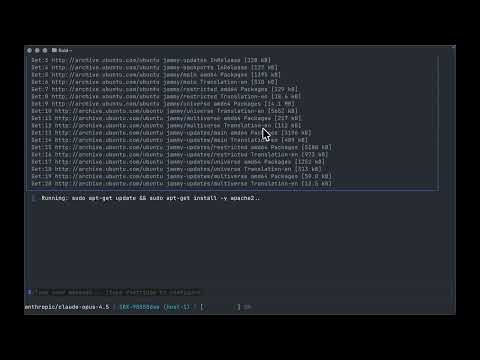
| Feature | Description |
|---|---|
| Autonomous Execution | Agents run commands, install packages, edit configs--no hand-holding |
| Full VM Isolation | Each agent gets a dedicated KVM virtual machine with root access |
| Human-in-the-Loop | Blocking approval workflow before any production changes |
| Ansible Export | Auto-generate playbooks from agent work for production apply |
| Python SDK | First-class SDK for building autonomous agents |
- Must have Go 1.24+ installed.
- Access to Remote Libvirt Host via SSH
- If you are able to access a Libvirt host via SSH then this will work.
To install you can either
curl -fsSL https://fluid.sh/install.sh | bashor
go install github.com/aspectrr/fluid.sh/fluid/cmd/fluid@latestThey do the same thing.
Next you can run
fluidto start onboarding.
Onboarding will take you through adding remote hosts, generating SSH CAs for the agent to access sandboxes, and getting your LLM API key setup.
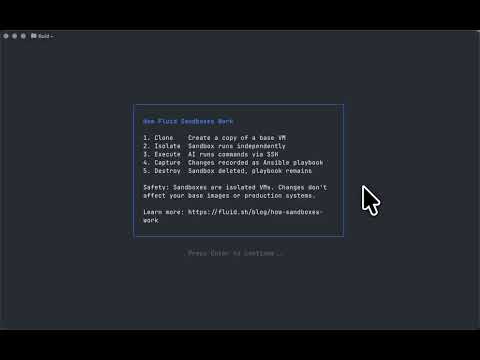
When a Libvirt host does not have enough memory available to create a sandbox, the sandbox creation event will cause an approval screen to prompting the user for approval. This is used to track memory and CPU, and useful for not straining your existing hardware. These limits can be configured with /settings.
All internet connections are blocked by default. Any command that reaches out of the sandbox require human approval first.
Context limits are set in /settings and used to configure when compaction takes place. Context is calculated with a rough heuristic of 0.33 tokens per char. This is meant as a rough estimate but this is likely to be fixed and updated in further iterations.
The agent has access to the following tools during execution:
| Tool | Only Usable in Sandbox | Only Can Act on Sandboxes | Potentially Destructive | Description |
|---|---|---|---|---|
list_sandboxes |
No |
No |
No |
List sandboxes with IP addresses |
create_sandbox |
No |
No, acts on libvirt host |
Yes |
Create new sandbox VM by cloning from source VM |
destroy_sandbox |
No |
Yes |
Yes |
Destroy sandbox and storage |
start_sandbox |
No |
Yes |
Yes |
Start a stopped sandbox VM |
stop_sandbox |
No |
Yes |
Yes |
Stop a started sandbox VM |
| Tool | Only Usable in Sandbox | Only can act on Sandboxes | Potentially Destructive | Description |
|---|---|---|---|---|
run_command |
Yes |
Yes |
Yes |
Execute a command inside a sandbox via SSH |
edit_file |
Yes |
Yes |
Yes |
Edit file on sandbox |
read_file |
Yes |
Yes |
No |
Read file on sandbox |
| Tool | Only Usable in Sandbox | Only can act on Sandboxes | Potentially Destructive | Description |
|---|---|---|---|---|
create_playbook |
No |
No |
No |
Create Ansible Playbook |
add_playbook_task |
No |
No |
No |
Add Ansible task to playbook |
list_playbooks |
No |
No |
No |
List Ansible playbooks |
get_playbook |
No |
No |
No |
Get playbook contents |
You can cycle between EDIT and READ-ONLY mode in the CLI via Shift-Tab.


Read only mode will give access to the model to only tools that are not potentially destructive:
| Tool | Only Usable in Sandbox | Only Can Act on Sandboxes | Potentially Destructive | Description |
|---|---|---|---|---|
list_sandboxes |
No |
No |
No |
List sandboxes with IP addresses |
| Tool | Only Usable in Sandbox | Only can act on Sandboxes | Potentially Destructive | Description |
|---|---|---|---|---|
read_file |
Yes |
Yes |
No |
Read file on sandbox |
| Tool | Only Usable in Sandbox | Only can act on Sandboxes | Potentially Destructive | Description |
|---|---|---|---|---|
create_playbook |
No |
No |
No |
Create Ansible Playbook |
add_playbook_task |
No |
No |
No |
Add Ansible task to playbook |
list_playbooks |
No |
No |
No |
List Ansible playbooks |
get_playbook |
No |
No |
No |
Get playbook contents |
Please reach out on Discord with any problems or questions you encounter! Discord
(
Fluid-Remote is the API version of Fluid. Allowing you to run agents autonomously on your infrastructure from the UI or API calls. Instead of just one agent in your terminal, control hundreds. Talk to Fluid in your favorite apps and spawn tasks to run async, getting your approval before continuining. Run Ansible playbooks from anywhere.
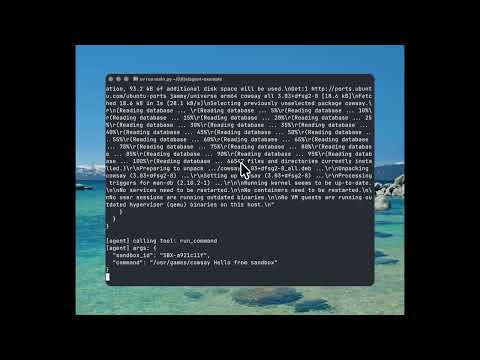
from fluid import Fluid

client = Fluid("http://localhost:8080")
sandbox = None

try:
    # Agent gets its own VM with full root access
    sandbox = client.sandbox.create_sandbox(
        source_vm_name="ubuntu-base",
        agent_id="nginx-setup-agent",
        auto_start=True,
        wait_for_ip=True
    ).sandbox

    run_agent("Install nginx and configure TLS, create an Ansible playbook to recreate the task.", sandbox.id)

    # NOW the human reviews:
    # - Diff between snapshots shows exactly what changed
    # - Auto-generated Ansible playbook ready to apply
    # - Human approves -> playbook runs on production
    # - Human rejects -> nothing happens, agent tries again

finally:
    if(sandbox):
        # Clean up sandbox
client.sandbox.destroy_sandbox(sandbox.id)fluid-remote is setup to be ran on a control plane on the same network as the VM hosts it needs to connect with. It will also need a postgres instance running on the control plan to keep tack of commands run, sandboxes, and other auditting.
If you need another way of accessing VMs, open an issue and we will get back to you.
The recommended deployment model is a single control node running the fluid-remote API and PostgreSQL, with SSH access to one or more libvirt/KVM hosts.
There is a Docker container and a docker-compose.yml file in this repo for fluid-remote, purely in the off-chance that you would prefer to host in a container VS install a system process.
The reason not to use docker is due to the networking issues that arise. fluid-remote uses SSH to connect to libvirt and in testing, containers can interfere with connections to hosts. If you must use Docker, please use host-mode for the network, vs Docker's internal network. Please reach out in the Discord if you want support implimenting this.
+--------------------+        SSH        +------------------+
| Control Node       |----------------->| KVM / libvirt    |
|                    |                  | Hosts            |
| - fluid-remote    |                  |                  |
| - PostgreSQL       |                  | - libvirtd       |
+--------------------+                  +------------------+
The control node:
- Runs the
fluid-remoteAPI - Stores audit logs and metadata in PostgreSQL
- Connects to hosts over SSH to execute libvirt operations
The hypervisor hosts:
- Run KVM + libvirt only
- Do not run agents or additional services
- Linux (x86_64)
- systemd
- PostgreSQL 14+
- SSH client
- Linux
- KVM enabled
- libvirt installed and running
- SSH access from control node
- Private management network between control node and hosts
- Public or tenant-facing network configured on hosts for VMs
This method installs a static binary and runs it as a systemd service. No container runtime is required.
# Import from keyserver
gpg --keyserver keys.openpgp.org --recv-keys B27DED65CFB30427EE85F8209DD0911D6CB0B643

# OR import from file
curl https://raw.githubusercontent.com/aspectrr/fluid.sh/main/public-key.asc | gpg --importVERSION=0.1.0
wget https://github.com/aspectrr/fluid.sh/releases/download/v${VERSION}/fluid-remote_${VERSION}_linux_amd64.tar.gz
wget https://github.com/aspectrr/fluid.sh/releases/download/v${VERSION}/checksums.txt
wget https://github.com/aspectrr/fluid.sh/releases/download/v${VERSION}/checksums.txt.sig# Verify GPG signature
gpg --verify checksums.txt.sig checksums.txt
# Verify file checksum
sha256sum -c checksums.txt --ignore-missingtar -xzf fluid-remote_${VERSION}_linux_amd64.tar.gz
sudo install -m 755 fluid-remote /usr/local/bin/Create a dedicated system user and required directories:
useradd --system --home /var/lib/fluid-remote --shell /usr/sbin/nologin fluid-remote

mkdir -p /etc/fluid-remote \
         /var/lib/fluid-remote \
         /var/log/fluid-remote

chown -R fluid-remote:fluid-remote \
  /var/lib/fluid-remote \
  /var/log/fluid-remote
Filesystem layout:
/usr/local/bin/fluid-remote
/etc/fluid-remote/config.yaml
/var/lib/fluid-remote/
/var/log/fluid-remote/
PostgreSQL runs locally on the control node and is bound to localhost only.
sudo -u postgres psql
# Generate strong password
openssl rand -base64 16
CREATE DATABASE fluid;
CREATE USER fluid WITH PASSWORD 'strong-password';
GRANT ALL PRIVILEGES ON DATABASE fluid TO fluid;Ensure PostgreSQL is listening only on localhost:
listen_addresses = '127.0.0.1'
Create the main configuration file:
vim /etc/fluid/config.yamlExample:
server:
  listen: 127.0.0.1:8080

database:
  host: 127.0.0.1
  port: 5432
  name: fluid
  user: fluid
  password: strong-password

hosts:
  - name: kvm-01
    address: 10.0.0.11
  - name: kvm-02
address: 10.0.0.12The control node requires SSH access to each libvirt host.
Recommended approach:
- Generate a dedicated SSH key for
fluid - Grant limited sudo or libvirt access on hosts
sudo -u fluid ssh-keygen -t ed25519On each host, allow execution of virsh via sudo or libvirt permissions.
Create the service unit:
vim /etc/systemd/system/fluid-remote.service[Unit]
Description=fluid-remote control plane
After=network.target postgresql.service
[Service]
User=fluid-remote
Group=fluid-remote
ExecStart=/usr/local/bin/fluid-remote \
--config /etc/fluid-remote/config.yaml
Restart=on-failure
RestartSec=5
LimitNOFILE=65536
[Install]
WantedBy=multi-user.targetEnable and start:
systemctl daemon-reload
systemctl enable fluid-remote
systemctl start fluid-remoteCheck service status:
systemctl status fluid-remoteBasic health checks:
curl http://localhost:8080/health
curl http://localhost:8080/v1/hosts- Download the new binary
- Verify checksum
- Replace
/usr/local/bin/fluid-remote - Restart the systemd service
PostgreSQL migrations are handled automatically on startup.
systemctl stop fluid-remote
systemctl disable fluid-remote
rm /usr/local/bin/fluid-remote
rm /etc/systemd/system/fluid-remote.service
(Optional) Remove data and user:
userdel fluid-remote
rm -rf /etc/fluid-remote /var/lib/fluid-remote /var/log/fluid-remoteNote: As the lovely contributors that you are, I host two Ubuntu VMs with libvirt installed for testing in the cloud for fluid-remote/fluid. If you would like access to these rather than the Mac workaround, please reach out in Discord and I will add your public keys to them. They reset every hour to prevent long-running malicious processes from staying put.
- mprocs - For local dev
- libvirt/KVM - For virtual machine management
- macOS:
- qemu -
brew install qemu(the hypervisor) - libvirt -
brew install libvirt(VM management daemon) - socket_vmnet -
brew install socket_vmnet(VM networking) - cdrtools -
brew install cdrtools(providesmkisofsfor cloud-init)
- qemu -
# Clone and start
git clone https://github.com/aspectrr/fluid.sh.git
cd fluid.sh
mprocs

# Services available at:
# API:      http://localhost:8080
# Web UI: http://localhost:5173Mac
You will need to install qemu, libvirt, socket_vmnet, and cdrtools on Mac:
# Install qemu, libvirt, socket_vmnet, and cdrtools
brew install qemu libvirt socket_vmnet cdrtools

# Set up SSH CA (Needed for Sanbox VMs)
cd fluid.sh
./fluid-remote/scripts/setup-ssh-ca.sh --dir .ssh-ca

# Create image directories
sudo mkdir -p /var/lib/libvirt/images/{base,jobs}
sudo chown -R $(whoami) /var/lib/libvirt/images/{base,jobs}

# Verify libvirt is running
virsh -c qemu:///session list --all

# Set up SSH CA (Needed for Sandbox VMs)
cd fluid.sh
./fluid-remote/scripts/reset-libvirt-macos.sh

# Set up libvirt VM (ARM64 Ubuntu)
SSH_CA_PUB_PATH=.ssh-ca/ssh_ca.pub SSH_CA_KEY_PATH=.ssh-ca/ssh_ca ./scripts/reset-libvirt-macos.sh

# Start services
mprocs
What happens:
- A SSH CA is generated and then is used to build the golden VM
- libvirt runs on the machine and is queried by the fluid-remote API
- Test VMs run on your root machine
Architecture:
┌─────────────────────────────────────────────────────────────────────┐
│                     Apple Silicon Mac                               │
│  ┌─────────────────┐                                                │
│  │ fluid-remote   │                                                │
│  │ API + Web UI    │────►  ┌──────────────────────────────────┐     │
│  │                 │       │     libvirt/QEMU (ARM64)         │     │
│  │ LIBVIRT_URI=    │       │  ┌──────────┐  ┌──────────┐      │     │
│  │ qemu+tcp://     │       │  │ sandbox  │  │ sandbox  │ ...  │     │
│  │ localhost:16509 │       │  │ VM (arm) │  │ VM (arm) │      │     │
│  └─────────────────┘       │  └──────────┘  └──────────┘      │     │
│                            └──────────────────────────────────┘     │
│                                                                     │
└─────────────────────────────────────────────────────────────────────┘
Create ARM64 test VMs:
./fluid-remote/scripts/reset-libvirt-macos.shDefault test VM credentials:
- Username:
testuser/ Password:testpassword - Username:
root/ Password:rootpassword
Linux x86_64 (On-Prem / Bare Metal)
Direct libvirt access for best performance:
# Install libvirt and dependencies (Ubuntu/Debian)
sudo apt update
sudo apt install -y \
    qemu-kvm qemu-utils libvirt-daemon-system \
    libvirt-clients virtinst bridge-utils ovmf \
    cpu-checker cloud-image-utils genisoimage

# Or on Fedora/RHEL
sudo dnf install -y \
    qemu-kvm qemu-img libvirt libvirt-client \
    virt-install bridge-utils edk2-ovmf \
    cloud-utils genisoimage

# Enable and start libvirtd
sudo systemctl enable --now libvirtd

# Add your user to libvirt group
sudo usermod -aG libvirt,kvm $(whoami)
newgrp libvirt  # or log out and back in

# Verify KVM is available
kvm-ok

# Create image directories
sudo mkdir -p /var/lib/libvirt/images/{base,jobs}

# Create environment file
cat > .env << 'EOF'
LIBVIRT_URI=qemu:///system
LIBVIRT_NETWORK=default
DATABASE_URL=postgresql://fluid:fluid@localhost:5432/fluid
BASE_IMAGE_DIR=/var/lib/libvirt/images/base
SANDBOX_WORKDIR=/var/lib/libvirt/images/jobs
EOF

# Start the default network
sudo virsh net-autostart default
sudo virsh net-start default

# Verify
virsh -c qemu:///system list --all

# Start services
docker-compose up --build
Architecture:
┌─────────────────────────────────────────────────────────────────────┐
│                    Linux x86_64 Host                                │
│                                                                     │
│  ┌─────────────────┐  ┌─────────────────┐  ┌─────────────────────┐  │
│  │ fluid-remote   │  │   PostgreSQL    │  │    Web UI           │  │
│  │ API (Go)        │  │   (Docker)      │  │    (React)          │  │
│  │ :8080           │  │   :5432         │  │    :5173            │  │
│  └────────┬────────┘  └─────────────────┘  └─────────────────────┘  │
│           │                                                         │
│           │ LIBVIRT_URI=qemu:///system                              │
│           ▼                                                         │
│  ┌──────────────────────────────────────────────────────────────┐   │
│  │                    libvirt/KVM (native)                      │   │
│  │                                                              │   │
│  │   ┌──────────────┐  ┌──────────────┐  ┌──────────────┐       │   │
│  │   │  sandbox-1   │  │  sandbox-2   │  │  sandbox-N   │  ...  │   │
│  │   │  (x86_64)    │  │  (x86_64)    │  │  (x86_64)    │       │   │
│  │   └──────────────┘  └──────────────┘  └──────────────┘       │   │
│  └──────────────────────────────────────────────────────────────┘   │
└─────────────────────────────────────────────────────────────────────┘
Create a base VM image:
# Download Ubuntu cloud image
cd /var/lib/libvirt/images/base
sudo wget https://cloud-images.ubuntu.com/jammy/current/jammy-server-cloudimg-amd64.img

# Create test VM using the provided script
./fluid-remote/scripts/setup-ssh-ca.sh --dir [ssh-ca-dir]
./fluid-remote/scripts/reset-libvirt-macos.sh [vm-name] [ca-pub-path] [ca-key-path]
Default test VM credentials:
- Username:
testuser/ Password:testpassword - Username:
root/ Password:rootpassword
Linux ARM64 (Ampere, Graviton, Raspberry Pi)
Native ARM64 Linux with libvirt:
# Install libvirt and dependencies (Ubuntu/Debian ARM64)
sudo apt update
sudo apt install -y \
    qemu-kvm qemu-utils qemu-efi-aarch64 \
    libvirt-daemon-system libvirt-clients \
    virtinst bridge-utils cloud-image-utils genisoimage

# Enable and start libvirtd
sudo systemctl enable --now libvirtd

# Add your user to libvirt group
sudo usermod -aG libvirt,kvm $(whoami)
newgrp libvirt

# Create environment file
cat > .env << 'EOF'
LIBVIRT_URI=qemu:///system
LIBVIRT_NETWORK=default
DATABASE_URL=postgresql://fluid:fluid@localhost:5432/fluid
BASE_IMAGE_DIR=/var/lib/libvirt/images/base
SANDBOX_WORKDIR=/var/lib/libvirt/images/jobs
EOF

# Start the default network
sudo virsh net-autostart default
sudo virsh net-start default

# Start services
docker-compose up --build
Download ARM64 cloud images:
cd /var/lib/libvirt/images/base
sudo wget https://cloud-images.ubuntu.com/jammy/current/jammy-server-cloudimg-arm64.img
Architecture is the same as x86_64 but with ARM64 VMs.
Default test VM credentials:
- Username:
testuser/ Password:testpassword - Username:
root/ Password:rootpassword
Remote libvirt Server
Connect to a remote libvirt host over SSH or TCP:
# SSH connection (recommended - secure)
export LIBVIRT_URI="qemu+ssh://user@remote-host/system"

# Or with specific SSH key
export LIBVIRT_URI="qemu+ssh://user@remote-host/system?keyfile=/path/to/key"

# TCP connection (less secure - ensure network is trusted)
export LIBVIRT_URI="qemu+tcp://remote-host:16509/system"

# Test connection
virsh -c "$LIBVIRT_URI" list --all

# Create .env file
cat > .env << EOF
LIBVIRT_URI=${LIBVIRT_URI}
LIBVIRT_NETWORK=default
DATABASE_URL=postgresql://fluid:fluid@localhost:5432/fluid
EOF

# Start services
docker-compose up --build
Remote server setup (on the libvirt host):
# For SSH access, ensure SSH is enabled and user has libvirt access
sudo usermod -aG libvirt remote-user

# For TCP access (development only!), configure /etc/libvirt/libvirtd.conf:
#   listen_tls = 0
#   listen_tcp = 1
#   auth_tcp = "none"  # WARNING: No authentication!
# Then restart: sudo systemctl restart libvirtd| Method | Endpoint | Description |
|---|---|---|
POST |
/v1/sandboxes |
Create a new sandbox |
GET |
/v1/sandboxes/{id} |
Get sandbox details |
POST |
/v1/sandboxes/{id}/start |
Start a sandbox |
POST |
/v1/sandboxes/{id}/stop |
Stop a sandbox |
DELETE |
/v1/sandboxes/{id} |
Destroy a sandbox |
| Method | Endpoint | Description |
|---|---|---|
POST |
/v1/sandboxes/{id}/command |
Run SSH command |
POST |
/api/v1/tmux/panes/send-keys |
Send keystrokes to tmux |
POST |
/api/v1/tmux/panes/read |
Read tmux pane content |
| Method | Endpoint | Description |
|---|---|---|
POST |
/v1/sandboxes/{id}/snapshots |
Create snapshot |
GET |
/v1/sandboxes/{id}/snapshots |
List snapshots |
POST |
/v1/sandboxes/{id}/snapshots/{name}/restore |
Restore snapshot |
| Method | Endpoint | Description |
|---|---|---|
POST |
/api/v1/human/ask |
Request approval (blocking) |
- VM Isolation - Each sandbox is a separate KVM virtual machine
- Network Isolation - VMs run on isolated virtual networks
- SSH Certificates - Ephemeral credentials that auto-expire (1-10 minutes)
- Human Approval - Gate sensitive operations
- Command allowlists/denylists
- Path restrictions for file access
- Timeout limits on all operations
- Output size limits
- Full audit trail
- Snapshot rollback
The control node connects to hypervisor hosts via SSH. You must configure proper host key verification to prevent man-in-the-middle attacks.
Required: Configure ~/.ssh/config on the control node:
# /home/fluid-remote/.ssh/config (for the fluid-remote user)

# Global defaults - strict verification
Host *
    StrictHostKeyChecking yes
    UserKnownHostsFile ~/.ssh/known_hosts

# Hypervisor hosts - explicitly trusted
Host kvm-01
    HostName 10.0.0.11
    User root
    IdentityFile ~/.ssh/id_ed25519

Host kvm-02
    HostName 10.0.0.12
    User root
    IdentityFile ~/.ssh/id_ed25519
Pre-populate known_hosts before first use:
# As the fluid-remote user, add each host's key
sudo -u fluid-remote ssh-keyscan -H 10.0.0.11 >> /home/fluid-remote/.ssh/known_hosts
sudo -u fluid-remote ssh-keyscan -H 10.0.0.12 >> /home/fluid-remote/.ssh/known_hosts

# Verify the fingerprints match your hosts
sudo -u fluid-remote ssh-keygen -lf /home/fluid-remote/.ssh/known_hosts
Warning: Never use StrictHostKeyChecking=no in production. This disables host verification and exposes you to MITM attacks.
- Docs from Previous Issues - Documentation on common issues working with the project
- Scripts Reference - Setup and utility scripts
- SSH Certificates - Ephemeral credential system
- Agent Connection Flow - How agents connect to sandboxes
- Examples - Working examples
To run the API locally, first build the fluid-remote binary:
# Build the API binary
cd fluid-remote && make build
Then, use mprocs to run all the services together for local development.
# Install mprocs for multi-service development
brew install mprocs  # macOS
cargo install mprocs # Linux

# Start all services with hot-reload
mprocs

# Or run individual services
cd fluid-remote && make run
cd web && bun run dev# Go services
(cd fluid-remote && make test)
# Python SDK
(cd sdk/fluid-py && pytest)
# All checks
(cd fluid-remote && make check)- Fork the repository
- Create a feature branch
- Make changes with tests
- Run
make check - Submit a pull request
All contributions must maintain the security model and include appropriate tests.
MIT License - see LICENSE for details.
Made with ❤️ by Collin & Contributors


![@github-actions[bot]](https://avatars.githubusercontent.com/in/15368?s=64&v=4)