패스트캠퍼스 강의 (10개 프로젝트로 한 번에 끝내는 MLOps 파이프라인 구현)
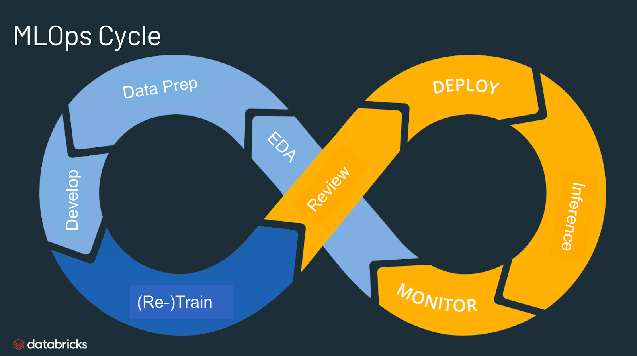
머신러닝 모델 상품화 과정
데이터를 활용해 어떠한 문제를 해결할지 정의한다.
- ex) 직원 Profile 데이터를 활용해 이 직원이 추후 퇴사할 지 여부를 판단한다.
- ex) 항공기가 얼마나 지연되어 도착할 지를 예측한다.
- ex) 은행 고객 데이터를 분석하여 마케팅을 진행할 지 여부를 분석한다.
- Categorical or Numerical
- Dependent or Independent
- 중복 data 제거
- 결측 Data 제거 및 대치
- 이상 데이터 처리
- 불필요 데이터 확인 (고유값확인)
Imbalance data set 확인 및 해결 필요

- 데이터 기반 접근 방법: sampling
- ML 알고리즘 기반 접근방법: cost-sensitive learning
column별 분포 확인

target column과의 분포 확인

target column과의 상관관계 확인 (카이제곱 검정)
# 카이제곱 검정 코드
list_meaningful_column_by_chi = []

for column_name in list_categorical_columns:
  statistic, pvalue, _, _ = chi2_contingency(pd.crosstab(df[target_column], df[column_name]))
  if pvalue <= 0.05:
    list_meaningful_column_by_chi.append(column_name)
  print(column_name, statistic, pvalue)

print("all categorical columns : ", len(list_categorical_columns))
print("selected columns by chi : ", len(list_meaningful_column_by_chi), list_meaningful_column_by_chi)

# selected columns by chi : 8 ['job', 'marital', 'education', 'default', 'contact', 'month', 'day_of_week', 'poutcome']column별 분포 확인

column간의 상관관계 확인 (Correlation Analysis, VIF Analysis)

target column과의 분포 확인

target column과의 유의미 관계 확인 (크루스칼 왈리스 검정)
list_column_normality = []
for column_name in list_numeric_columns:
  statistic, pvalue = stats.shapiro(df[column_name])
  if pvalue > 0.05:
    list_column_normality.append(column_name)
  print(column_name, ", statistic : ",statistic,", pvalue : ", pvalue)
print("정규성 만족하는 column 수 : ", len(list_column_normality))- 카이제곱 검정을 통과한 categorical 선택
- kruskall 검정 통과한 numerical 선택
- correlation에서 상관관계가 높다고 판단한 numericla data 제거
- Label Encoding
- feature scaling for numerical data
- One-hot Encoding for categorical column dat
- Sampling for imbalanced data (by SMOTEENN, ..)
- Base Model Learning
- Optimization 1 : ML with Feature Selection (No samping)
- Optimization 2 : ML with Feature selection and Combined Sampling
- Optimization 3 : ML with Feature Selection and No Combined Sampilng + Cost Sensitive Learning


- Accuracy(정확도) = (TP+TN)/(TP+FN+FP+TN))
- Precision(정밀도) = (TP)/(TP+FP)
- Recall(재현도) = (TP)/(TP+FN)
- F1 Score = Precision과 Recall의 조화평균 = (2 _ Precision _ Recall)/(Precision+Recall)
https://github.com/choikwangil95/MLOps/blob/main/lecture/2_ML_MLOps/3_ML_Infra.md
- Storage
- Computing Resource
- Container ex) Docker
- Orchestrator ex) k8s
- Workflow Management ex) MLFlow
- CI/CD
머신러닝 프로젝트를 관리하기 위한 오픈소스 플랫폼

구성요소
- MLFlow Tracking : 머신러닝 모델 학습 결과를 추적하고, 다양한 프레임워크에서 동작할 수 있는 학습 코드의 재현성을 보장하는 기능
- MLFlow Projects : 머신러닝 프로젝트의 코드, 환경 설정, 종속성 등을 관리
- MLFlow Models : 학습된 머신러닝 모델을 관리하고, 다양한 환경에서 모델을 배포할 수 있는 기능 제공
- MLFlow Registry : 모델 버전을 관리하고, 공동 작업을 위한 모델 저장소를 제공

- 1 NLP 모델 GCS 업로드 라이브러리
- 2 NLP 모델 GKE Helm 기반 배포
- 3 NLP 모델 실시간 API Serving