





FPRCal calibrates detector scores to a fixed false-positive-rate scale, so thresholds retain the same operational meaning after retraining.
Fit it on representative benign scores and it returns a standard scikit-learn pipeline. Each detector release gets its own calibration artifact, while downstream systems keep the same calibrated thresholds.
Paper · PyPI · Example · Contributing
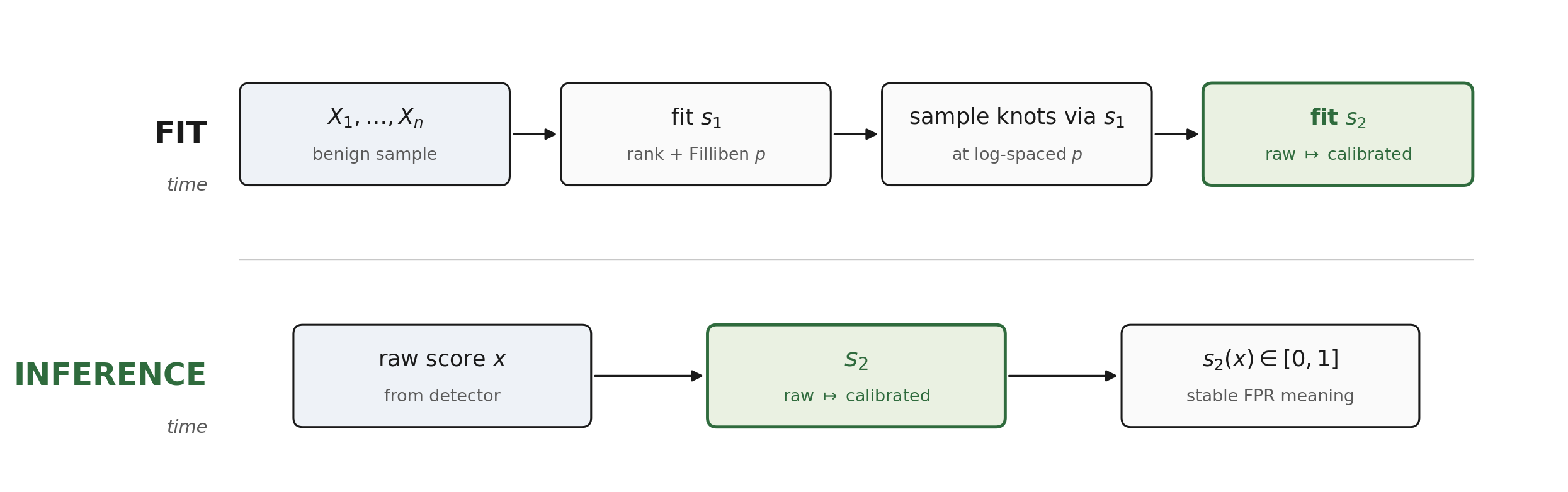
FPRCal maps a raw detector score to a calibrated threshold on a fixed log-FPR scale. The same calibrated threshold therefore carries the same target benign FPR for each independently calibrated model release.
| Calibrated threshold | Target benign FPR | Operational meaning |
|---|---|---|
0.10 |
10% | 1 in 10 benign samples flagged |
0.30 |
1% | 1 in 100 |
0.50 |
0.1% | 1 in 1,000 |
0.70 |
0.01% | 1 in 10,000 |
0.85 |
0.001% | 1 in 100,000 |
0.95 |
0.0001% | 1 in 1,000,000 |
The pipeline emits values no greater than 0.99, so a threshold of 1.0
flags nothing.
FPRCal supports Python 3.12 and 3.13.
python -m pip install fprcalPin a release when reproducibility matters:
python -m pip install "fprcal==0.1.0"With uv:
uv add fprcalfit_calibration_pipeline accepts a one-dimensional array of benign detector
scores in [0, 1], where higher values indicate stronger detection confidence.
The returned object is a fitted scikit-learn Pipeline.
import joblib
import numpy as np

from fprcal import fit_calibration_pipeline

# Replace this synthetic sample with scores from representative benign traffic.
rng = np.random.default_rng(7)
benign_scores = rng.beta(a=2.0, b=20.0, size=100_000)

calibrator = fit_calibration_pipeline(benign_scores)

raw_scores = np.array([0.05, 0.20, 0.80])
calibrated_scores = calibrator.predict(raw_scores.reshape(-1, 1))

joblib.dump(calibrator, "calibration.joblib")
restored = joblib.load("calibration.joblib")
assert np.allclose(
    calibrated_scores,
    restored.predict(raw_scores.reshape(-1, 1)),
)
Fit one calibration artifact for each detector release using that release's
benign scores. Ship the serialized pipeline with the detector and call
predict on an (n_samples, 1) array at inference time.
- FPRCal sorts the benign scores and assigns median-centered Filliben plotting positions to estimate the fresh-sample tail probability at each threshold.
- A temporary monotone spline maps target FPR values to raw-score thresholds on a fixed log-spaced grid.
- A second monotone spline maps raw scores to the fixed calibrated scale. Only this bounded, standard scikit-learn pipeline ships to production.
Set plotting_position="mean" to use mean-centered k/(n+1) positions instead
of the default Filliben positions. Set keep_debug=True only for diagnostics;
the retained fit-time arrays increase serialized artifact size with the number
of benign samples.
Benign sample count limits the FPR range that data can support. For target FPR
p and relative 95% half-width r, the normal-approximation planning rule is
n ≈ 4 / (r²p). Estimating 0.1% FPR with a 25% relative half-width therefore
requires about 64,000 representative benign samples. Values below the smallest
observed tail FPR are extrapolations, not additional statistical evidence.
The paper derives the planning rule and discusses finite-sample limits, plotting-position bias, and benign-distribution drift.
Fit a new calibration artifact for every detector release and whenever the benign score distribution changes. The fixed scale standardizes target FPR meaning across artifacts; it cannot correct a calibration set that no longer represents production traffic. Evaluate detector quality separately by comparing true-positive rate at the same target FPR.
On one held-out Credit Card Fraud Detection split, the paper reports relative FPR error no greater than 2.3% from 10% through 0.1% FPR and 7.2% at 0.01% FPR. Across calibration sets from 1,000 to 10 million benign samples, the serialized production artifact remained below 200 KB. See the full evaluation and the reproduction guide for the dataset split, confidence interval, detector choice, and commands.
Read Full-range Binary Classifier Calibration for Stable Model Updates in Production for the method, statistical analysis, evaluation, and limitations. The checked-in paper directory contains the source and generated figures.
git clone https://github.com/cisco-ai-defense/fpr-model-calibration.git
cd fpr-model-calibration
uv sync --all-extras --locked
uv run pytest --cov=fprcal --cov-report=term-missing
See CONTRIBUTING.md for the complete validation suite, SECURITY.md for private vulnerability reporting, and RELEASING.md for the maintainer release procedure.
FPRCal is available under the Apache License 2.0.