Deterministic, explainable scorecards for RAG answer confidence — using the retrieval, grounding, citation, freshness, and corpus signals your system already has.






Transparent Confidence™ is a scoring methodology that makes RAG answer quality auditable — every point on the 0–100 scale has an explicit reason attached to it.
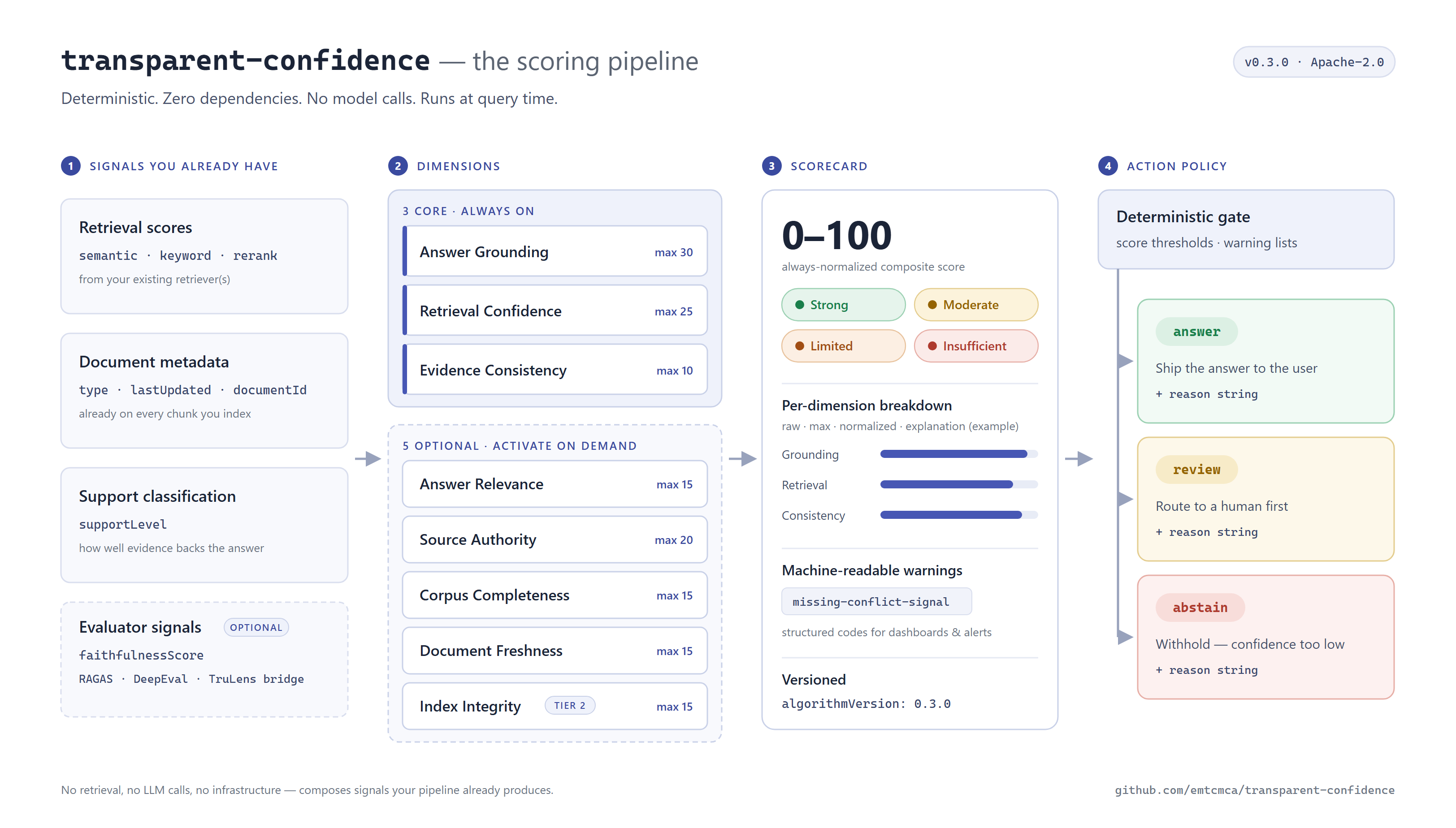
transparent-confidence v0.3 is a deterministic, auditable runtime confidence layer for RAG systems. It turns retrieval, grounding, evaluator, citation, corpus, freshness, authority, and index integrity signals into a versioned scorecard, action recommendation, and calibration-ready log record.
The score is not a probability of correctness unless you calibrate it against your own labeled outcomes. The package does not retrieve documents, call an LLM, or verify citations by itself.
▶ Try it in your browser — zero-install StackBlitz playground. Four scenarios (strong answer, conflicting evidence, weak retrieval, production gating) running the published npm package. Boots in seconds.
| Current release | v0.3.0 — published to npm, stable, production-ready |
| Algorithm / schema | algorithmVersion 0.3.0 · schemaVersion 0.3 |
| Tests | 412 passing across 19 files · coverage targets ≥ 90% line / ≥ 95% function / ≥ 85% branch |
| Dimensions | 3 core (always on) + 5 optional (Relevance, Authority, Corpus, Freshness, Index Integrity) |
| Runtime dependencies | 0 (hard architectural constraint) |
| Node | ≥ 20 · dual ESM + CJS output with TypeScript declarations |
| Next milestone | v1.0 — API stabilization; candidate scope in Roadmap |
v0.3.0 is the current published line and is stable. Work now targets a v1.0 release that locks the public API surface. The Roadmap lists candidate features under evaluation for v1.0; none are committed yet.
- Project Status
- The Problem
- The Solution
- vs. Alternatives
- Best for / Not for
- Install
- Quick Start
- From Your Retriever to Candidate[]
- Recommended Action
- Warnings and Missing Signals
- v0.3 Production Workflows
- Algorithm
- Retrieval Tuning
- Signal Policy
- Calibration Utilities
- Evaluator Signal Bridge
- Index Integrity
- Answer Relevance
- Dimension Weights
- Machine-readable Breakdowns
- Observability Logging
- API Reference
- Extensions
- Enhanced Signals
- Examples
- Upgrading from 0.2.x to 0.3.0
- Upgrading from 0.1.x to 0.2.0
- Roadmap
- Contributing
- License
You can't put a cosine score in a UI. You can't explain a 0.73 to a compliance team. You can't alert on retrieval drift when the only signal is a number with no context.
RAG pipelines ship answers. They don't ship confidence.
- Retrieval scores (cosine similarity, BM25) measure vector proximity — not whether the answer is correct, grounded, or complete
- LLM self-assessment (
"I'm confident that...") is uncalibrated and invisible to downstream systems - There is no standard for expressing RAG answer quality in a way that is auditable, explainable, and actionable at runtime
transparent-confidence computes a typed scorecard (0–100) for any RAG answer at query time — no additional model calls, no infrastructure:
- Always normalized — score is 0–100 regardless of which optional dimensions are active
- Per-dimension breakdowns — every point is explainable, not a black box
- Tiered display — Answer Confidence (Tier 1) and System Readiness (Tier 2) shown separately
- Recommended action —
answer,review, orabstainwith a reason string - Machine-readable warnings — structured warning codes for dashboards and alerting
- Zero required config — three core dimensions work out of the box; optional extensions activate on demand
- Zero dependencies — no ML stack, no server, no model calls; runs inline in any Node.js 20+ process
| transparent-confidence | RAGAs | TruLens | DeepEval | |
|---|---|---|---|---|
| Runs at query time | ✅ | |||
| Requires LLM calls | ✅ none | ❌ yes | ❌ yes | ❌ yes |
| Per-dimension breakdown | ✅ | ✅ | ✅ | ✅ |
| Zero dependencies | ✅ | ❌ | ❌ | ❌ |
| TypeScript-native types | ✅ | ❌ | ❌ | partial |
| Authority / corpus / freshness | ✅ | ❌ | ❌ | ❌ |
RAGAs, TruLens, and DeepEval are evaluation frameworks — they run offline or in a separate evaluation pipeline and call LLMs to judge answer quality. That's valuable for batch evaluation and benchmarking.
transparent-confidence runs inline at query time using signals your pipeline already has: retrieval scores, document metadata, and LLM-assessed confidence. No extra calls. No separate infrastructure. The tradeoff is that it doesn't do LLM-based faithfulness judgment natively — but it accepts an external faithfulnessScore if you run one.
Note: This package does not judge answer correctness. It composes signals your system already produces into an explainable, auditable confidence scorecard. Use it alongside — not instead of — offline evaluation tools.
Best for:
- RAG apps that need a live confidence indicator in a UI, API response, or log
- Systems where you want to gate on answer quality before responding to users (e.g. route to human review if score < 40)
- Domains with structured document hierarchies: legal, compliance, governance, HR policy, technical documentation
- Pipelines that mix multiple retrieval methods (semantic + keyword + rerank) and need a single interpretable signal
- Teams that need to explain AI answer confidence to non-technical stakeholders
Not for:
- Offline batch evaluation of a fine-tuned model's accuracy — use RAGAs or DeepEval
- LLM-as-judge faithfulness scoring — those tools call a model to assess the answer; this package does not
- Single-retrieval pipelines with no metadata — you'll get a score, but consider
minConfirmedMethods: 1(see Retrieval Tuning) - Replacing a proper eval suite — use this at runtime and eval tools offline; they complement each other
npm install transparent-confidenceRequires Node.js 20+.
import { computeConfidence } from 'transparent-confidence';

const scorecard = computeConfidence({
  supportLevel: 'high',
  hasConflict: false,   // explicit — prevents missing-conflict-signal warning
  citationCount: 3,
  candidates: [
    {
      retrievalScores: { semantic: 0.88, keyword: 0.72 },
      combinedScore: 0.88,
      documentId: 'doc-001',
    },
    {
      retrievalScores: { semantic: 0.85, keyword: 0.68 },
      combinedScore: 0.85,
      documentId: 'doc-002',
    },
    {
      retrievalScores: { semantic: 0.82, keyword: 0.65 },
      combinedScore: 0.82,
      documentId: 'doc-003',
    },
  ],
});

console.log(scorecard.total);             // 100
console.log(scorecard.label);             // 'Strong'
console.log(scorecard.recommendedAction); // 'answer'
console.log(scorecard.actionReason);      // 'Score 100 meets answerAt threshold (65).'
Output shape:
{
  "total": 100,
  "label": "Strong",
  "labelColor": "green",
  "recommendedAction": "answer",
  "actionReason": "Score 100 meets answerAt threshold (65).",
  "tier1": { "score": 100, "label": "Strong", "color": "green" },
  "tier2": null,
  "dimensions": {
    "grounding":   { "raw": 30, "max": 30, "normalized": 100, "explanation": "..." },
    "retrieval":   { "raw": 25, "max": 25, "normalized": 100, "explanation": "..." },
    "consistency": { "raw": 10, "max": 10, "normalized": 100, "explanation": "..." }
  },
  "meta": {
    "algorithmVersion": "0.3.0",
    "schemaVersion": "0.3",
    "rawTotal": 65,
    "maxPossible": 65,
    "activeExtensions": [],
    "activeDimensions": ["grounding", "retrieval", "consistency"],
    "warnings": [],
    "missingSignals": [],
    "weights": { "grounding": 30, "retrieval": 25, "consistency": 10 }
  }
}Candidate[] maps directly to what most retrievers already return. Here's how to translate common retriever output shapes:
LangChain / LlamaIndex document chunks:
import { computeConfidence, type Candidate } from 'transparent-confidence';

// retrievedDocs is what your retriever returns — adjust field names to match your stack
const candidates: Candidate[] = retrievedDocs.map((doc) => ({
  retrievalScores: {
    semantic: doc.metadata.score ?? doc.score,         // cosine or dot-product score
    keyword:  doc.metadata.bm25Score ?? 0,             // BM25 if your pipeline provides it
  },
  combinedScore:    doc.metadata.score ?? doc.score,   // final blended score used for ranking
  documentId:       doc.metadata.source ?? doc.id,     // used for source diversity scoring
  documentType:     doc.metadata.documentType,         // optional — used by Authority extension
  lastUpdated:      doc.metadata.lastUpdated            // optional — used by Freshness extension
                      ? new Date(doc.metadata.lastUpdated)
                      : undefined,
  extractionQuality: doc.metadata.extractionQuality,   // optional — PDF/OCR quality 0–1
}));

const scorecard = computeConfidence({
  supportLevel: 'high',   // how strongly the retrieved sources support the answer
  hasConflict: false,
  candidates,
});
pgvector / Supabase:
// rows from: SELECT *, 1 - (embedding <=> $query_embedding) AS score FROM documents
const candidates: Candidate[] = rows.map((row) => ({
  retrievalScores: { semantic: row.score },
  combinedScore:   row.score,
  documentId:      row.id,
  documentType:    row.document_type,
  lastUpdated:     row.updated_at ? new Date(row.updated_at) : undefined,
}));
The minimum required per candidate is retrievalScores (any key name, any number of methods) and combinedScore. Everything else is optional and activates additional scoring sub-signals.
Every scorecard includes recommendedAction ('answer' | 'review' | 'abstain') and actionReason (a human-readable string explaining the first rule that decided the action).
The 8-rule cascade runs in order and returns on the first match:
| Rule | Trigger | Action |
|---|---|---|
| 1 | documentsSilent === true |
abstain |
| 2 | Any warning code is in abstainOnWarnings |
abstain |
| 3 | total < abstainBelow (default 40) |
abstain |
| 4 | tier1.score < requireTier1AtLeast (default 40) |
review |
| 5 | Any warning code is in reviewOnWarnings |
review |
| 6 | total >= answerAt (default 65) |
answer |
| 7 | total >= reviewAt (default 40) |
review |
| 8 | Fallback | abstain |
Default warning lists:
reviewOnWarnings:['missing-answer-relevance', 'missing-conflict-signal']abstainOnWarnings:['documents-silent']
Important: Most simple RAG calls omit
hasConflict— this generates amissing-conflict-signalwarning, which fires rule 5 and returnsrevieweven if the score is high. PasshasConflict: false(orconflictingCandidateCount: 0) explicitly to clear this warning.
computeConfidence(inputs, {
  actionPolicy: {
    answerAt: 70,                      // raise the answer threshold
    reviewAt: 45,
    abstainBelow: 35,
    requireTier1AtLeast: 50,           // stricter tier 1 floor
    reviewOnWarnings: [],              // disable warning-based review
    abstainOnWarnings: ['documents-silent'],
  },
});const scorecard = computeConfidence(inputs, config);
if (scorecard.recommendedAction === 'abstain') {
return { answer: null, reason: scorecard.actionReason };
}
if (scorecard.recommendedAction === 'review') {
return { answer, reviewRequired: true, confidence: scorecard.total };
}
return { answer, confidence: scorecard.total };scorecard.meta.warnings is an array of structured warnings produced during scoring. Each warning has:
| Field | Type | Description |
|---|---|---|
code |
ConfidenceWarningCode |
Machine-readable identifier |
severity |
'info' | 'warn' | 'error' |
Severity level |
message |
string |
Human-readable description |
path |
string? |
Input path that triggered the warning |
scorecard.meta.missingSignals lists concise identifiers for signals that would improve scoring accuracy if provided.
| Code | Severity | Triggered when |
|---|---|---|
missing-conflict-signal |
warn | Neither hasConflict nor conflictingCandidateCount provided |
missing-faithfulness |
warn | No faithfulnessScore or claimSupport provided |
missing-answer-relevance |
warn | config.relevance.required = true but answerRelevanceScore absent |
missing-freshness-dates |
warn | Freshness extension active but no candidates have lastUpdated |
missing-corpus-count |
warn | Corpus extension active but corpusTypeCount not provided |
authority-unclassified |
warn | Some candidates couldn't be classified against any authority tier |
documents-silent |
warn | documentsSilent = true — corpus has no content for this question |
ambiguous-top-results |
warn | Gap between top-1 and top-2 retrieval scores is smaller than the configured threshold |
single-retrieval-method |
warn | All candidates have only one retrieval method and minConfirmedMethods > 1 |
required-signal-missing |
warn | A signal listed in signalPolicy.require was not provided |
citation-quality-floor |
warn | citationCoverageScore is below signalPolicy.minCitationCoverageScore, or invalidCitationCount exceeds maxInvalidCitationCount |
invalid-citations |
warn | invalidCitationCount is 1 (−2 grounding penalty) or ≥ 2 (−5 penalty) |
low-citation-coverage |
warn | citationCoverageScore is below 0.50 |
duplicate-content |
info/warn | Candidates with duplicate contentHash values detected; severity is warn when mode: 'penalize' is active |
rank-signal-missing |
info | Candidates missing rank while rankPenalty.mode = 'penalize' is active |
low-calibration-sample-size |
warn | A calibration band has fewer samples than config.minSamplesPerBand |
index-integrity-incomplete |
warn | An Index Integrity sub-signal was not provided (scores that sub-signal at 0) |
embedding-version-mismatch |
warn | actualEmbeddingModelVersion does not match expectedEmbeddingModelVersion |
acl-filter-unconfirmed |
warn | aclFilterConfirmed was not provided or false, and requireAclFilterConfirmation is true |
deleted-source-leakage |
error | deletedSourceLeakageCount > 0 — deleted source content appears in retrieval results |
// Default: input issues produce warnings, config errors throw
computeConfidence(inputs, config);

// Strict: input issues also throw
computeConfidence(inputs, { ...config, validation: 'strict' });
v0.3 adds production hardening around the deterministic scorer without adding runtime dependencies or model calls.
const scorecard = computeConfidence(inputs, {
  preset: 'production-v0.3',
});
production-v0.3 requires:
answerRelevanceScorehasConflictorconflictingCandidateCountfaithfulnessScoreorclaimSupport
When these are missing, the scorecard includes required-signal-missing warnings and the action is forced to review.
Use preset: 'legacy-v0.2' when migrating code that expects the closest v0.2 action behavior.
If you pass signalPolicy with preset: 'production-v0.3', caller policy is merged with the production preset. Custom policy adds requirements or gates; it does not silently remove the production evaluator/relevance/conflict requirements.
computeConfidence(inputs, {
  signalPolicy: {
    require: ['answerRelevanceScore', 'conflictSignal', 'citationCoverageScore'],
    reviewWhenMissing: ['answerRelevanceScore', 'conflictSignal'],
    abstainWhenMissing: ['citationCoverageScore'],
    minCitationCoverageScore: 0.75,
    maxInvalidCitationCount: 0,
  },
});
Signal policy lets you make missing evaluator, citation, conflict, corpus, authority, rank, content-hash, or index-health signals machine-readable and actionable.
import { analyzeCalibration } from 'transparent-confidence';

const report = analyzeCalibration(samples, {
  minSamplesPerBand: 30,
  targetPrecisionForAnswer: 0.9,
  targetRecallForAbstain: 0.8,
});
Calibration returns score bands, empirical positive rates, action summaries, recommended thresholds, and low-sample warnings. targetPrecisionForAnswer tunes answerAt; targetRecallForAbstain tunes abstainBelow and reviewAt. It does not change the scoring algorithm.
import { fromRagasLike, mergeEvaluationSignals } from 'transparent-confidence';

const signals = fromRagasLike(ragasResult);
const { inputs: enrichedInputs } = mergeEvaluationSignals(inputs, signals);
const scorecard = computeConfidence(enrichedInputs);
The bridge accepts plain objects from RAGAS-like, DeepEval-like, TruLens-like, or custom judge outputs. It imports no evaluator SDKs.
contentHash and rank are diagnostic-only by default. To make them affect the retrieval raw score:
computeConfidence(inputs, {
  retrieval: {
    duplicateContent: { mode: 'penalize' },
    rankPenalty: { mode: 'penalize' },
  },
});const scorecard = computeConfidence(
{
...inputs,
indexIntegrity: {
expectedEmbeddingModelVersion: 'text-embedding-3-large@2026-01',
actualEmbeddingModelVersion: 'text-embedding-3-large@2026-01',
sourceVersionMatchRatio: 0.998,
staleIndexedDocumentRatio: 0.004,
failedIngestionCount: 0,
aclFilterConfirmed: true,
deletedSourceLeakageCount: 0,
},
},
{ indexIntegrity: {} },
);Index integrity is an opt-in Tier 2 dimension. It is inactive unless config.indexIntegrity is present.
The score is built from three core dimensions (always active) and optional dimensions/extensions. Raw points from all active dimensions are summed and normalized to 0–100.
normalizedScore = round((rawTotal / maxPossible) × 100)
maxPossible = 65 (core: grounding + retrieval + consistency)
+ 15 (Relevance active)
+ 20 (Authority active)
+ 15 (Corpus active)
+ 15 (Freshness active)
+ 15 (Index Integrity active)
Applied to the final normalized score:
| Label | Range | Color |
|---|---|---|
| Strong | ≥ 85 | green |
| Moderate | ≥ 65 | amber |
| Limited | ≥ 40 | orange |
| Insufficient | < 40 | red |
Tier 1 — Answer Confidence: Grounding + Retrieval + Consistency + Relevance (when active) + Authority (when active). Normalized independently to 0–100. Labels match composite scale.
Tier 2 — System Readiness: Corpus + Freshness + Index Integrity (when active). Normalized independently to 0–100. Uses separate labels: Complete / Good / Partial / Thin. Hidden (null) when none of these extensions are configured.
Scores how well the LLM answer is grounded in source documents.
Required inputs: supportLevel
Optional inputs: ambiguityNotes, documentsSilent, requiresExpertReview, externalConstraintNote, hasConflict, queryComplexity, faithfulnessScore, claimSupport, citationCount, citationCoverageScore, invalidCitationCount
| Condition | Base |
|---|---|
documentsSilent = true |
0 — all further logic skipped |
supportLevel = 'low' |
5 |
supportLevel = 'medium' |
13 |
supportLevel = 'high' + ambiguity present |
21 |
supportLevel = 'high' + no ambiguity |
30 |
| Condition | Penalty |
|---|---|
requiresExpertReview = true |
−3 |
externalConstraintNote present |
−2 |
hasConflict = true |
−5 |
| Value | Ceiling |
|---|---|
'direct' or not provided |
30 (no ceiling) |
'inferential' |
24 |
'multi-hop' |
18 |
'comparative' |
16 |
An external faithfulness score or claim support summary that measures whether the LLM answer text is supported by the retrieved passages.
| Effective Support Score | Modifier |
|---|---|
| ≥ 0.90 | +0 |
| 0.70–0.89 | −3 |
| 0.50–0.69 | −7 |
| < 0.50 | −12 |
| Both present | Uses the more conservative (lower) value |
| Not provided | Not applied; warning missing-faithfulness |
If claimSupport.contradictedClaims >= 1, an additional −5 contradiction penalty applies.
| Signal | Effect |
|---|---|
invalidCitationCount = 1 |
−2, no citation bonus |
invalidCitationCount >= 2 |
−5, no citation bonus |
citationCoverageScore < 0.50 |
−3 |
citationCoverageScore 0.50–0.79 |
−1 |
| Value | Bonus |
|---|---|
| ≥ 3 | +2 |
| 2 | +1 |
| 0–1 or not provided | +0 |
The citation count bonus is not applied when invalidCitationCount > 0.
Scores the quality, breadth, and agreement of the retrieved candidates. Three sub-signals summed, total capped at 25.
Required inputs: candidates[].retrievalScores, candidates[].combinedScore
Optional inputs: candidates[].documentId, candidates[].extractionQuality, config.retrieval
A candidate is "confirmed" when the number of retrieval methods that scored above the configured threshold is ≥ minConfirmedMethods (default 2).
| Confirmed candidates | Points |
|---|---|
| ≥ 3 | 15 |
| 2 | 12 |
| 1 | 8 |
| 0 | 3 |
Single-vector pipelines: set minConfirmedMethods: 1 so all candidates count as confirmed. See Retrieval Tuning.
Average combinedScore of top topK (default 3) candidates. If extractionQuality is provided: effectiveScore = combinedScore × extractionQuality.
| Avg effective score | Points |
|---|---|
| ≥ 0.80 | 8 |
| ≥ 0.65 | 6 |
| ≥ 0.50 | 4 |
| ≥ 0.35 | 2 |
| < 0.35 | 0 |
Source diversity counts unique documentId values. In v0.3, contentHash is diagnostic-only by default; duplicate content hashes reduce retrieval raw score only when retrieval.duplicateContent.mode = 'penalize'.
Unique documentId values |
Points |
|---|---|
| ≥ 3 distinct documents | +3 |
| 2 distinct documents | +1 |
| 1 or not provided | +0 |
| Total candidate count | Points |
|---|---|
| ≥ 5 | +2 |
| 3–4 | +1 |
| ≤ 2 | +0 |
Scores retrieval score stability plus explicit evidence conflict status. A missing conflict signal is treated as a conservative neutral, not as implicit agreement.
Required inputs: candidates[].combinedScore
Optional inputs: conflictingCandidateCount, hasConflict
conflictingCandidateCount takes precedence over boolean hasConflict when both are provided.
Population standard deviation of combinedScore across all candidates:
| Condition | Points |
|---|---|
| No candidates | 0 |
| Only 1 candidate | 3 (neutral — variance unmeasurable) |
| std dev < 0.10 | 6 |
| std dev < 0.20 | 5 |
| std dev < 0.30 | 3 |
| std dev ≥ 0.30 | 1 |
| Condition | Points |
|---|---|
conflictingCandidateCount = 0 |
4 |
hasConflict = false (no count given) |
4 |
| No conflict signal provided | 2 + warning missing-conflict-signal |
conflictingCandidateCount = 1 |
1 |
conflictingCandidateCount ≥ 2 |
0 |
hasConflict = true (no count given) |
0 |
Tight retrieval scores are not treated as proof of semantic agreement. An explicit
hasConflict: falseorconflictingCandidateCount: 0earns the full conflict-signal points. Omitting both generates a warning and a conservative neutral score.
The retrieval dimension is fully configurable via config.retrieval.
Default score bands (full: 0.80, high: 0.65, medium: 0.50, low: 0.35) assume combinedScore is normalized to [0, 1]. If your scores are not in that range, tune the bands:
computeConfidence(inputs, {
retrieval: {
scoreBands: {
full: 0.95, // your system's "great" threshold
high: 0.80,
medium: 0.60,
low: 0.40,
},
},
});Warning: BM25, ColBERT, reranker, and cross-encoder scores are not comparable to cosine similarity without normalization. If you pass unnormalized scores as
combinedScore, configurescoreBandsto match your distribution before deploying.
For pipelines that use one retrieval method only:
computeConfidence(inputs, {
retrieval: {
minConfirmedMethods: 1, // 1 method is enough for confirmation
},
});Without this, all candidates fail the default "2+ methods" check and method agreement scores at its lowest band (3 pts).
computeConfidence(inputs, {
retrieval: {
methodThresholds: {
semantic: 0.70, // semantic score must exceed 0.70 to confirm
keyword: 0.40, // keyword score must exceed 0.40 to confirm
rerank: 0.80,
},
},
});computeConfidence(inputs, {
retrieval: {
topK: 5, // average magnitude over top 5 instead of top 3
},
});The Answer Relevance dimension (max 15 pts) scores whether the answer addresses the user's question. This is distinct from grounding — a grounded answer can still be off-topic.
Relevance is active when:
inputs.answerRelevanceScoreis provided (any value), orconfig.relevance.required === true(scores 0 + warning if score is missing)
const scorecard = computeConfidence(
{ ...inputs, answerRelevanceScore: 0.92 },
{},
);
// Relevance now in Tier 1 and meta.activeDimensions| Score | Points |
|---|---|
| ≥ 0.90 | 15 |
| ≥ 0.75 | 12 |
| ≥ 0.60 | 8 |
| ≥ 0.40 | 4 |
| < 0.40 | 0 |
| Missing (required) | 0 + warning missing-answer-relevance |
Custom bands:
computeConfidence(inputs, {
relevance: {
required: true,
scoreBands: { full: 0.95, high: 0.80, medium: 0.65, low: 0.50 },
},
});You can override the max-point weight for any dimension. The default weight for each dimension equals its native max points, so default behavior is unchanged. Activating a custom weight changes how much of the 0–100 total that dimension can contribute.
computeConfidence(inputs, {
weights: {
grounding: 50, // double grounding's influence
retrieval: 20,
consistency: 10,
relevance: 15, // only included if relevance is active
authority: 15,
corpus: 10,
freshness: 10,
},
});| Dimension | Default weight |
|---|---|
| grounding | 30 |
| retrieval | 25 |
| consistency | 10 |
| relevance | 15 |
| authority | 20 |
| corpus | 15 |
| freshness | 15 |
| indexIntegrity | 15 |
For each active dimension:
weightedRaw = (dimension.raw / dimension.max) × activeWeight
When activeWeight === dimension.max (the default), weightedRaw = dimension.raw — so default behavior is identical to the v0.1 formula. Proof: (raw / max) × max = raw.
Changing a weight does not change dimension.raw — it changes how much that dimension contributes to the total. meta.weights always shows the active weights used.
Every dimension returns a breakdown object for dashboards, diffing, and audit trails.
interface DimensionBreakdown {
components: Record<string, number>; // positive sub-signal contributions
adjustments: Record<string, number>; // penalties, bonuses, caps, rounding
diagnostics?: Record<string, number | string | boolean>; // facts, not points
uncappedRaw: number; // score before final clamp
raw: number; // final raw score (equals DimensionScore.raw)
}Invariant: breakdown.raw === DimensionScore.raw for every active dimension, always. This is enforced by tests.
Example — grounding breakdown for a multi-hop query:
{
"components": { "supportBase": 30 },
"adjustments": { "complexityCeiling": -12, "citationBonus": 2 },
"uncappedRaw": 20,
"raw": 20
}Example — retrieval breakdown:
{
"components": {
"agreement": 15,
"magnitude": 8,
"diversity": 3,
"breadth": 1
},
"adjustments": {},
"diagnostics": {
"topScoreGap": 0.03,
"scoreStdDev": 0.024,
"singleMethodCandidateCount": 0,
"duplicateContentHashCount": 0
},
"uncappedRaw": 27,
"raw": 25
}Log the full scorecard as structured JSON for observability pipelines (OpenTelemetry, Datadog, Splunk, etc.):
const scorecard = computeConfidence(inputs, config);
// Structured log entry — include alongside the answer in your LLM response log
const confidenceLog = {
timestamp: new Date().toISOString(),
algorithmVersion: scorecard.meta.algorithmVersion,
total: scorecard.total,
label: scorecard.label,
recommendedAction: scorecard.recommendedAction,
actionReason: scorecard.actionReason,
tier1Score: scorecard.tier1?.score,
tier2Score: scorecard.tier2?.score,
rawTotal: scorecard.meta.rawTotal,
maxPossible: scorecard.meta.maxPossible,
activeExtensions: scorecard.meta.activeExtensions,
warningCodes: scorecard.meta.warnings.map((w) => w.code),
missingSignals: scorecard.meta.missingSignals,
dimensions: Object.fromEntries(
scorecard.meta.activeDimensions.map((name) => [
name,
{
raw: scorecard.dimensions[name]?.raw,
max: scorecard.dimensions[name]?.max,
normalized: scorecard.dimensions[name]?.normalized,
},
]),
),
};
logger.info('rag_confidence', confidenceLog);This gives you per-dimension drift tracking, warning-code alerting, and action distribution monitoring without any additional infrastructure.
function computeConfidence(inputs: ScoringInputs, config?: ScoringConfig): ConfidenceScorecard;Scores a single RAG answer. config is optional — omitting it runs the three core dimensions only.
function createScorer(config: ScoringConfig): {
compute: (inputs: ScoringInputs) => ConfidenceScorecard;
};Returns a scorer pre-bound to a config. Use when scoring many answers against the same corpus/authority setup.
const scorer = createScorer({ corpus: { expectedTypeCount: 10 } });
const s1 = scorer.compute(inputs1);
const s2 = scorer.compute(inputs2);function analyzeCalibration(
samples: CalibrationSample[],
config?: CalibrationConfig,
): CalibrationReport;Offline utility. Takes historical { total, outcome, recommendedAction? } records and returns score bands with empirical positive rates, an action summary, and a recommended ActionPolicy. Does not modify the scorer or change any thresholds at runtime.
import { analyzeCalibration } from 'transparent-confidence';
const report = analyzeCalibration(historicalSamples, {
minSamplesPerBand: 30,
targetPrecisionForAnswer: 0.9, // tunes answerAt
targetRecallForAbstain: 0.8, // tunes abstainBelow
});
console.log(report.recommendedPolicy);
// { answerAt: 75, reviewAt: 45, abstainBelow: 45 }CalibrationSample.outcome accepts 'correct' | 'incorrect' | 'accepted' | 'rejected' | 'escalated'. Configure which outcomes are "positive" via config.positiveOutcomes (default: ['correct', 'accepted']).
function mergeEvaluationSignals(
inputs: ScoringInputs,
signals: ExternalEvaluationSignals,
): EvaluationSignalMergeResult;Merges external evaluator signals into ScoringInputs. Existing fields on inputs are never overwritten — signals fill gaps only. Returns { inputs: ScoringInputs, warnings: ConfidenceWarning[] }.
fromRagasLike(result) / fromDeepEvalLike(result) / fromTruLensLike(result) / fromCustomJudge(result)
function fromRagasLike(result: Record<string, unknown>): ExternalEvaluationSignals;
function fromDeepEvalLike(result: Record<string, unknown>): ExternalEvaluationSignals;
function fromTruLensLike(result: Record<string, unknown>): ExternalEvaluationSignals;
function fromCustomJudge(result: Record<string, unknown>): ExternalEvaluationSignals;Defensive adapters that extract ExternalEvaluationSignals from the plain-object output of common eval frameworks. Accept Record<string, unknown> — safe against unexpected shapes. Import no evaluator SDKs.
| Function | Maps from | Fields extracted |
|---|---|---|
fromRagasLike |
RAGAs result dict | faithfulness, answer_relevancy / answerRelevance |
fromDeepEvalLike |
DeepEval metric result | faithfulnessScore, answerRelevancyScore, generic score when metric === 'faithfulness' |
fromTruLensLike |
TruLens feedback result | groundedness → faithfulnessScore, answer_relevance |
fromCustomJudge |
Any custom judge output | All ExternalEvaluationSignals fields by exact key name |
import { fromRagasLike, mergeEvaluationSignals, computeConfidence } from 'transparent-confidence';
const signals = fromRagasLike(ragasResult);
const { inputs: enrichedInputs } = mergeEvaluationSignals(inputs, signals);
const scorecard = computeConfidence(enrichedInputs, config);| Field | Type | Required | Description |
|---|---|---|---|
supportLevel |
'high' | 'medium' | 'low' |
✅ | How strongly the retrieved sources support the answer |
candidates |
Candidate[] |
✅ | Retrieved chunks used to produce the answer |
ambiguityNotes |
string | null |
— | Non-null value signals the LLM found ambiguity in the source |
requiresExpertReview |
boolean |
— | LLM recommends human expert review |
externalConstraintNote |
string | null |
— | Non-null signals an external constraint limits the answer |
documentsSilent |
boolean |
— | True when source documents do not address the question at all |
hasConflict |
boolean |
— | Documents contain conflicting information |
conflictingCandidateCount |
number |
— | Number of conflicting candidates (overrides hasConflict) |
queryComplexity |
'direct' | 'inferential' | 'multi-hop' | 'comparative' |
— | Complexity ceiling applied to grounding |
faithfulnessScore |
number |
— | 0–1 external faithfulness score; applies modifier to grounding |
claimSupport |
ClaimSupport |
— | Claim-level support summary (alternative to faithfulnessScore) |
citationCount |
number |
— | Distinct source sections explicitly cited in the answer |
citationCoverageScore |
number |
— | 0–1 fraction of answer covered by valid citations |
invalidCitationCount |
number |
— | Citations that do not support the cited answer text |
answerRelevanceScore |
number |
— | 0–1 relevance score; activates the Answer Relevance dimension |
corpusTypeCount |
number |
— | Current document type count in the corpus (required when Corpus extension active) |
presentTypes |
string[] |
— | Named document types present (alternative to corpusTypeCount for named-type mode) |
missingRelevantType |
boolean |
— | True when a known relevant document type is not in the corpus |
missingTypes |
string[] |
— | Named document types known to be missing for this query |
| indexIntegrity | IndexIntegrityInputs | optional | Optional index operational health signals; used only when config.indexIntegrity is active |
| Field | Type | Required | Description |
|---|---|---|---|
retrievalScores |
Record<string, number> |
✅ | Named scores per retrieval method, e.g. { semantic: 0.8, keyword: 0.6 } |
combinedScore |
number |
✅ | Final blended score 0–1 used for ranking |
documentId |
string |
— | Source document identifier; used for diversity scoring |
documentType |
string |
— | Document type label; matched against Authority tier keywords |
authorityRank |
number |
— | Explicit authority rank (lower = higher authority); overrides keyword matching |
isAmendment |
boolean |
— | True if this candidate comes from an amendment to the base document |
extractionQuality |
number |
— | 0–1 OCR or extraction quality multiplier applied to combinedScore |
lastUpdated |
Date |
— | Document last-updated date; used by Freshness extension |
contentHash |
string |
— | Stable content hash for duplicate detection; diagnostic by default, penalized only when configured |
rank |
number |
— | 1-based final retrieval/rerank position from your pipeline |
contentHash is diagnostic-only by default in v0.3. Configure retrieval.duplicateContent.mode = 'penalize' when duplicate chunks should reduce retrieval raw score.
All fields optional. Passing a key activates that extension.
| Field | Type | Default | Description |
|---|---|---|---|
retrieval |
RetrievalConfig |
— | Retrieval scoring overrides |
preset |
'legacy-v0.2' | 'balanced-v0.3' | 'production-v0.3' |
'balanced-v0.3' |
Compatibility or production-hardening preset |
signalPolicy |
SignalPolicy |
preset-derived | Required-signal and citation-quality gating policy |
retrieval.scoreBands |
Partial<{ full, high, medium, low }> |
0.80/0.65/0.50/0.35 |
Score magnitude bands |
retrieval.minConfirmedMethods |
number |
2 |
Methods needed to confirm a candidate |
retrieval.defaultMethodThreshold |
number |
0 |
Score threshold for method confirmation |
retrieval.methodThresholds |
Record<string, number> |
{} |
Per-method score thresholds |
retrieval.topK |
number |
3 |
Candidates used for magnitude scoring |
relevance |
RelevanceConfig |
— | Activates Answer Relevance dimension |
retrieval.duplicateContent |
DuplicateContentConfig |
diagnostic | Duplicate content-hash diagnostics or opt-in penalty |
retrieval.rankPenalty |
RankPenaltyConfig |
diagnostic | Candidate rank diagnostics or opt-in late-rank penalty |
relevance.required |
boolean |
false |
If true, missing score generates a warning and scores 0 |
relevance.scoreBands |
Partial<{ full, high, medium, low }> |
0.90/0.75/0.60/0.40 |
Relevance score bands |
authority |
AuthorityConfig |
— | Activates Source Authority extension |
authority.tiers |
AuthorityTier[] |
Primary/Secondary/Supporting | Custom document hierarchy |
authority.aggregation |
'weighted' | 'best' |
'weighted' |
'best' reproduces v0.1 min-rank behavior |
authority.topK |
number |
5 |
Candidates included in authority scoring |
corpus |
CorpusConfig |
— | Activates Corpus Completeness extension |
corpus.expectedTypeCount |
number |
(required) | Document types expected in a complete corpus |
corpus.expectedTypes |
string[] |
— | Named expected types (infers expectedTypeCount) |
freshness |
FreshnessConfig |
— | Activates Document Freshness extension |
freshness.maxAgeForFullScore |
number (days) |
90 |
Documents within this age receive full freshness points |
freshness.penaltyPerMonth |
number |
1.5 |
Points deducted per 30-day increment beyond window |
freshness.hardCutoffAge |
number (days) |
730 |
Documents at or beyond this age score 0 |
freshness.now |
Date |
new Date() |
Reference date for deterministic replay and tests |
freshness.aggregation |
'median' | 'oldest' | 'newest' |
'median' |
Which document age to score |
weights |
Partial<Record<DimensionName, number>> |
— | Custom max-point weights per dimension |
actionPolicy |
ActionPolicy |
— | Custom thresholds and warning lists |
indexIntegrity |
IndexIntegrityConfig |
optional | Activates Index Integrity Tier 2 extension |
validation |
'warn' | 'strict' |
'warn' |
Strict mode throws on input issues |
| Field | Type | Description |
|---|---|---|
total |
number |
Normalized score 0–100 (integer) |
label |
'Strong' | 'Moderate' | 'Limited' | 'Insufficient' |
Human-readable label |
labelColor |
'green' | 'amber' | 'orange' | 'red' |
Display color for UI badge |
recommendedAction |
'answer' | 'review' | 'abstain' |
Runtime action recommendation |
actionReason |
string |
First rule that decided the action |
tier1 |
Tier1Result | null |
Answer Confidence tier (Grounding + Retrieval + Consistency + Relevance + Authority) |
tier2 |
Tier2Result | null |
System Readiness tier (Corpus + Freshness + Index Integrity); null when none are active |
dimensions.grounding |
DimensionScore |
Always present |
dimensions.retrieval |
DimensionScore |
Always present |
dimensions.consistency |
DimensionScore |
Always present |
dimensions.relevance |
DimensionScore | undefined |
Present only when Answer Relevance active |
dimensions.authority |
DimensionScore | undefined |
Present only when Authority extension active |
dimensions.corpus |
DimensionScore | undefined |
Present only when Corpus extension active |
dimensions.freshness |
DimensionScore | undefined |
Present only when Freshness extension active |
dimensions.indexIntegrity |
DimensionScore | undefined |
Present only when Index Integrity extension active |
meta.algorithmVersion |
string |
Algorithm version, e.g. '0.3.0' |
meta.schemaVersion |
string |
Output schema version, e.g. '0.3' |
meta.rawTotal |
number |
Sum of weighted raw points before normalization |
meta.maxPossible |
number |
Maximum achievable weighted points given active dimensions |
meta.activeExtensions |
string[] |
Optional extensions active for this call |
meta.activeDimensions |
DimensionName[] |
All active dimensions including core |
meta.warnings |
ConfidenceWarning[] |
Warnings produced during scoring |
meta.missingSignals |
string[] |
Signals that would improve scoring accuracy if provided |
meta.weights |
Partial<Record<DimensionName, number>> |
Active weights used for this scorecard |
| Field | Type | Description |
|---|---|---|
raw |
number |
Raw points scored for this dimension |
max |
number |
Maximum raw points for this dimension |
normalized |
number |
raw / max × 100, rounded (0–100) |
explanation |
string |
Human-readable summary of what drove the score |
breakdown |
DimensionBreakdown |
Machine-readable sub-signal attribution |
warnings |
ConfidenceWarning[]? |
Dimension-level warnings (also in meta.warnings) |
Scores how authoritative the retrieved sources are. Useful for legal, compliance, governance, and policy domains where document hierarchy matters.
import { computeConfidence } from 'transparent-confidence';
const scorecard = computeConfidence(inputs, {
authority: {
tiers: [
{ name: 'CC&Rs', rank: 10, keywords: ['CC&Rs', 'Declaration', 'Master Deed'] },
{ name: 'Bylaws', rank: 15, keywords: ['Bylaws'] },
{ name: 'Rules', rank: 20, keywords: ['Rules', 'Regulations', 'Policy'] },
{ name: 'Board Notes', rank: 30, keywords: ['Minutes', 'Resolution'] },
],
},
});Each candidate is classified by matching documentType against tier keywords (case-insensitive). authorityRank on the candidate overrides keyword matching if provided.
Default weighted aggregation: Authority is scored as a weighted average across the top-K candidates, where each candidate's weight is proportional to its combinedScore. This rewards answers supported by many strong-scoring authoritative sources, not just the single highest-authority hit.
v0.1 compat — best source wins: aggregation: 'best' reproduces the original min-rank behavior.
authority: { aggregation: 'best' }Scoring table:
| Effective Rank | Candidate Points |
|---|---|
| ≤ 10 | 18 |
| ≤ 20 | 13 |
| ≤ 30 | 7 |
| > 30 or unclassified | 2 |
Bonuses: +1 if any included candidate has isAmendment: true, +1 if more than one rank bucket is represented. Max 20.
Scores how complete the document corpus is relative to what's expected. Surfaces the risk that a correct answer exists but the documents needed to find it haven't been uploaded.
// Count-based
const scorecard = computeConfidence(inputs, {
corpus: { expectedTypeCount: 6 },
});
// Named-type mode — also tracks which types are missing
const scorecard2 = computeConfidence(
{ ...inputs, presentTypes: ['CC&Rs', 'Bylaws', 'Rules'] },
{ corpus: { expectedTypes: ['CC&Rs', 'Bylaws', 'Rules', 'Amendments', 'Budget'] } },
);Scoring: 15 pts at 100% coverage, scales down by ratio. −3 penalty for missingRelevantType. Floor 0.
Scores how recent the retrieved documents are.
const scorecard = computeConfidence(inputs, {
freshness: {
maxAgeForFullScore: 60, // days — full score if selected age ≤ 60
penaltyPerMonth: 2, // pts lost per 30-day increment beyond window
hardCutoffAge: 365, // days — score = 0 beyond this
now: referenceDate, // inject for deterministic tests and replays
aggregation: 'median', // 'median' (default) | 'oldest' | 'newest'
},
});'median'— score the median age across candidates (v0.1 behavior)'oldest'— score the oldest candidate's age (conservative; useful for compliance)'newest'— score the newest candidate's age (useful when any current source is sufficient)
All three config fields are optional; defaults are maxAgeForFullScore: 90, penaltyPerMonth: 1.5, hardCutoffAge: 730. Provide lastUpdated: Date on each candidate.
Scores index operational readiness signals that corpus completeness and document freshness do not cover.
const scorecard = computeConfidence(
  {
    ...inputs,
    indexIntegrity: {
      expectedEmbeddingModelVersion: 'text-embedding-3-large@2026-01',
      actualEmbeddingModelVersion: 'text-embedding-3-large@2026-01',
      sourceVersionMatchRatio: 0.998,
      staleIndexedDocumentRatio: 0.004,
      failedIngestionCount: 0,
      aclFilterConfirmed: true,
      deletedSourceLeakageCount: 0,
    },
  },
  { indexIntegrity: {} },
);
Index Integrity is opt-in. It contributes 15 max points to Tier 2 only when config.indexIntegrity is present.
These inputs add nuance to the core dimension scores. All are optional and independently skipped when not provided.
A 0–1 score measuring whether the LLM answer text is actually supported by the retrieved passages — distinct from supportLevel, which is a coarse support classification. Tools like RAGAs compute this. Applies a −3 to −12 modifier to grounding, preventing high-support scores when the model hallucinates.
Structured claim-level support summary. When both faithfulnessScore and claimSupport are provided, the scoring uses the more conservative (lower) effective support score.
{
  claimSupport: {
    totalClaims: 8,
    supportedClaims: 7,
    unsupportedClaims: 1,
    contradictedClaims: 0,
  }
}Indicates structural complexity of the question. Sets a ceiling on grounding to prevent high scores on questions that require inference the model may not have made correctly.
| Value | Ceiling | Use when |
|---|---|---|
'direct' |
30 (none) | Factual lookup, single document section |
'inferential' |
24 | Requires reasoning across implicit relationships |
'multi-hop' |
18 | Answer requires chaining multiple document sections |
'comparative' |
16 | Comparing two or more policies, rules, or entities |
Citation signals reward answers that show their work and penalize those that cite incorrectly. Set invalidCitationCount: 0 explicitly to confirm all citations are valid.
Activates the Answer Relevance dimension. Scores whether the answer addresses the user's question, independent of grounding quality.
A 0–1 multiplier per candidate reflecting OCR or PDF extraction quality. Applied as effectiveScore = combinedScore × extractionQuality before retrieval scoring. Prevents high retrieval scores from poorly-extracted documents.
Setting documentId on candidates enables source diversity scoring. Answers grounded in 3+ distinct documents earn +3 pts; 2 documents earn +1 pt. Encourages retrieval pipelines to cast a wide net rather than pulling multiple chunks from the same document.
Working examples are in the examples/ directory. Each file includes the scenario description, expected label, expected score range, and expected recommended action in the header comment.
| File | Scenario | Total | Action |
|---|---|---|---|
basic-rag.ts |
Core dimensions, explicit no-conflict | 100 | answer |
knowledge-base.ts |
Vector-only retrieval + Freshness | ~78 | answer |
legal-docs.ts |
Authority + Corpus, shows warning-driven review | ~74 | review |
full-pipeline.ts |
Full pipeline with authority, corpus, and freshness | ~90 | answer |
production-gating.ts |
production-v0.3 required-signal gating |
100 | review |
calibration-analysis.ts |
Offline calibration report and policy recommendation | 100 | answer |
evaluator-bridge.ts |
RAGAS-like evaluator output merged into scoring inputs | ~95 | answer |
retrieval-tuning.ts |
Duplicate and rank diagnostics with opt-in penalties | ~97 | answer |
index-integrity.ts |
Opt-in Tier 2 index integrity extension | ~95 | answer |
Run any example:
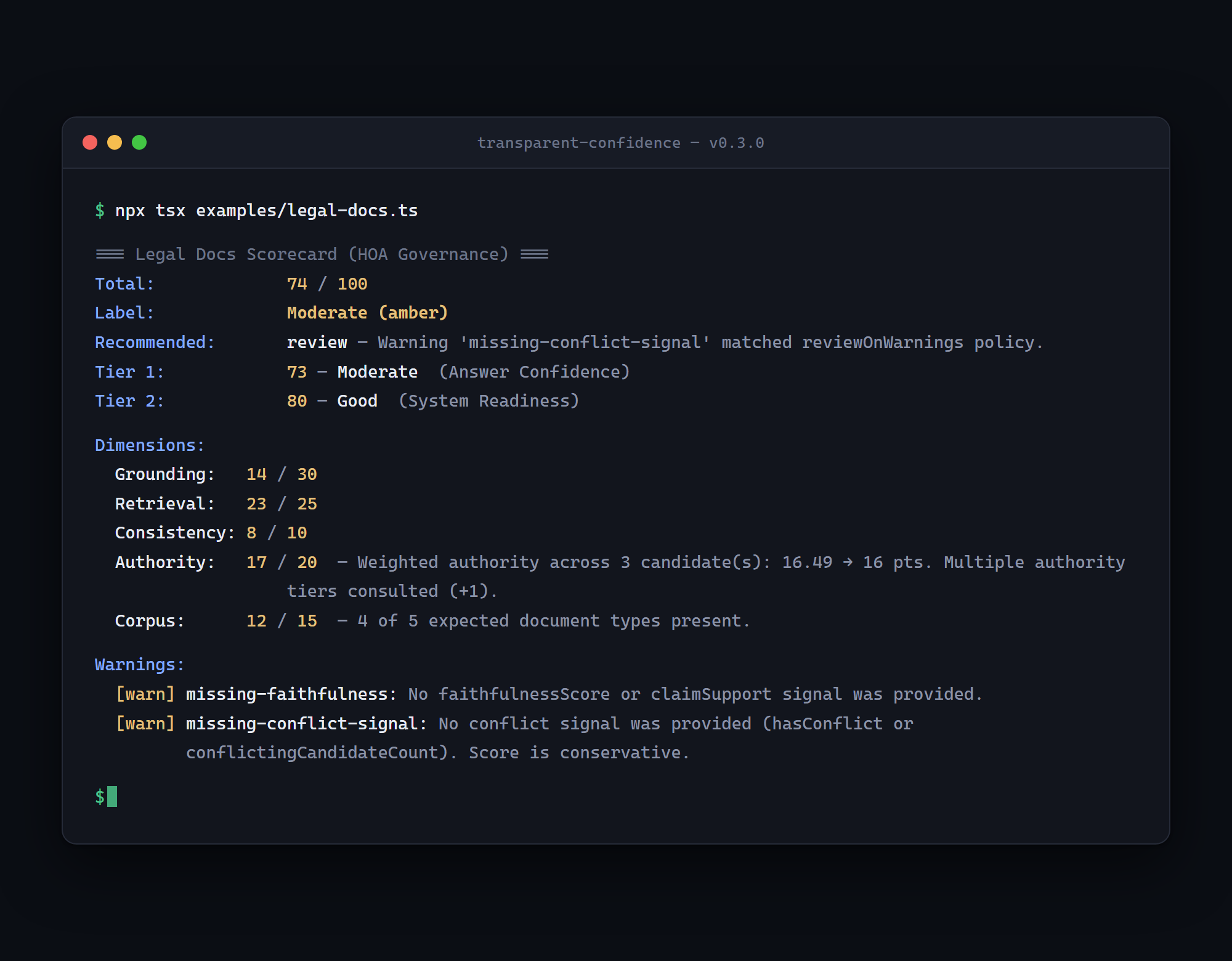
npx tsx examples/basic-rag.tsOutput of legal-docs.ts — a 74/100 scorecard where a missing conflict signal forces review despite a decent total:
v0.3.0 is mostly additive. See docs/migration-v0-3.md for the full guide.
Key decisions:
- Choose
preset: 'legacy-v0.2',balanced-v0.3, orproduction-v0.3. - For production gating, provide
answerRelevanceScore, a conflict signal, and eitherfaithfulnessScoreorclaimSupport. - Add
contentHashandrankwhen you want retrieval duplicate/rank diagnostics. - Add
indexIntegrityinputs only when you opt intoconfig.indexIntegrity. - Use
analyzeCalibrationbefore treating score thresholds as local reliability thresholds.
Algorithm reference: docs/algorithm-v0-3.md.
v0.2.0 includes breaking field renames and behavioral changes. See docs/migration-v0-2.md for the full guide.
| 0.1.x | 0.2.0 | Why |
|---|---|---|
confidenceLevel |
supportLevel |
The signal describes source support, not calibrated model confidence |
corpusDocCount |
corpusTypeCount |
The Corpus extension counts document types, not raw documents |
corpus.expectedDocCount |
corpus.expectedTypeCount |
Matches the document-type semantics |
Migration is a direct find-and-replace:
// Before (0.1.x)
computeConfidence({ confidenceLevel: 'high', corpusDocCount: 4, candidates }, {
  corpus: { expectedDocCount: 5 },
});

// After (0.2.0)
computeConfidence({ supportLevel: 'high', corpusTypeCount: 4, candidates }, {
  corpus: { expectedTypeCount: 5 },
});Consistency (Dimension 3): Omitting conflict signals now generates a missing-conflict-signal warning and scores conservatively, instead of silently treating the omission as implicit agreement. Pass hasConflict: false explicitly.
Authority (Extension): Default aggregation changed from "best source wins" (v0.1 min-rank) to weighted average across top-K candidates. Use authority: { aggregation: 'best' } to restore v0.1 behavior.
Recommended action: recommendedAction and actionReason are now always present on the scorecard. The default policy includes missing-conflict-signal in reviewOnWarnings, so scores that were previously labeled Strong may now return review if no conflict signal was provided.
Meta fields added: algorithmVersion, schemaVersion, activeDimensions, warnings, missingSignals, weights.
Current line: v0.3.0 (published, stable). Next milestone: v1.0 — stabilize and lock the public API surface for a 1.0 commitment.
Candidate features under evaluation for v1.0 — none are started or committed; all remain subject to the zero-runtime-dependency constraint:
- Batch scoring —
computeAll(inputs[])returning sorted scorecards for comparison - Score explanation renderer — format
DimensionScore.explanationfields into structured Markdown or HTML for display - Streaming scorecard — emit partial scorecard as dimensions complete, useful for long-running pipelines
- Python port — identical algorithm, same test scenarios, same output shape
- Preset configs —
createScorer(presets.legalDocs),createScorer(presets.customerSupport)for common domain setups
Full guide: CONTRIBUTING.md. Looking for a starting point? Check the good first issue label.
-
Clone the repo and install dependencies:
git clone https://github.com/emtcmca/transparent-confidence.git cd transparent-confidence npm install -
Run tests:
npm test -
Type-check:
npm run typecheck
-
Lint and format:
npm run lint
-
File issues at GitHub Issues. PRs welcome — please open an issue first for non-trivial changes.
Test coverage target: ≥ 90% line, ≥ 95% function, ≥ 85% branch. Run npm run coverage to check.