A simple logic circuit simulator.
llama_sim is a tool written in C that allows users to create and simulate logic circuits. These circuits are composed of elementary logic gates and electronics: switches, NOT gates, OR gates, AND gates, etc.
- The idea is relatively simple in practice: a bunch of interconnected structures.
- All electronics (switches, gates, etc) are connected via "wires".
- Gates can have multiple input wires, but typically only have 1 output wire.
- Each gate holds references to each input and output wires.
- If a wire is an input to a gate, then it stores a pointer to the gate.
- If the state of the wire changes (for example: by toggling the state of a switch), then we can adjust the state of the connected gate accordingly (using the pointer stored in the wire structure).
- If the gates output changes as the input (wire) changes, then we update the state of the gates output wire (if it exists).
- Similarly, if this output wire of gate #1 is an input to some other gate #2, then we repeat the same process, but now, we update the state of gate #2.
- This process is repeated until our wire is NOT an input wire or until we reach a dead end.
typedef struct wire {
	bool val, is_input;
	void* gate;
	int gate_type; // gate and gate_type are only
		       // used if wire is an input, so when
		       // we update the value of wire, we can update
		       // the output of the gate.
} wire;typedef struct toggle_switch {
bool is_on;
wire *out;
} toggle_switch;typedef struct led {
bool is_on;
wire *in;
} led;typedef struct NOT {
wire *in, *out;
} NOT;
typedef struct AND {
int ports;
wire **in, *out;
} AND;
typedef struct OR {
int ports;
wire **in, *out;
} OR;#include <stdio.h>
#include "src/gate.h"
#include "src/switch.h"
int main(void) {
toggle_switch *sw = init_empty_switch();
wire *w = init_wire(0, 0);
// connects the wire w
// to the output of switch sw
connect_wire_to_switch(sw, w);
// toggle switch sw: on
toggle_switch_status(sw);
printf("%d\n", w->val); // outputs: 1
toggle_switch_status(sw);
printf("%d\n", w->val); // outputs: 0
return 0;
}
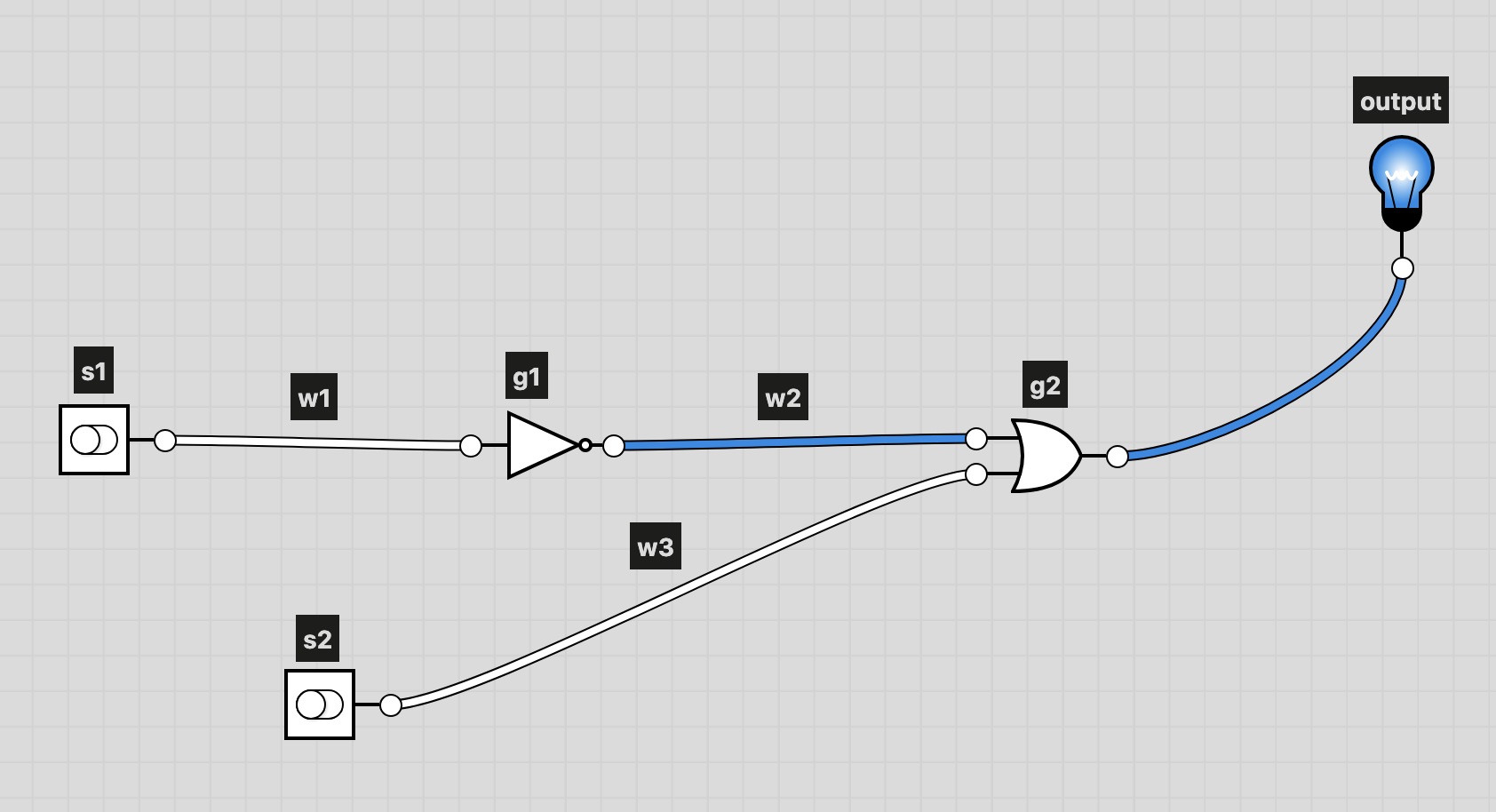 circuit example (pt. 1) (using logic.ly)
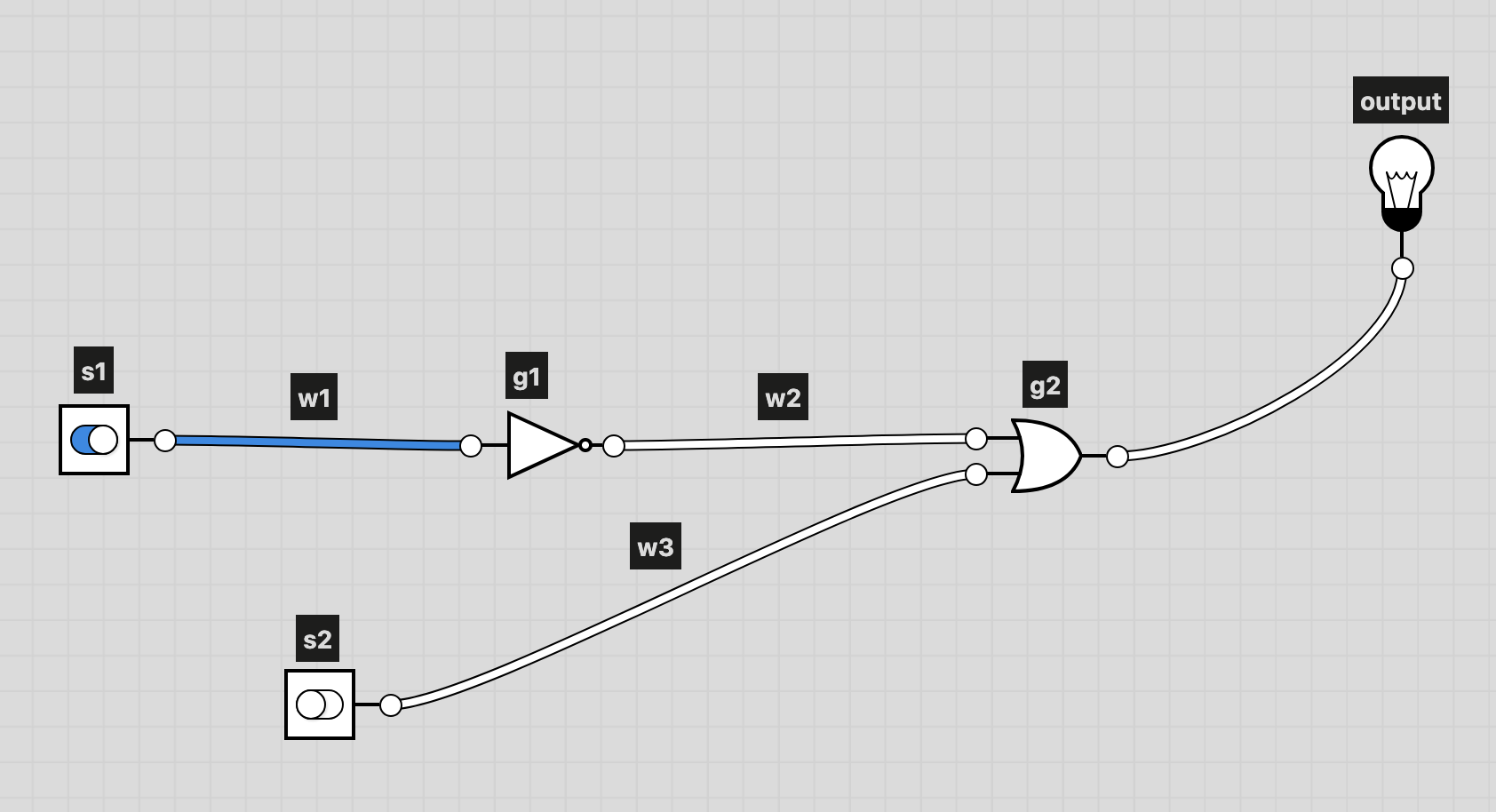 circuit example (pt. 2) (using logic.ly)
In the example above:
- Switching on
s1causes the signal inw1to beON. - Since
s1is an input wire to gateg1, then we need to recompute the output ofg1. - Since
g1is a NOT gate, and its input isON, then its output will beOFF. - By changing out output to our
g1gate, ourw2wire also changes state fromONtoOFF, so we need to recompute the output ofg2. - Since
g2is an OR gate, and both its input areOFF, then its output will also beOFF. - Thus, our output (LED) is OFF.
#include <stdio.h>
#include "../src/gate.h"
#include "../src/switch.h"
#include "../src/led.h"

int main(void) {
	led *l = init_led(NULL);
	toggle_switch *s1 = init_empty_switch(), *s2 = init_empty_switch();
	wire *w1 = init_wire(0, 0), *w3 = init_wire(0, 0);

	connect_wire_to_switch(s1, w1);
	connect_wire_to_switch(s2, w3);

	NOT *g1 = init_not(NULL);
	connect_wire_to_gate(w1, (void*) g1, NOT_GATE_ID, 0);

	OR *g2 = init_or(2);
	connect_wire_to_gate(g1->out, (void*) g2, OR_GATE_ID, 0);
	connect_wire_to_gate(w3, (void*) g2, OR_GATE_ID, 1);
	connect_wire_to_led(l, g2->out);

	printf("%d\n", l->is_on); // outputs: 1

	toggle_switch_status(s1);

	printf("%d\n", l->is_on); // outputs: 0

	return 0;
}