

Your prompts get the placeholders. You keep the secrets.
A local privacy layer for AI tools: swaps personal data for placeholders before requests leave your machine, then restores the originals in the reply.


Works with Claude Code · GitHub Copilot · Codex · Cursor · Aider · Gemini · any OpenAI-compatible client
📖 User guide · Quickstart · Install · Gateway · CLI · Copilot · doctor · Troubleshooting · All agents →
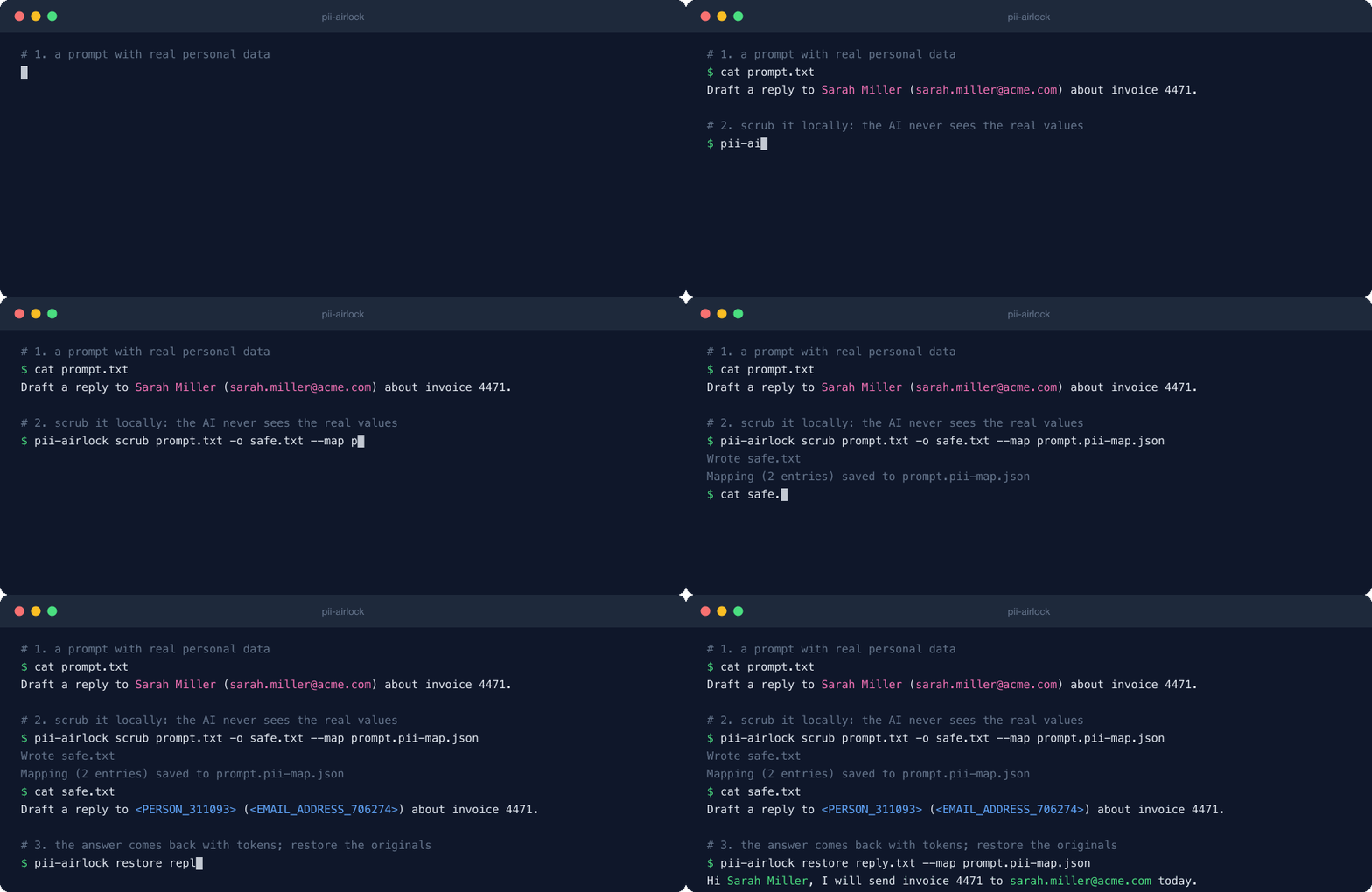
Everything you paste into an AI tool is sent to a third party. pii-airlock sits between you and the provider: it spots names, emails, phones, cards, IBANs and secrets, and sends placeholders instead. Answers come back with your real values restored.
Example:
John Smith (john@acme.com) → <PERSON_482913> (<EMAIL_ADDRESS_093117>)
Runs on macOS, Linux, Windows (Python ≥ 3.10). Built on Microsoft Presidio.
| Problem | What pii-airlock gives you |
|---|---|
| You use multiple AI clients/providers | One local gateway URL for all of them |
| You need reversible anonymization | Stable placeholders + local mapping file |
| You use Claude Code tools/files | Native hooks for prompt + tool-data checks (Claude Code, Copilot) |
| You want to avoid vendor lock-in | Provider adapters: OpenAI-style, Anthropic, Gemini |
Detection happens locally. Gateway traffic is forwarded only after PII is replaced.
pipx install pii-airlock        # or: brew install matinfo/tap/pii-airlock
cd my-project
pii-airlock init                # guard this project
That's it. init creates .pii-airlock/ in the project, installs the hooks for
Claude Code and GitHub Copilot (once, for your user), and downloads the detection
models. From now on, in this project only, prompts and tool calls that contain
personal data are stopped before they leave your machine.
pii-airlock status              # what is guarded, by which hooks, with which policy
pii-airlock allow "Acme SA"     # never PII here (your company, products)
pii-airlock deny "Project X"    # always sensitive here (client, code name)
pii-airlock off                 # pause here (`pii-airlock on` resumes)
Using a chat client instead of an agent (Cursor, Codex, an SDK)? Add the
gateway: pii-airlock proxy, then point the
client's base URL at http://127.0.0.1:8745/openai.
Like .git/ or .codegraph/, one folder holds everything pii-airlock knows about a project,
and its presence is the on switch:
my-project/.pii-airlock/
  config.yaml   policy: allow/deny lists, actions, patterns    committed, shared with the team
  .gitignore    ignores everything else                        committed
  maps/         mappings from `scrub` (real values, encrypted)  local only
  off           present while paused (`pii-airlock off`)        local only
- Hooks are installed once for your user and do nothing outside a project home, so unrelated repos are untouched. It is found from any subdirectory.
- A teammate who clones the repo runs
pii-airlock inittoo. The sharedconfig.yamlthen applies, but only the settings that tighten protection, until they review it and runpii-airlock trust(see Trust). - The token key and trust decisions stay in
~/.local/state/pii-airlock/, never in the project: encrypted maps next to their key would protect nothing. - To guard every directory instead, set
activation: alwaysin~/.config/pii-airlock/config.yaml. - The gateway has no notion of project: it scrubs whatever is sent to it.
Requires Python ≥ 3.10 and pipx (recommended) or pip. Works the same on macOS, Linux and Windows.
pipx install "pii-airlock[proxy]"   # recommended (gateway included)
pii-airlock init                    # guided setup (models + env hints)
Alternative: Homebrew (macOS or Linux, instead of pipx). One command installs the
pii-airlock CLI, the Claude Code hooks and the gateway proxy:
brew install matinfo/tap/pii-airlock
pii-airlock download-models         # spaCy models, downloaded once
Homebrew puts everything in a private Python virtualenv (an isolated folder of packages),
so it cannot clash with your own Python. You never activate it: pii-airlock on your
PATH already points into it. Things to know:
-
Location:
$(brew --prefix pii-airlock)/libexec(find it withbrew --prefix pii-airlock). -
Extras:
brewhas no flag for the optionaldocx,pdfandglinerextras. Install them into that venv with its ownpip(glinerpulls PyTorch, a large download):"$(brew --prefix pii-airlock)/libexec/bin/python" -m pip install 'pii-airlock[docx]'
-
Upgrades reset it:
brew upgradeorbrew reinstallrebuilds the venv, so re-run the extras andpii-airlock download-modelsafterwards. If that is a nuisance, use pipx, whosepipx injectadditions survive upgrades.
Latest from source (before a release lands on PyPI):
pipx install git+https://github.com/matinfo/pii-airlockOptional format support (plain text, CSV and JSON work out of the box):
pipx inject pii-airlock 'pii-airlock[docx]'   # Word .docx
pipx inject pii-airlock 'pii-airlock[pdf]'    # PDF (text extraction)
pipx inject pii-airlock 'pii-airlock[all]'    # everything
If you installed without gateway support and need it later:
pipx inject pii-airlock 'pii-airlock[proxy]'If download-models reports that your interpreter has no pip (common in
pipx), run the printed pipx inject pii-airlock "<model-wheel-url>" commands.
The command now prints exact model wheel URLs for you.
pii-airlock doctorThis checks proxy dependencies, model installation, and mapping roundtrip in one command.
echo "Contact John Smith at john@example.com" | pii-airlock scrub -o /tmp/scrubbed.txt
cat /tmp/scrubbed.txt   # Contact <PERSON_482913> at <EMAIL_ADDRESS_093117>
pii-airlock restore /tmp/scrubbed.txtThe gateway is the easiest mode for non-technical users: point your AI client at
localhost, and pii-airlock handles scrub/restore automatically.
  your app ──http──▶ pii-airlock gateway ──https──▶ provider API
           ◀───────────  (restore)  ◀───────────  (scrub)
# already included if you installed with "pii-airlock[proxy]"
# pipx inject pii-airlock 'pii-airlock[proxy]'
pii-airlock proxy            # listens on http://127.0.0.1:8745
Then set the base URL in whatever client you use:
# OpenAI SDK / Codex CLI / most OpenAI-compatible tools
export OPENAI_BASE_URL=http://127.0.0.1:8745/openai

# Anthropic SDK
export ANTHROPIC_BASE_URL=http://127.0.0.1:8745/anthropic

# Google Gemini — use base path
#   https://generativelanguage.googleapis.com  ->  http://127.0.0.1:8745/gemini
Why this is practical: configure once, keep existing clients, and avoid changing prompt habits.
- No TLS interception. Your client talks plain HTTP to
localhost; the proxy makes the real HTTPS call upstream. No certificates to install. Bind stays on127.0.0.1by default. - Auth passes through untouched and pii-airlock never logs request headers or bodies.
(uvicorn runs at log level
warning, so request lines aren't logged either.) - A fresh in-memory mapping per request — the gateway writes no PII to disk (only the stable-token key, see Tokens).
- Concurrency-safe: detection is serialized with a lock, so the engine is shared safely across simultaneous requests.
Provider coverage — three wire formats, each with an adapter in pii_scrub/payload.py:
| Route | Wire format | Covers | Streaming |
|---|---|---|---|
/openai |
Chat Completions, Responses, Completions, Embeddings, Moderations | OpenAI, Codex, Cursor, Continue, Ollama, LiteLLM, vLLM, … | SSE ✅ |
/anthropic |
Messages (incl. count_tokens, batches) |
Claude SDKs, Claude-compatible tools | SSE ✅ |
/gemini |
generateContent, countTokens, embedContent | Google Gemini | SSE ✅ · array-stream buffered |
Tool traffic is covered too: tool results / function outputs (where file contents and command output live) and tool-call arguments are scrubbed on the way out; tool-call arguments the model emits are restored on the way back.
Fail closed. A request body the gateway doesn't know how to scrub — an unknown
endpoint (file uploads, audio, …) or a body that isn't JSON — is refused (403/400)
instead of being forwarded. Opt specific paths out with passthrough_paths if you
know they carry no personal data.
Need setup for a specific client? Use AGENTS.md (Claude Code, Codex, Cursor, Continue, Aider, Gemini, GitHub Copilot).
# 1. Scrub — replaces PII with tokens, keeps the mapping (encrypted) in .pii-airlock/maps/
echo "Contacte Jean Dupont à jean@acme.fr" | pii-airlock scrub
# → Contacte <PERSON_558644> à <EMAIL_ADDRESS_094087>

# 2. Send the scrubbed text to your LLM …

# 3. Restore — swap tokens back in the model's response (use your own tokens)
echo "J'ai répondu à <PERSON_558644> via <EMAIL_ADDRESS_094087>." | pii-airlock restore
# → J'ai répondu à Jean Dupont via jean@acme.fr.Same value, same token, so the model still sees coreference. By default tokens are
stable: <PERSON_558644> is a keyed hash (HMAC-SHA256) of the value, so it is the
same in every request, file and process — across turns, subagents, trimmed or compacted
histories — and prompt caches keep hitting. The key is created on first use in
~/.local/state/pii-airlock/token.key (owner-only) and never leaves your machine;
without it a token reveals nothing about its value.
token_rotation: day(default) |week|never— how long a value keeps its token. Tokens cannot be linked across periods, so a provider cannot follow one person through all your conversations. Useneverto scrub a dataset in several runs.token_style: surrogate— realistic fakes instead of tokens, keyed the same way:Jean Dupont→Jasper Iverson,jean.dupont@acme.fr→jasper.iverson@example.com; phones, cards (Luhn-valid), IBANs (valid checksum) keep their shape, IPs come from the documentation ranges. Text reads naturally, which some models and tools handle better than<TOKENS>. A surname alone gets the surname of the full fake, and restores alone too. Other entities (IDs, secrets, places) keep stable tokens. Trade-off: a fake the model writes in another sense (a fake first name alone, for someone else) is restored as well.token_style: sequential—<PERSON_1>,<PERSON_2>in reading order, per request or file (the previous default).- Delete
token.keyto rotate the key immediately.
pii-airlock detect notes.txt
# PERSON           0.85  [9:21]    'Jean Dupont'
# EMAIL_ADDRESS 0.99 [24:38] 'jean@acme.fr'pii-airlock scrub report.csv -o report.scrubbed.csv
pii-airlock scrub data.json -o data.scrubbed.json
pii-airlock scrub contract.docx -o contract.scrubbed.docx # requires [docx]
pii-airlock scrub scan.pdf # requires [pdf] → text on stdoutpii-airlock scrub prompt.txt --no-map # irreversible one-way scrub
pii-airlock scrub --lang fr,en # explicit language list
pii-airlock scrub --threshold 0.7 # raise confidence cutoff
pii-airlock scrub input.txt -o out.txt --map m.json # mapping elsewhere (plain JSON)
pii-airlock restore out.txt --map m.jsonMappings go to the project's .pii-airlock/maps/ (outside a project:
~/.local/state/pii-airlock/maps/), encrypted, never next to your file. restore tries them
all, so no --map is needed.
pii-airlock init installs them in ~/.claude/settings.json. Or use the plugin instead:
/plugin marketplace add matinfo/pii-airlock
/plugin install pii-airlock@pii-airlock
The plugin adds a /pii-airlock:setup skill; init sees it and skips its own hooks, so
nothing is scanned twice. The plugin cannot install the Python CLI: install it first. While
the CLI is missing, prompts and tool calls in a guarded project are blocked
(PII_AIRLOCK_PLUGIN_FAIL_OPEN=1 lets them through). The launcher is a POSIX shell script: on
Windows use init.
| Leak vector | Covered by | Default action |
|---|---|---|
| PII you type in a prompt | UserPromptSubmit |
block, shows a scrubbed version to send instead |
| PII in a text file Claude reads (the hook scans the file content) | PreToolUse (Read) |
ask |
| PII in a shell command, file write/edit, search pattern, URL or web query | PreToolUse |
ask |
| PII in MCP tool arguments | PreToolUse (mcp__*) |
ask |
| Claude knowing the rules (placeholders, never work around a block) | SessionStart |
rules added to the session |
The hooks detect and block/ask — they don't silently rewrite payloads (the hook API doesn't support in-place rewriting). For a silent, reversible rewrite, use the CLI pipe above.
hook_decision: denyblocks tool calls instead of asking.prompt_decision: warnsends prompts containing PII anyway, with a warning (Claude Code has no "ask" for prompts: it's block or send).- If detection can't run (e.g. missing spaCy model), the hooks fail closed: the
input is treated as containing PII. Set
hook_on_error: opento skip checks instead. pii-airlock install-hookregisters them by hand:--scope projectwrites the repo's.claude/settings.json(every teammate then needs the CLI),--event tool|promptpicks one.
Speed: the hook daemon. Claude Code starts a new process for every hook call, and
loading the spaCy models costs 0.5–3 s each time. With the default hook_daemon: auto,
the first hook call starts a small background daemon that keeps the models loaded;
later calls answer in ~60 ms. It listens on a Unix socket (mode 0600, in a directory
only you can write to) or, on Windows, on 127.0.0.1 with a random secret kept in a file only you
can read: the hook checks the daemon knows that secret before it sends any text. It reloads your
project policy on every call, and exits after hook_daemon_idle_minutes (30) idle. Nothing leaves
your machine.
pii-airlock daemon status     # also shown by `pii-airlock status`
pii-airlock daemon start      # warm it up now (e.g. from your shell profile)
pii-airlock daemon stop
While no daemon answers, hooks analyze in-process (hook_fallback: inprocess). With
hook_fallback: regex they use patterns only, in milliseconds: emails, phones, IBANs,
cards, IPs, FR/CH IDs, secrets and your deny_list — names and places are not
detected in that mode. hook_daemon: off disables the daemon.
Not covered by hooks: the output of a command or tool (e.g. cat in Bash, Grep
matches, a fetched web page) reaches the model unchecked, as do binary files (images,
PDFs). For full coverage, route the traffic through the gateway.
pii-airlock init installs the hook in ~/.copilot/hooks/ when it finds Copilot. It guards
Copilot's tool calls (preToolUse: shell commands, edits, file reads, web fetches, MCP
calls) in the Copilot CLI, the cloud agent and VS Code agent mode, in guarded projects only.
- Cloud agent: it runs on GitHub's machines, so it needs the repo-level hook:
pii-airlock install-hook --target copilotwrites.github/hooks/pii-airlock.json. - Chat in VS Code: a hook cannot block prompts, so add your own model as a Custom Endpoint that points at the gateway (config in AGENTS.md).
- Not covered: Copilot's default models and inline suggestions.
Written from GitHub's hook specs; not yet run against a live Copilot session.
Override chain (lowest → highest priority):
bundled defaults → ~/.config/pii-airlock/config.yaml (you, every project)
  → <project>/.pii-airlock/config.yaml (this project) → CLI flags
allow_list, deny_list and custom_patterns accumulate across layers (your
personal allow list + the project's); every other key is overridden.
Default config (config.default.yaml):
languages: [en, fr]
models:
  en: en_core_web_lg
  fr: fr_core_news_lg
score_threshold: 0.5
entities: []          # empty = all entities Presidio recognizes, minus exclude_entities
entity_actions: {}    # per type: tokenize | redact | allow | block (see Per-project policy)
exclude_entities: [DATE_TIME, URL, NRP, US_DRIVER_LICENSE, US_BANK_NUMBER,
                   US_PASSPORT, IN_VEHICLE_REGISTRATION]  # noisy in code; [] keeps all
score_thresholds: {}  # per-entity minimum, e.g. {PERSON: 0.7}
builtin_recognizers: true  # FR/CH IDs, FR/CH phone formats, secrets (see below)
analysis_cache_size: 2048  # texts remembered per language (digest + offsets, never the text); 0 = off
activation: project        # hooks run in projects with .pii-airlock/ (always: everywhere)
hook_daemon: auto          # keep models loaded between hook calls (off: never)
hook_fallback: inprocess   # no daemon answer: load models (inprocess) or patterns only (regex)
hook_decision: ask    # tool calls: ask (surface + confirm) | deny (block)
prompt_decision: block  # prompts: block (show scrubbed version) | warn (send anyway)
hook_on_error: closed   # detection failure: closed (treat as PII) | open (skip)
hook_max_file_bytes: 2000000  # larger files read by Claude count as a detection failure
passthrough_paths: []   # gateway: path fragments whose bodies may be forwarded unscrubbed

# Advanced (proxy runtime):
mapping_backend: memory   # memory (default) | file
# mapping_dir: /var/lib/pii-airlock/maps
For higher-volume/self-hosted setups, mapping_backend: file can be useful for
debugging or operational inspection. memory stays the safest default for local
use because mappings are ephemeral.
Mapping files hold the real values, so the file backend encrypts them at rest
(AES-256-GCM, key derived from token.key in the state directory). A copied or
backed-up maps/ directory is then useless without that key: keep token.key out of
backups, and note that losing it makes pending mappings unreadable (they only live for
one request). Plain files from older versions still load. Set mapping_encryption: false
to write readable JSON for debugging; this is ignored in an untrusted project's config.
pii-airlock scrub encrypts its mappings the same way, unless you pass --map (plain JSON
where you said).
On top of Presidio, pii-airlock ships checksum-validated recognizers that work in every language and need no model:
| Entity | What | Validation |
|---|---|---|
FR_NIR |
French social security number | mod-97 key (incl. Corsica 2A/2B) |
CH_AHV |
Swiss AHV/AVS number 756.xxxx.xxxx.xx |
EAN-13 check digit |
FR_SIRET / FR_SIREN |
French business IDs (sole traders are people) | Luhn; SIREN needs the keyword |
DE_TAX_ID |
German tax ID (Steuer-IdNr.), needs the keyword (Steuer-ID, IdNr) |
ISO 7064 MOD 11,10 |
DE_TAX_NUMBER |
German Steuernummer (21/815/08150), needs the keyword |
format |
IT_VAT_CODE |
Italian Partita IVA, with the IT prefix or a P.IVA keyword |
Luhn |
PHONE_NUMBER |
International +CC … in any language; FR/CH/DE/IT national formats (06 12 34 56 78, 079 123 45 67, 030 12345678, 333 1234567) |
format |
SECRET |
AWS/GitHub/Slack/OpenAI/Anthropic/Google/Stripe keys, JWTs, private keys, URL passwords, password=… values |
format |
Exclude any of them with exclude_entities, or all with builtin_recognizers: false.
The project policy is .pii-airlock/config.yaml, a plain YAML file that takes any setting
above. Edit it by hand or from the CLI:
pii-airlock allow "Acme SA"                        # never PII here (your company, products)
pii-airlock deny "Project Phoenix" --as CODENAME   # always sensitive here
pii-airlock allow "Jane Roe" --scope user          # personal, all projects
pii-airlock status # effective policyallow_list: [Acme SA]
deny_list:
CODENAME: [Project Phoenix]
custom_patterns:
- {entity: CONTRACT_ID, regex: 'CT-\d{6}'}Hooks apply the policy of the project Claude Code is working in. Every detection message shows the one-command fix for a false positive.
Trust. The policy comes with the repo, and a policy can loosen protection
(allow_list, hook_on_error: open, entity_actions: {PERSON: allow}...). So for a
project you have not trusted, only settings that tighten apply (deny-list terms,
custom patterns, block / redact, deny / block / closed decisions). A policy
init creates, and your own allow, deny and action edits, are trusted; after a
git pull that changes it, review it and run pii-airlock trust. pii-airlock status
says what is being ignored. User-level config is always trusted.
By default every detected entity is tokenized (reversible). Choose per type:
| Action | Effect |
|---|---|
tokenize |
token or fake, restored in the response (default) |
redact |
irreversible [IBAN_CODE]; the value is never kept, not even in a mapping file |
allow |
left as is and not flagged (what exclude_entities does for its list) |
block |
the gateway answers 403 and sends nothing, scrub writes nothing, hooks deny (even with hook_decision: ask) and block prompts (even with prompt_decision: warn); messages name the type and count, never the value |
pii-airlock action IBAN_CODE redact          # this project
pii-airlock action CREDIT_CARD block --scope userentity_actions:
IBAN_CODE: redact
SECRET: block # API keys and passwords never leave the machine
LOCATION: allowLayers accumulate (user config + project policy); an explicit action beats
exclude_entities. Names found elsewhere in the text keep following their person:
with EMAIL_ADDRESS: allow, marie@acme.fr stays but a bare marie that
matches a detected "Marie Dubois" is still tokenized.
python -m spacy download de_core_news_lg# .pii-airlock/config.yaml (or ~/.config/pii-airlock/config.yaml)
languages: [en, fr, de]
models:
de: de_core_news_lgInstead of a spaCy model per language, GLiNER
(urchade/gliner_multi_pii-v1) finds people, organizations and places in any language
with one model. Emails, phones, IDs and secrets are still found by patterns.
pipx inject pii-airlock 'pii-airlock[gliner]'   # or: pip install 'pii-airlock[gliner]' (PyTorch)
pii-airlock download-models # with ner_backend: gliner, fetches the ~1.1 GB modelner_backend: glinerOn the bundled EN+FR eval corpus (python -m tests.eval.run_eval --backend gliner):
spaCy _sm models |
GLiNER | |
|---|---|---|
| PERSON recall / precision | 0.96 / 0.68 | 1.00 / 0.95 |
| All entities, precision | 0.67 | 0.98 |
| Time per message (CPU) | ~6 ms | ~40 ms |
Fewer false positives means fewer needless hook prompts. Long texts are scanned in overlapping windows (GLiNER itself truncates past a few hundred words). Organizations and places must be capitalized to count, which drops common nouns GLiNER tags ("la société", "client"); names are kept in any case. With the hook daemon the model is loaded once.
What pii-airlock guarantees
- Reversibility is exact. Any value the engine tokenized is restored byte-for-byte
via the mapping.
restore(scrub(text))round-trips for tokenized spans. - Determinism. The same value gets the same token within a mapping (and, with stable tokens, across requests), so coreference is preserved for the model.
- Found once, scrubbed everywhere. A value detected anywhere in a request or file — and the parts of a person's name — is scrubbed at every other mention, earlier ones included, even where the model missed it.
- Tokens are opaque & safe. Restored values are re-inserted through proper JSON
encoding; values containing quotes, newlines or
<…>won't corrupt payloads. - Local-only detection. Detection never makes a network call. Only the gateway forwards (already-scrubbed) traffic onward.
What it does not guarantee — read this
- Detection is best-effort, not complete. Presidio + spaCy are statistical; they
miss and mis-tag entities (more so with
_smmodels, or for phone numbers with odd spacing). pii-airlock reduces exposure — it is not a guarantee that every piece of PII is removed. Review sensitive material; raisescore_thresholdor add custom recognizers as needed. - Gateway scope. Text in generation, embedding and token-count requests is scrubbed,
including tool results and tool-call arguments. Images, audio and file attachments
inside a request are forwarded as-is (not inspected). Other endpoints with a body are
refused unless listed in
passthrough_paths. Anthropicthinkingblocks are signed, so they are neither scrubbed nor restored. - All configured languages are analyzed for every text and the results merged, so mixed EN/FR text is covered — at the cost of one NER pass per language.
- Gemini array streaming (without
alt=sse) is buffered, then restored as one response rather than streamed live. .docxscrubbing rewrites changed paragraphs into a single run, so inline formatting within those paragraphs is not preserved. PDF is extract-only → scrubbed text out (no PDF re-render).
Tested in CI on Linux, macOS and Windows (Python 3.10–3.14 on Linux; 3.12–3.13 on macOS/Windows). One platform nuance:
- Mapping files are created with mode
0600on POSIX (macOS/Linux). On Windowschmodis a no-op; the file inherits your account's default ACLs — typically already user-private in a home directory. Treat mapping files as secrets regardless (below).
Run this first for a quick diagnosis:
pii-airlock doctor.venv/bin/pytest: bad interpreter .../pii-scrub/...
Your venv points to an old repo path. Recreate it:
rm -rf .venv
python3 -m venv .venv
.venv/bin/python -m pip install -U pip
.venv/bin/python -m pip install -e '.[dev]'
No module named spacy when running python -m spacy ...
You are likely using system Python instead of the pii-airlock environment.
Use:
pii-airlock download-modelsdownload-models says this interpreter has no pip
This is normal in many pipx environments. Run the exact pipx inject command
printed by download-models for each model wheel URL.
pii-airlock proxy fails with missing httpx / starlette / uvicorn
Install gateway dependencies:
pipx inject pii-airlock 'pii-airlock[proxy]'OSError: [E050] Can't find model ... after download
Install the model wheel directly into the same environment where pii-airlock
runs (the command prints the exact wheel URL in this case).
A mapping file pairs every token with the original personal data.
scrubwrites them to.pii-airlock/maps/(owner-only folder), encrypted (AES-256-GCM, key derived fromtoken.keyin~/.local/state/pii-airlock/). A copied, synced or backed-up project folder is useless without that key: keeptoken.keyout of backups and never in the repo. Losing it makes the maps unreadable..pii-airlock/.gitignorekeepsmaps/out of git; onlyconfig.yamlis committed.--map PATHwrites plain JSON where you say (add--encrypt-mapto encrypt it): never commit such files. The repo.gitignorehere excludes*.pii-map.jsonand*.pii-map.*.- Delete maps you no longer need. Use
--no-mapwhen reversibility isn't required. - The gateway keeps its mapping in memory only and discards it after each response.
git clone https://github.com/matinfo/pii-airlock
cd pii-airlock
pip install -e ".[dev]"
ruff check .
pytest -q
Unit tests stub out Presidio/spaCy and run entirely offline. Detection quality is measured separately on a labeled EN+FR+DE+IT corpus (fake data) with the real small models: python -m tests.eval.run_eval -v prints per-entity recall/precision, --gate fails below tests/eval/thresholds.json (also pytest -m eval). Add a case to tests/eval/corpus.jsonl when you fix a miss.
For a live end-to-end check, run pii-airlock download-models first, then:
echo "Call John Smith at john@example.com" | pii-airlock scrub- 🧩 Integrate with your agent — Claude Code, GitHub Copilot, Cursor, Codex, Gemini, Continue, Aider, …
- ❓ Need help? Open a bug report with:
pii-airlock --version- your install method (
pipxorpip) - the exact command and full error output
- 🤝 Contributing — adding a language or a provider adapter is a great first PR
- 🔒 Security policy — responsible disclosure + the honest threat model
- 📜 Changelog · Code of Conduct
If pii-airlock helps you keep PII out of your AI tools, a ⭐ helps others find it.
MIT © pii-airlock contributors