



A zero-dependency multi-agent orchestrator for AI coding agents.
Run a team of Claude Code, OpenAI Codex, Gemini CLI, and Hermes side by side in tmux — each in its own directory, each messaging the others only where your config allows.
Formerly AgentSwarm. Installed globally the command is agentainer; from a clone, ./agentainer in the repo root is identical.
Agentainer is a lightweight, stdlib-only orchestrator (Python 3 + bash + tmux, no runtime dependencies) that launches multiple AI coding agents — Claude Code, OpenAI Codex, Google's Gemini CLI, and Hermes — in isolated tmux sessions, each with its own working directory, and routes messages between them under a configurable access-control list. Define your whole agent team in a single YAML file; one command brings it online.
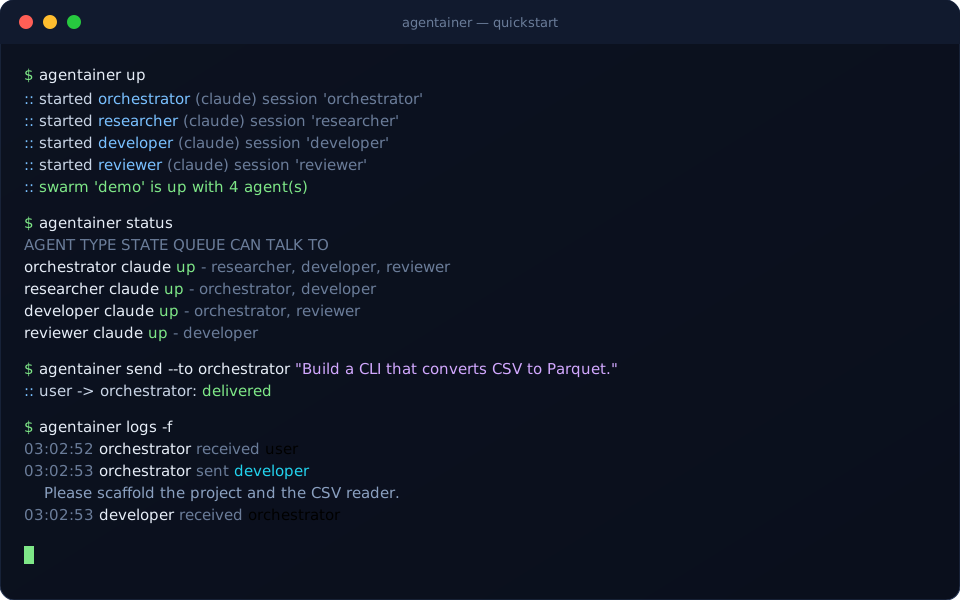
Start a four-agent swarm, check status, hand it a task, and watch the messages route — in four commands.
- Why Agentainer
- How it fits together
- Requirements
- Install
- Quickstart
- FAQ
- How it works
- Capturing what an agent says
- Subagents, parallel work, and busy agents
- Configuration reference
- Examples
- Commands
- Project layout
- Tests
- Troubleshooting
- A note on flags
- Multi-agent, one command. Spin up a whole team with
agentainer up— folders, hooks, tmux sessions, and first prompts, all wired automatically. - Zero runtime dependencies. Just Python 3 + bash + tmux. No pip installs, no bloated toolchain.
- Real ACLs, not vibes. Agents only message who your YAML
can_talk_tolist permits."*"for everyone, an explicit list for tight graphs. - Survives restarts. Each turn's conversation id is recorded;
up --resumereattaches instead of starting cold. - Self-healing routing. Busy agents queue inbound work, stranded messages get swept, and agents are nudged when a reply reaches nobody.
- Any mix of CLIs. Claude, Codex, Gemini, Hermes — or your own type — in the same swarm.
Architecture at a glance: a single agents.yaml file maps each AI coding agent to its own tmux session and working directory, while Agentainer routes and logs every message between them under a can_talk_to access-control list.
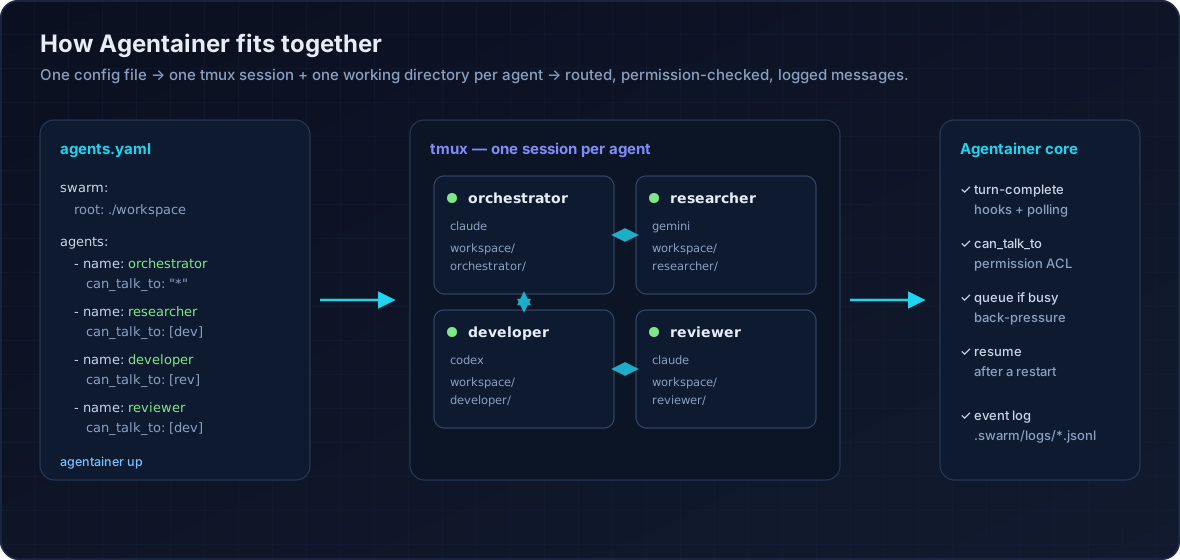
One command starts the swarm: it creates a folder per agent, installs a completion hook inside each folder, opens a tmux session per agent, launches the CLI, and types each agent's first prompt into it.
Plain-text diagram
   agents.yaml                 tmux
  ┌────────────┐        ┌──────────────────┐
  │ orchestr.  │───────▶│ session: orchestr│──┐
  │ researcher │        │ session: research│  │  swarm send --to developer "..."
  │ developer  │        │ session: develop │◀─┘
  │ reviewer   │        │ session: reviewer│
  └────────────┘        └──────────────────┘
         │                       │
         │  workspace/<agent>/   │  hooks capture each finished turn
         ▼                       ▼
   one folder per agent    messages routed + logged
tmux(3.0+)python3— PyYAML is used if present, otherwise a bundled parser handles the confignode(16+) — only for the globalagentainercommand; not needed if you run./agentainerfrom a clone- whichever agent CLIs you reference:
claude,codex,gemini,hermes— install only the one(s) you actually use
Global, via npm:
npm install -g agentainer
agentainer --version     # print the installed version (also: agentainer -v)
agentainer doctor        # check tmux/python3 are present; report which agent CLIs it found
agentainer doctor verifies the required tools (tmux, python3) and reports
which agent CLIs are available — it never fails on a missing agent CLI, since
you may only use one of them.
Or from a clone (no npm needed):
git clone https://github.com/mehmetcanfarsak/AgentSwarm.git && cd AgentSwarm
./agentainer --help # same commands as the global `agentainer`, straight from the repocp agents.example.yaml agents.yaml
agentainer validate # parse the config, print the resolved swarm, launch nothing
agentainer up # create dirs, install hooks, start tmux, send first prompts
agentainer status # who is running
agentainer attach developer
agentainer down # stop everythingGive the swarm its actual work:
agentainer send --to orchestrator "Build a CLI that converts CSV to Parquet."Watch the traffic between agents:
agentainer logs -f              # whole swarm, live
agentainer logs reviewer -n 20  # one agent
agentainer inbox developer      # messages an agent received
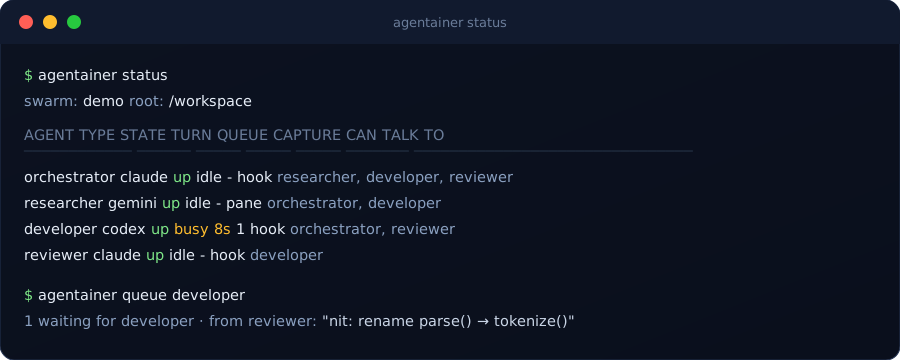
agentainer status gives you the whole swarm at a glance — who is up, who is mid-turn, and how deep each queue is:
What is Agentainer? Agentainer is a zero-dependency multi-agent orchestrator that runs a team of AI coding agents — Claude Code, OpenAI Codex, Google's Gemini CLI, and Hermes — in isolated tmux sessions, each with its own working directory, and routes messages between them under a configurable access-control list. You describe the whole team in one YAML file and start it with a single command.
Which AI coding agents does Agentainer support?
Claude Code (claude), OpenAI Codex (codex), Google's Gemini CLI (gemini), and Hermes (hermes) out of the box. You can also define your own agent type via agent_types: — any CLI that takes input on stdin/tty works, with capture: pane or capture: none.
Does Agentainer need Docker or any runtime dependencies?
No. It is stdlib-only: Python 3, bash, and tmux. PyYAML is used if present, but a bundled parser handles the config without it. Node is only needed for the global npm launcher — running ./agentainer from a clone needs no Node at all.
How do I run multiple coding agents together?
Write a YAML config listing your agents (and who may talk to whom), then run agentainer up. It creates a folder and a tmux session per agent, installs a turn-completion hook, launches each CLI, and types in the first prompt. agentainer send --to <agent> "…" messages any agent; agentainer validate previews the resolved swarm without launching anything.
Can agents communicate with each other, and how is that controlled?
Yes. Agents exchange tagged <swarm-message> / <swarm-send> blocks. Messaging is a whitelist: an agent may only reach the agents in its can_talk_to list ("*" means everyone else); anything else is refused. Auto-forwarding (forward_responses_to) can relay finished turns hands-free, bounded by a hop count to prevent loops.
How do I resume a swarm after a crash or reboot?
Each finished turn records the agent's conversation id in .swarm/sessions.yaml. agentainer up --resume reattaches every agent to its own conversation instead of starting cold, keeping any queued mail. Claude resumes with --resume <id>, Codex with resume <id>; Gemini and Hermes have no recoverable session id and always start fresh (with a warning).
Is it safe to let agents run unattended?
Agents run with whatever privileges their CLI is launched with. Flags like claude --dangerously-skip-permissions, codex --yolo, and gemini --yolo let them act without confirmation, which is usually what you want for an unattended swarm — so point root at a disposable directory and never run a swarm over a checkout you can't afford to lose.
How is Agentainer different from just opening several terminals? It automates the brittle parts: detecting when each turn finishes (via a Stop/notify hook for Claude/Codex, or pane polling for Gemini/Hermes), typing multi-line prompts reliably into a live TUI, pre-trusting folders so the "trust this directory?" modal doesn't eat the first prompt, enforcing the comms ACL, queueing messages to busy agents, and resuming conversations after a restart.
One folder + one tmux session per agent. Agent developer gets
workspace/developer/ and a tmux session named developer (plus any
session_prefix). The agent's CLI is launched inside that folder, so its file
operations are naturally scoped to it.
By default every agent gets a fresh folder under root, created for you. You can
override that per agent, or for the whole swarm via defaults:
swarm:
  root: ./workspace
  create_workdirs: true          # auto-create missing folders (default)

agents:
  - name: developer              # -> ./workspace/developer  (created)

  - name: reviewer
    workdir: ~/projects/acme-api # -> an existing checkout
    create_workdir: false        # ...and fail loudly if it is not there

  - name: scribe
workdir: "{root}/{name}-notes" # {name} {root} {swarm} {type}workdirmay be absolute, relative to the config file, or use~.create_workdir: falseturns a missing folder into an error instead of a new empty directory — the right setting when you are pointing agents at real repositories, where a typo should not silently create~/projcets/acme-api.defaults.workdirapplies to every agent that does not override it. With a{name}placeholder it lays out a folder each; without one, every agent shares a single directory.- Sharing is allowed and sometimes the point (a driver and a navigator in one
checkout), but agents then overwrite each other's files and interleave commits,
so
validateandupwarn when it happens. Seeexamples/existing-repo.yaml. rootis still used even when every agent lives elsewhere: it holds.swarm/with the logs, inboxes and theswarmshim.
Prompts are typed in, not piped. swarm up drops each first prompt into the
agent's input box with a tmux bracketed paste, as one block, then presses Enter.
That is why multi-line prompts survive intact instead of being submitted line by
line.
Getting that to work reliably against a live TUI took more than a sleep:
- Claude Code silently discards keystrokes for several seconds partway through
startup. Measured on v2.1.205: input at t=2s landed, t=6s and t=12s vanished,
t=20s landed. A fixed
boot_delay_msis therefore a coin flip. Before typing, Agentainer types a throwaway token and waits for the input box to echo it back, then erases it (ready_probe). Enter is never sent, so nothing is submitted. - Readiness is not monotonic, so after pasting, Agentainer checks that the text actually appeared on screen before pressing Enter, and retries if it did not. If delivery cannot be confirmed it refuses to press Enter, rather than submitting a half-delivered prompt.
- Both CLIs open a "do you trust this folder?" modal on first run in a new
directory, which would eat the first prompt (Enter answers the dialog). Claude
does this even under
--dangerously-skip-permissions. Agentainer pre-trusts each agent's workdir: for codex in its generatedconfig.toml, for claude by addinghasTrustDialogAcceptedfor that path in~/.claude.json. - Both collapse a long paste into a chip rather than showing the text —
[Pasted text #1 +36 lines]for claude,[Pasted Content 2580 chars]for codex. Delivery verification recognises both.
Agents talk in tagged messages. A message arrives inside an envelope, so the agent always knows where it starts, where it ends, and who sent it:
<swarm-message from="lead" to="reviewer" id="m-eb4105" reply-to="m-3f9a1c">
Review finding for ./parse: tokenize() mishandles a trailing backslash.

    printf 'a\' | ./parse
</swarm-message>
To send one, the agent simply writes a block in its reply. The capture hook reads it when the turn ends and delivers it — no shell, no quoting, so multi-line bodies, code blocks and backslashes survive intact:
<swarm-send to="reviewer" reply-to="m-3f9a1c">
Please review src/parse.py.

    printf 'a\' | ./parse
</swarm-send>
<swarm-broadcast> (no to) reaches everyone the sender may talk to. The id
and reply-to attributes let agents thread a conversation instead of guessing
which question an answer belongs to. Set message_format: plain to go back to the
old [swarm] message from <sender>: header, and parse_outbound_tags: false to
stop reading tags out of replies.
Agents can also send from their shell, which is useful mid-task rather than at the end of a turn (but then they must quote the text themselves):
swarm send --to reviewer "I finished the parser, please review src/parse.py"
swarm broadcast "heads up: I renamed the config module"
Either way the message is permission-checked against can_talk_to, archived under
.swarm/inbox/<recipient>/, and written to the event log.
The raw tmux equivalent also works, and bypasses permissions and logging:
tmux send-keys -t reviewer -l "your message" && tmux send-keys -t reviewer EnterAgents get reminded when their answer goes nowhere. A model that was asked a
question will often just write the answer as prose and end its turn — and that
prose reaches nobody, because only a <swarm-send> block is delivered. So when an
agent owes a reply and finishes a turn without sending one, Agentainer messages it:
Your last turn sent no message to anyone, and lead is waiting on your answer to
message m-c73724.
...
<swarm-send to="lead" reply-to="m-c73724">
your answer here, over as many lines as you need
</swarm-send>
If instead the agent tried to send but the block was malformed, it gets the
specific diagnosis — unclosed tag, missing to, unknown recipient, permission
denied — so it can correct itself rather than lose the message silently.
It is reminded at most max_reply_reminders times (default 1), then Agentainer
gives up and stops nagging. An agent that auto-forwards via forward_responses_to
is never reminded, since its words did reach someone. Turn it off per agent with
reply_reminder: false.
Conversations survive a restart. Each time an agent finishes a turn, its
conversation id is written to <root>/.swarm/sessions.yaml:
agents:
  lead:
    session_id: "0c2e47e2-5110-4e69-ae45-69d8492d2084"
    type: "claude"
    transcript: "/root/.claude/projects/.../0c2e47e2-....jsonl"
    updated_at: "2026-07-09T21:00:41+00:00"
If the machine dies, swarm up --resume reattaches every agent to its own
conversation instead of starting a fresh one — it does not re-send the first
prompt, and it keeps any mail still queued for that agent:
agentainer sessions          # what is recorded, and the command that would resume it
agentainer up --resume       # reattach; agents without a recorded id start fresh
Claude is resumed with --resume <id>, codex with resume <id>. Set
swarm.resume: true to make it the default, and --no-resume to override.
Gemini and hermes have no recoverable session id (their turns are scraped from
the terminal), so they always start a fresh conversation, with a warning.
If your command runs the CLI through an alias or wrapper, flags cannot simply be appended — give the full recipe:
- name: lead
  command: "bash -ic chy3"
  resume_command: "bash -ic 'chy3 --resume {session_id}'"
Permissions are a whitelist. An agent may only message the agents in its
can_talk_to list. Anything else is refused with an explanatory error that the
agent sees on its own terminal. Use can_talk_to: "*" for "everyone else".
Agentainer needs to know when an agent finishes a turn — both to log it and to support auto-forwarding. How it finds out depends on the CLI, and the two mechanisms are not equally good:
capture |
Used by | Mechanism | Reliability |
|---|---|---|---|
hook |
claude, codex |
The CLI runs a program when a turn completes | Exact — the model's final message |
pane |
gemini, hermes |
Poll the tmux pane, diff it once it stops changing | Heuristic — sees rendered text |
none |
any | Nothing is captured | — |
- claude → a
Stophook is written into<agent-dir>/.claude/settings.json, with nomatcherkey (Stopis not a tool event, and supplying one stops the interactive TUI from ever running the hook). It reads the session transcript. Claude fires the hook before flushing the assistant message to that transcript, so Agentainer polls it briefly, and only reads text written after the last user message — otherwise a turn would silently capture nothing, or re-relay the previous turn's reply. - codex → the agent gets a private
CODEX_HOMEat<agent-dir>/.codex/with anotifyprogram wired up (your~/.codex/auth.jsonis symlinked in, so it stays logged in, and your existingconfig.tomlis carried over). The generated file keepsnotifyabove every[table]header -- TOML is order-sensitive, and anotifywritten after one silently becomesprojects.<dir>.notify, which codex never calls. - gemini / hermes → no turn-completion hook exists, so a background watcher
samples the pane and emits the new text once it has been quiet for
pane_idle_ms. It filters out the terminal's echo of incoming messages, but it is still terminal scraping: spinners and redraws can leak in. Prefer having these agents callswarm sendexplicitly.
Set capture: per agent to override the default for its type.
Coding agents spawn subagents and background tasks. Four things follow from that.
A subagent that calls swarm send speaks as its parent. Subagents inherit the
agent's environment, so SWARM_AGENT still names the parent and can_talk_to is
enforced against the parent. That is almost always what you want: the swarm sees
one developer, not five anonymous workers.
Parallel subagents cannot garble each other. A paste and the Enter that submits it are two separate tmux calls, so two senders racing on one pane used to produce one Enter submitting two concatenated messages and another submitting nothing. Everything that types into a pane now takes a per-recipient lock, so concurrent sends queue up instead of interleaving. Different recipients are still messaged in parallel.
A message that arrives while an agent is busy is queued, not lost. The CLIs
hold it in their input box and process it when the current tool call finishes —
codex says so out loud (Messages to be submitted after next tool call).
An agent that ends its turn saying "I'll respond when the subagent finishes"
gets captured twice. With capture: hook, the Stop/notify hook fires when the
agent's turn ends. Claude's Task subagents run inside the turn, so the hook
waits for them. But work the agent genuinely backgrounds lets the turn end early,
and then:
- that interim message is captured, and forwarded if
forward_responses_tois set; - when the agent is re-invoked and finishes for real, its answer is captured and forwarded too. The hop counter records the hop at which the agent received its last message, so a second response does not consume an extra hop — the real answer is never suppressed by the loop guard.
Subagent chatter never leaks: Claude writes subagent turns into the same transcript
marked isSidechain: true, and the hook skips them, so what gets relayed is the
agent's own final message rather than whatever a subagent happened to say last.
With capture: pane (gemini, hermes) this breaks down. A quiet pane is the only
"turn finished" signal there is, so a pause while a subagent works looks exactly
like a completed turn: the interim "I'll respond when it finishes" is captured and
forwarded, then the real answer is captured separately. Raise pane_idle_ms above
the longest silence you expect, or set capture: none and have the agent call
swarm send when it actually has something to say.
If b gives a a task, a is mid-turn. When c then tries to task a as well,
the message is refused rather than dropped into a working agent's input box:
$ swarm send --to a "please review my diff"
xx a is busy right now (working for 42s on a task from b). Please try again after
   some time, or put your message in the queue and wait for the answer:
     swarm send --to a --queue "..."   # delivered automatically when a is free
     swarm send --to a --wait "..."    # block here until a is free
   Meanwhile you are free to do other work.
So c chooses: come back later, --queue it and carry on with other work, or
--wait and block. A queued message is delivered by the next capture hook that
fires for a, the moment it goes idle. Agents are told all of this in the
communication block appended to their first prompt.
swarm status          # TURN column: idle / busy 42s / untracked, plus QUEUE depth
swarm queue a         # what is waiting for a, and who sent it
swarm queue a --clear # drop it all
swarm idle a          # force a back to idle, then drain -- if a capture never fired
This is safe against parallel senders. The busy check and the "now busy" write happen inside the same per-recipient lock as the paste, so two subagents racing to message an idle agent cannot both pass the check — one delivers, the other is told it is busy. A flag checked and set separately would let both through.
Some honest limits:
- Busy tracking needs a "turn finished" signal, so it only works for agents with
capture: hookorcapture: pane. Acapture: noneagent reportsuntrackedand always accepts mail. - With
capture: pane, "idle" means "the pane went quiet", which a thinking agent can also look like. Backpressure there is a hint, not a guarantee. - A turn started by a human typing directly into the pane is not tracked.
- If a capture never fires (crashed CLI, misconfigured hook), the agent would look
busy forever. After
busy_timeout_ms(default 15 minutes) it is treated as idle again, with a warning.swarm idle <agent>clears it immediately. Any mail queued for such an agent is not lost either: whenever some other agent finishes a turn, Agentainer sweeps the now-idle agent's queue and delivers what was stranded — so one missed turn-completion cannot wedge a queue permanently. - A capture only fires if the agent's
typematches the CLI itscommandactually runs. If you point atype: codexagent at aclaudecommand (e.g. through an alias), it gets codex'snotifyhook, which claude never calls — its turns are never detected and it looks busy forever. Settypeto whatever the command runs. --forceand--ignore-busydeliver anyway. The agent's CLI will queue the message and handle it after the current tool call, so nothing is lost — you just give up the backpressure.
forward_responses_to relays an agent's finished turn to other agents without
it having to ask:
- name: researcher
  can_talk_to: [orchestrator, developer]
  forward_responses_to: [orchestrator]   # must be a subset of can_talk_to
Two agents forwarding to each other would ping-pong forever, so every forwarded
message carries a hop count, and forwarding stops at max_forward_hops
(default 3). A fresh message from you resets the count. Auto-forwarding is
powerful but chatty — for most swarms it is better to let agents decide when to
speak, and leave forward_responses_to unset.
Full annotated example: agents.example.yaml.
Machine-readable summary for agents: llms.txt.
| Key | Default | Meaning |
|---|---|---|
name |
config filename | Label used in prompts and logs |
root |
./workspace |
Where per-agent folders are created |
create_workdirs |
true |
Auto-create missing agent folders |
session_prefix |
"" |
Prepended to every tmux session name |
send_delay_ms |
150 |
Pause before pasting into a pane |
enter_delay_ms |
250 |
Pause between pasting and pressing Enter |
max_forward_hops |
3 |
Auto-forward loop guard |
ready_timeout_ms |
60000 |
How long to wait for an agent's input box to respond |
busy_timeout_ms |
900000 |
After this, a stuck "busy" agent is treated as idle |
message_format |
tagged |
tagged XML-ish envelopes, or plain text headers |
max_reply_reminders |
1 |
How often to remind an agent that its reply reached nobody |
resume |
false |
Make up reattach to recorded conversations by default |
pane_idle_ms |
2500 |
Quiet time before a pane turn counts as done |
pane_poll_ms |
700 |
Pane sampling interval |
pane_scrollback |
400 |
Lines of scrollback the watcher diffs |
tmux_history_limit |
50000 |
Scrollback kept per agent pane so you can scroll up (0 = tmux default) |
tmux_mouse |
true |
Enable mouse-wheel scrolling in the panes |
| Key | Default | Meaning |
|---|---|---|
name |
required | Folder name and tmux session name |
type |
claude |
claude, codex, gemini, hermes, or one you define |
command |
from type | Exact CLI to run, e.g. claude --dangerously-skip-permissions |
can_talk_to |
[] |
Whitelist of agents it may message; "*" for all others |
first_prompt |
"" |
Prompt typed in after the CLI boots |
first_prompt_file |
— | Read the prompt from a file instead |
append_agents_that_you_can_talk_to_prompt |
true |
Append the "here's who you can message and how" block |
in_first_prompt_append_your_task_will_be_sent_in_the_next_prompt |
false |
Append "stand by, your task is coming next" |
forward_responses_to |
[] |
Auto-relay finished turns to these agents |
capture |
from type | hook, pane, none, or auto |
boot_delay_ms |
from type | Grace period before probing the input box (not a delivery guarantee) |
ready_probe |
true |
Wait for the input box to echo a token before typing |
busy_check |
true |
Refuse incoming messages while this agent is mid-turn |
parse_outbound_tags |
true |
Route <swarm-send> blocks the agent writes in its reply |
reply_reminder |
true |
Remind it when it owes a reply but sent nothing |
resume_args |
from type | Appended to command to resume, e.g. --resume {session_id} |
resume_command |
— | Full replacement command when flags can't be appended |
workdir |
<root>/<name> |
Override the agent's directory (~, {name}, {root}, {swarm}, {type}) |
create_workdir |
from create_workdirs |
Create the folder if missing, else error |
env |
{} |
Extra environment variables for its tmux session |
Override a built-in launch command, or define a new agent type:
agent_types:
  claude:
    command: "claude --dangerously-skip-permissions --model opus"
  aider:                       # a type of your own
    command: "aider --yes"
    capture: pane              # only claude/codex support `hook`
    boot_delay_ms: 4000
defaults: supplies any agent key for agents that don't set it, including
workdir — useful for putting a whole swarm in one repository. templates:
overrides the text Agentainer generates — comms and task_notice (appended to
first prompts), plus reply_reminder and send_failed (the nudges) —
with {agent} {swarm} {peers} {prefix} {inbox} {workdir} available as
placeholders.
Ready-to-run swarms in examples/:
| File | Shape | Shows off |
|---|---|---|
research-swarm.yaml |
Hub and spoke | A lead delegating to a scout, an analyst and a writer; a custom output folder |
software-company.yaml |
Org chart | Six agents across all four CLIs, with a deliberately restricted comms graph |
bug-hunt.yaml |
Pipeline | forward_responses_to chaining reproduce → diagnose → fix → verify, hands-free |
existing-repo.yaml |
Pairing | Two agents in one existing checkout, with create_workdirs: false |
red-team.yaml |
Adversarial triad | Attacker vs defender arbitrated by a referee, over one existing checkout |
debate.yaml |
Debate + judge | Two advocates argue opposite sides; a judge cross-examines and rules |
writers-room.yaml |
Hub + review cycle | An editor driving a writer, fact-checker and critic to a finished article |
incident-response.yaml |
Incident hub | A commander coordinating investigator/responder/scribe under time pressure |
tdd-pingpong.yaml |
Tight 2-agent loop | Tester writes one failing test, coder makes it pass, in one shared repo |
brainstorm.yaml |
Diverge + converge | Three angled idea-generators fanning out, then a synthesiser ranks them |
localization.yaml |
Pipeline | Translate → review → back-check, auto-forwarded via forward_responses_to |
multi-language-broadcast.yaml |
Broadcast fan-out | One translator broadcasts a source to N language reviewers; a consolidator compiles and broadcasts back |
code-review-broadcast.yaml |
Broadcast hub | One PR broadcast to specialist reviewers (correctness/security/perf); each replies to the coordinator who synthesizes |
ping-pong.yaml |
Round-robin | Two agents trade a unit of work, each broadcast naming who is up next (distinct from tdd-pingpong's fixed forward_responses_to) |
agentainer validate -c examples/research-swarm.yaml   # look before you leap
agentainer up       -c examples/research-swarm.yaml
agentainer send --to lead "Research the state of WebGPU compute shaders."
existing-repo.yaml intentionally refuses to start until you point workdir at
a repository that exists.
| Command | Purpose |
|---|---|
agentainer up |
Start the swarm. --only a,b, --restart, --resume, --no-prompt, --attach |
agentainer down |
Kill sessions and watchers. --only a,b |
agentainer restart |
down then up |
agentainer status |
Table of agents, sessions, capture mode, permissions |
agentainer attach <agent> |
Attach to an agent's tmux session |
agentainer send --to <agent> "msg" |
Deliver a message (--from, --file, --queue, --wait, --ignore-busy, --force) |
agentainer broadcast "msg" |
Message everyone the sender may talk to |
agentainer sessions |
Show each agent's recorded conversation id (--raw) |
agentainer queue <agent> |
Show what is waiting for a busy agent (--clear) |
agentainer idle <agent> |
Force an agent back to idle, then drain its queue |
agentainer inbox <agent> |
Print archived messages |
agentainer logs [agent] [-f] |
Event log: prompts, responses, messages |
agentainer validate |
Parse the config. --show-prompts renders final prompts |
agentainer my-swarm.yaml is shorthand for agentainer up -c my-swarm.yaml.
-c and $SWARM_CONFIG both select a config; -c wins.
AgentSwarm/
├── agentainer                # entrypoint
├── agents.example.yaml     # annotated config
├── llms.txt                # reference for agents configuring this tool
├── hooks/
│   ├── claude_stop.sh      # Claude Code Stop hook
│   └── codex_notify.sh     # Codex notify program
├── lib/
│   ├── swarm.py            # tmux orchestration, routing, capture
│   ├── config.py           # schema, defaults, validation
│   └── minyaml.py          # YAML subset parser, used when PyYAML is absent
├── tests/validate.sh       # full suite: mock agents, no model calls
├── examples/               # research, software company, bug hunt, pairing, red team, debate, writers' room, incident, tdd, brainstorm, l10n, multi-language + code-review (broadcast), ping-pong (round-robin)
└── workspace/              # created by `up`
    ├── <agent>/            # one folder per agent
    └── .swarm/
        ├── state.json      # what `up` started
        ├── sessions.yaml   # each agent's conversation id, for `up --resume`
        ├── bin/swarm       # the `swarm` command agents call
        ├── logs/           # <agent>.jsonl + swarm.jsonl
        ├── inbox/<agent>/  # archived messages
        └── run/            # watcher pids, hop counters
tests/validate.sh48 checks over the real code paths — tmux, hooks, locks, queues, the tag parser, sessions and resume — driven by mock agents, so it needs no API key and costs nothing. It covers the awkward cases: the check-and-set race between concurrent senders, a queued message beating a reply reminder, a subagent's sidechain turn being skipped, and a transcript read before Claude has flushed it.
"could not confirm the text arrived; NOT pressing Enter". The agent's input
box never echoed the prompt, so Agentainer refused to submit it. Attach to the
session to see what state the CLI is in -- usually a modal (login, trust,
onboarding) is holding focus. Raise ready_timeout_ms if the CLI is merely slow.
An agent says it "cannot message" another. That is the permission check
doing its job — add the recipient to the sender's can_talk_to.
A pane agent forwards garbage. Terminal scraping picked up a redraw. Raise
pane_idle_ms, or set capture: none and instruct the agent to call
swarm send itself.
Forwarding stopped with a hop-limit warning. Two agents were relaying to each
other. Raise max_forward_hops, or break the cycle in forward_responses_to.
Nothing captured from a claude agent. Check <agent-dir>/.claude/settings.json
exists and .swarm/logs/hooks.log for errors. If the agent also looks busy forever,
its type probably does not match the CLI its command runs (see the capture note
under Busy agents).
Can't scroll up in an attached session. Agentainer raises tmux's scrollback to
tmux_history_limit (50000 lines) and turns on tmux_mouse, so the wheel scrolls
the backlog; press q to leave copy mode. If your terminal grabs the wheel itself,
use Ctrl-b [ then PageUp. Both options are set on the tmux server before sessions
are created, so a server that was already running keeps its old panes' smaller
buffer — restart the swarm (or that pane) to pick up the larger one.
claude --dangerously-skip-permissions, codex --yolo and gemini --yolo let
agents act without asking for confirmation. That is usually what you want for an
unattended swarm, and it means several models are running tools unsupervised in
these directories. Point root somewhere disposable, and don't run a swarm over
a directory you can't afford to lose.
Pull requests and issues are welcome. See CONTRIBUTING.md for the zero-dependency principles, a key-free smoke test, and the PR checklist. A safe first run with no API keys lives in quickstart.yaml.
Released under the MIT License.