Repository navigation
Kernel rig: fillets/cov-junction-boss-tilt-40-root-round now builds, and the round is right: take it off the known-failing list #2829
Description

§0 item 1 (main green) and item 3 (the rig's failures). The kernel rig case fillets/cov-junction-boss-tilt-40-root-round is listed known failing (known_failing.json, issue "to file") with "fillet status 1001 … as on SMLib". On main (d93a19bd4) solidcore builds it, so the kernel-rig job reports it as "Known-failing whose result moved" and stays red for it (the list from #2793, measured again in #2817). This issue is the one the entry asks for.
The case
A plate 60 × 60 × 10 (top face z = 0) and a boss: a cylinder R 6 whose axis runs through the origin along a = (sin 40°, 0, cos 40°), from t = −2 to t = 23. Its bottom cap (the plane p·a = −2) meets the plate's top along x = −2 / sin 40° = −3.111448, so on the −x side the cap overhangs the plate. The root ellipse from (−3.111448, −5.506259, 0) round the +x side to (−3.111448, +5.506259, 0) is rounded r 1.5. Each end of the round is a mixed End that runs on past the seam's vertex, as tangency-labs/solidcraft#13825 describes (smlib#124, ported in #2364).
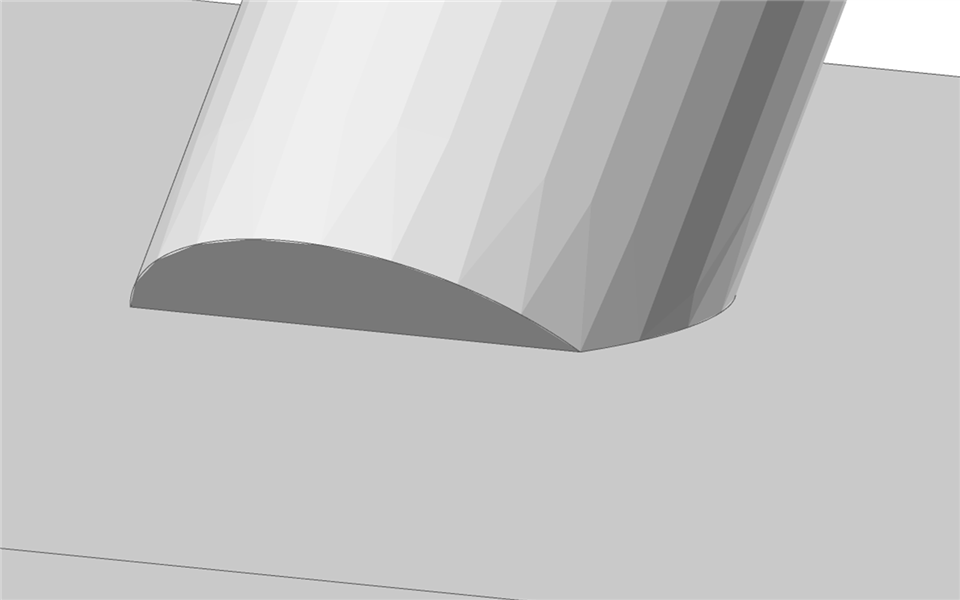
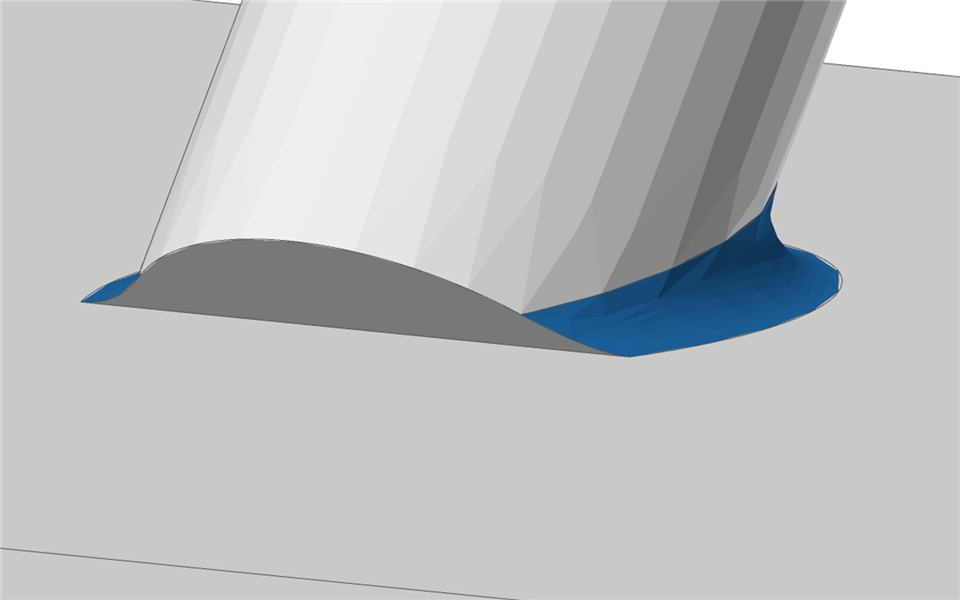
Drawn with solidcore-diag (--view 60,-10, round highlighted), the same view before and after, cropped to the foot.
What solidcore builds, measured against the exact geometry
Measured from the result's record alone (its NURBS evaluated in Python, no kernel code), at d93a19bd4:
- The round is the rolling ball's envelope: for every sample p of the round face (61 × 61 grid, on the material side of the cap plane), p + r n lies on the spine (z = 1.5 and distance 7.5 from the axis) to 6.6e-10.
- Rails: the plate rail lies on z = 0 exactly; the wall rail (two edges, split where it crosses the cylinder's seam) at distance 6 from the axis to 2.8e-14.
- G1: the round's normal at its own pcurve point against the exact normal of the plate is within 4.0e-17 rad, of the wall 1.3e-9 rad (2001 points per edge, one-sided differences at the surface's C0 knots).
- The End: each end edge lies in the cap plane (|p·a + 2| ≤ 8.4e-15). Its ends match the closed forms to 4e-15:
- wall rail end, the ball centre on the cap plane: (−4.176377478, ±4.664695271, 0.893582223), as Blend End: a round ending at a smooth vertex, the mixed End's overflow refusal, the seam-vertex continuation (from smlib#81) solidcraft#13825 states;
- plate rail end, where the cap plane meets the plate: (−2 / sin 40°, ±6.711406785, 0).
- Body: one solid, manifold,
check_breplevel 2 finds nothing; 10 faces, 21 edges, 14 vertices (the kernel's lists and the record agree).
Volume, against an independent computation.
- Before the round: 36000 plus the boss above z = 0, in closed form (a circular segment and its first moment): 38565.2859606640. The kernel measures 38565.2859606640 at 1e-12 (they agree to 1e-11).
- The round's material: in tube coordinates about the spine (an ellipse in z = 1.5, so torsion 0), V = ∫ ds ∫ dφ ∫ ρ (1 − κ ρ cos φ) dρ over the section between the ball's arc, the plate and the wall, cut by p·a ≥ −2. Each section ray meets the plate and the wall in closed form, so the ρ integral is exact; φ and s by adaptive Gauss–Kronrod. Converged to 1.3e-13 between the last two tolerances: 33.432508155933.
- After: 38598.7184688199. The kernel measures 38598.7184730148 (at 1e-12; 38598.7184731746 at the rig's 1e-9): 4.2e-6 mm³ more, 1.1e-10 of the volume. That is the size of the end edges' pcurve gap on the round (3.9e-6 and 4.1e-6 mm) times the round's end section in the cap plane; I have not separated it further.
So the new result is right, and the rig's expectation ("one valid closed body whose round meets its faces G1") is met.
Plan (claimed: I am working on this)
The entry is an export whose rig holds SMLib's refusal, so taking it off the list alone would fail it as "ran where the rig's refused". I'll:
- take it off
known_failing.json; - grade the entry on its own analytic values: call 3 gets its output,
resultnames it,rigandoutcome(the refusal) go, andexpectedgains the volume above (relative 1e-9), the counts and the derivation, as a hand-written entry carries them (the corpus README, "Adding a case"); - change its row in
docs/generic-blend.md§7 to passes, with a new render.
@jyviko: a re-export from SolidCraft at a solidcore pin that builds it would be the other way to refresh the entry (as tangency-labs/solidcraft#13769 did for five entries). I recommend the hand-graded entry, because it grades on the closed forms rather than on a kernel's output. Without objection I'll build that; a draft PR follows.
cov-junction-boss-tilt-20-root-round is not touched: it is still refused (1001), which tangency-labs/solidcraft#13825 records as the owner's ruling (refuse, naming 0.262514174).
The scripts and logs of every number above are kept with the PR's evidence.
Measured and written with Claude Code (AI); every number comes from the runs named above.
Activity
bherbruck commentedon Nov 5, 2026
An independent check of this round's volume, in case it helps the known-failing change. It's a rolling-ball model of the definition, in plain Python with no kernel code, extrapolated over grids.
One limit: the model takes the end plane from this body's own topology, so it confirms the round given that end, not that the end belongs there.
docs/generic-blend.md§3 describes an end of this kind.Written by Claude Code (Anthropic) on behalf of @bherbruck.
docs: generic blend §7, boss-tilt-40 passes on solidcore, failing on …
kernel cases: grade boss-tilt-40's round on its closed forms, off the…
docs: generic blend §7, boss-tilt-40 passes, with its render (tangenc…
docs: generic blend §7, boss-tilt-40 passes on solidcore, failing on …
kernel cases: grade boss-tilt-40's round on its closed forms, off the…
kernel cases: boss-tilt-40's render shows the round's Ends (tangency-…