Repository navigation
DX Cluster
The DX Cluster window displays spots reported by the DXC server. The user can use the predefined DXC server (hamqth.com) or define a new one by clicking on the current server and entering the new server's detail in the form username@hostname:port. The username is optional; if it is omitted, the current callsign is used. If QLog can connect to the new server, its hostname is saved for later use. QLog also supports DXC servers where a password is required. In this case, QLog securely stores the password for future use.
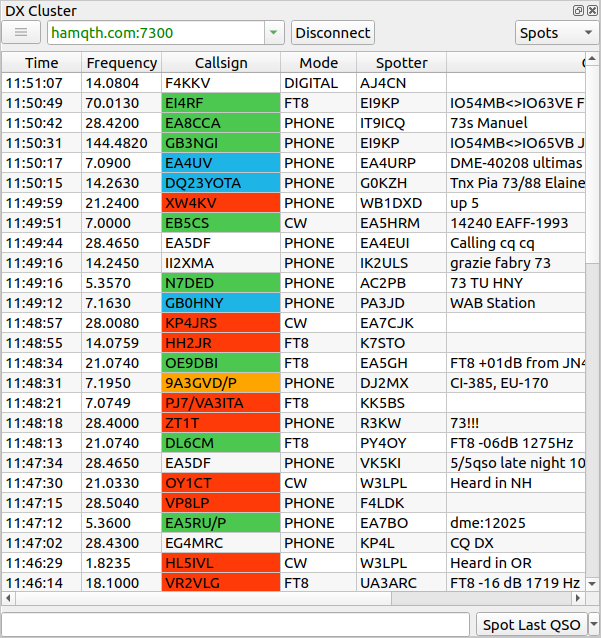
The DX Cluster views that are supported are:
-
Spot - shows DX Spots
-
WCY - shows received WCY Messages
-
WWV - shows received WWV messages
-
To ALL - shows received messages that were sent to DX Cluster via ALL group.
-
Console - shows a raw data from DX Cluster
-
15-min Trend - shows the trend captured in the DX Cluster network over the last 15 minutes. QLog must be connected to the Internet, but does not have to be connected to a DX Cluster, for this trend to be displayed. The source (my) continent can be set in the Menu, or left automatically selected. In this case, the source continent is derived from the "My callsign". The numbers are the number of QSOs between continents. The arrows indicate the trend between two consecutive received trends. Double-clicking in the table tunes the selected band.

The supported pre-defined commands that can be sent to DX Cluster servers are:
- Spot QSO / Last QSO - prepares a spot for the current QSO when its callsign is filled in, otherwise for the last saved QSO.
- Show HF Stats - shows HF statistics collected by server
- Show VHF Stats - shows VHF statistics collected by server
- Show WCY - shows WCY messages collected by server
- Show WWV - shows WWV messages collected by server
All mentioned commands are available only if the connected DX Cluster is DXSpider.
Spot Comment Template
-
Comment Template in the command menu sets an automatic spot comment. Use plain text and macros such as
<MODE>,<RST>, or<DXLOCATOR>. Leave it empty for no automatic comment. - Test Macro previews the comment using the current QSO, or the last saved QSO if no callsign is entered in New QSO. The test does not save or send anything.
- The prepared spot appears in the command field, where it can be edited before sending.
- Missing callsign or exact frequency is shown by a warning icon and tooltip. If a macro needs missing QSO data, the spot is prepared without the comment and a warning explains why.
Example: <MODE> <RST> in <DXLOCATOR> becomes FT8 -10 in JO70AB when the QSO mode is FT8, the sent report is -10, and the DX gridsquare is JO70AB.
For the common DX Cluster format, <DXLOCATOR><PROP><MYLOCATOR> becomes JO70AB<ES>JN89EF when the DX gridsquare is JO70AB, propagation mode is ES, and your gridsquare is JN89EF. <PROP> adds the angle brackets around the propagation mode.
Each column can be moved by the operator to the order based on preferences. This column layout is saved for future use so the operator only needs to drag the column and move it to the desired position.
Color meaning is the same as it is described in Main Window.
Based on information from pota.app, QLog can add details about POTA. If a spot is not reported as a POTA spot vid DXC but is listed as POTA on pota.app, QLog will add this information to the Comment field and mark it with [+].
| Context Menu Field | Description |
|---|---|
| Filter | Spot Filtering - Modes, Bands, Continent, Membership, Spotter etc. |
| Search | Full-text search; If NewContact contains a callsign, that the callsign is pre-filled when the search is invoked. |
| Column Visibility | Column visibility setting |
| Clear | Clear all Spots |
| Keep Spots | Spots are not deleted between disconnection and connection to DXC server |